
同在马萨诸塞州,公共医疗补助参保的哮喘儿童较少看上专科
JAMA Network Open2024横断面研究Crossref 记录被引 15 次
病情更需要专科的孩子,实际得到多少专科照护?
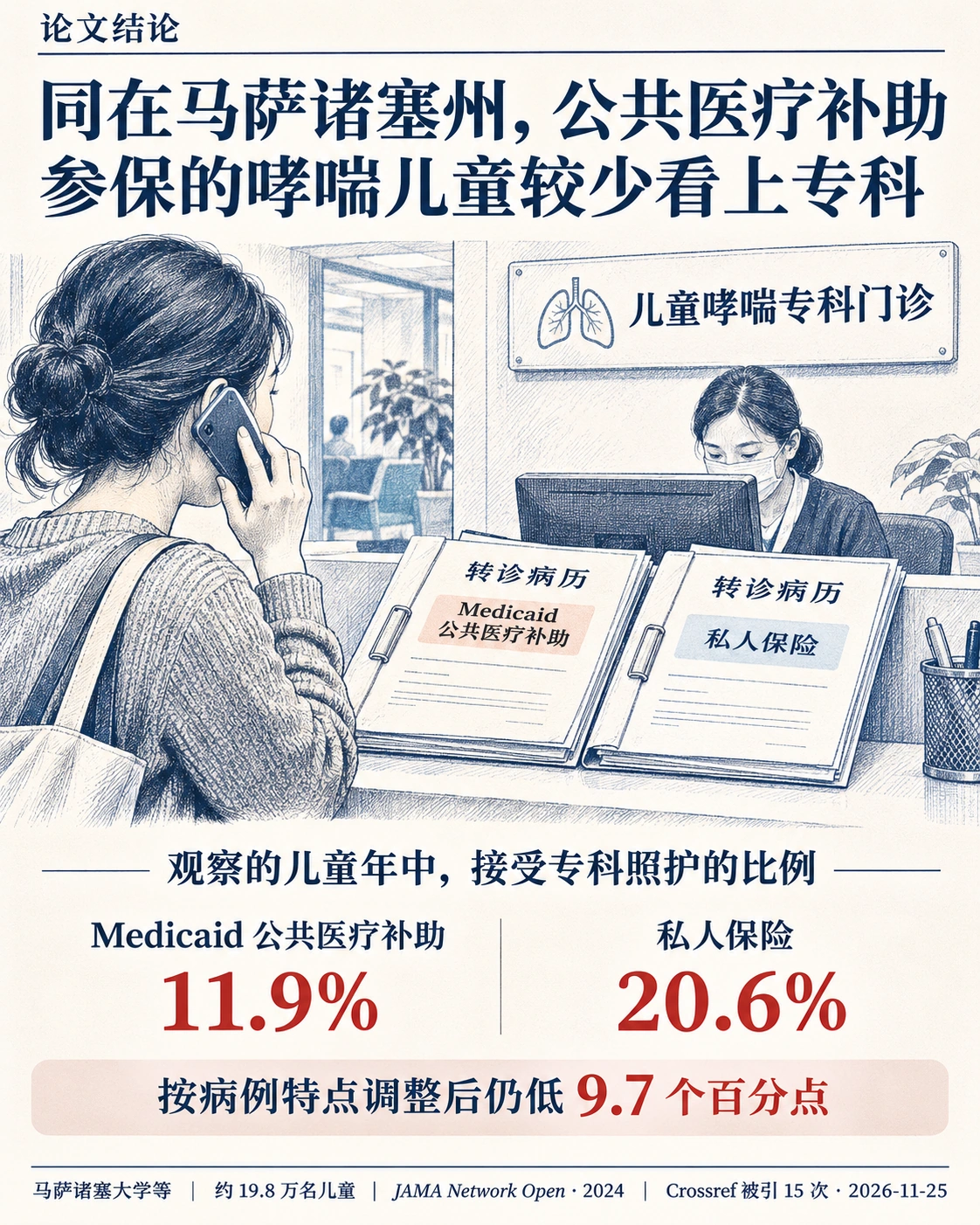
在马萨诸塞州的理赔记录中,按每个孩子参保一年计算,公共医疗补助参保者看过哮喘相关专科的比例为 11.9%,私人保险参保者为 20.6%。病情持续的孩子差距更大。
推荐阅读的理由
多数哮喘在基层可以管理,但反复或控制不佳时,肺科及过敏专科等可以参与评估。研究者逐年核对实际门诊理赔。公共医疗补助组持续性哮喘的比例较高,接受专科照护的比例却较低。
Health Insurance Type and Outpatient Specialist Care Among Children With Asthma
作者摘要 · 中文编译
背景与目的 有些患儿只需基层医生便能很好控制哮喘,但控制不佳者往往需要专科。不同保险下儿童专科利用的差别尚不清楚。研究比较公共医疗补助和私人保险患儿接受哮喘专科照护的情况。
方法 这项横断面研究使用马萨诸塞州 2014 至 2020 年的全付款方理赔数据,纳入 2015 至 2020 年 2 至 17 岁的哮喘儿童。公共保险包括 Medicaid 和儿童健康保险计划。主要结局为在门诊看过肺科、过敏与免疫科或耳鼻喉科医生。多变量逻辑回归考虑人口特点、健康状况、持续性哮喘、日历年及居住地邮区特征,另考察按哮喘持续性、严重程度和年份的变化。2023 年 1 月至 2024 年 4 月分析。
结果 198,101 名不同的儿童共贡献 432,455 个儿童年,其中女孩 186,296(43.1%)、男孩 246,159(56.9%),5 至 11 岁 211,269(48.9%),持续性哮喘 82,108(19.0%)。公共保险占 286,408(66.2%),私人保险占 146,047(33.8%)。持续性哮喘在两组分别占 20.0%(57,381)和 16.9%(24,727)。总体 64,239 个儿童年(14.9%)有专科照护,公共保险为 34,093(11.9%),私人保险为 30,146(20.6%)。校正后专科就诊优势比为 0.45(95% 置信区间 0.43 至 0.47),调整后的比例差为 −9.7 个百分点(−10.4 至 −9.1)。对持续性哮喘者,公共保险组另有 3.2 个百分点的额外缺口(2.0 至 4.4)。
结论 公共医疗补助参保儿童较少得到专科照护,持续性哮喘者的差距最大。缩小这一差距可能有助于改善哮喘结局的不平等。
展开英文原摘要收起英文原摘要Although children with asthma are often successfully treated by primary care clinicians, outpatient specialist care is recommended for those with poorly controlled disease. Little is known about differences in specialist use for asthma among children with Medicaid vs private insurance. To examine differences among children with asthma regarding receipt of asthma specialist care by insurance type. In this cross-sectional study using data from the Massachusetts All Payer Claims Database (APCD) between 2014 to 2020, children with asthma were identified and differences in receipt of outpatient specialist care by whether their insurance was public (Medicaid and the Children’s Health Insurance Program) or private were examined. Eligible participants included children with asthma in 2015 to 2020 aged 2 to 17 years. Data analysis was conducted from January 2023 to April 2024. Medicaid vs private insurance. The primary outcome was receipt of specialist care (any outpatient visit with a pulmonology, allergy and immunology, or otolaryngology physician). Multivariable logistic regression models estimated differences in receipt of specialist care by insurance type accounting for child and area characteristics including demographics, health status, persistent asthma, calendar year, and zip code characteristics. Additional analyses examined if the associations of specialist care with insurance type varied by asthma persistence and severity, and whether associations varied over time. Among 198 101 unique children, there were 432 455 child-year observations (186 296 female [43.1%] and 246 159 male [56.9%]; 211 269 aged 5 to 11 years [48.9%]; 82 108 [19.0%] with persistent asthma) including 286 408 (66.2%) that were Medicaid insured and 146 047 (33.8%) that were privately insured. Although persistent asthma was more common among child-year observations with Medicaid vs private insurance (57 381 [20.0%] vs 24 727 [16.9%]), children with Medicaid were less likely to receive specialist care. Overall, 64 239 child-year observations (14.9%) received specialist care, with substantially lower rates for children with Medicaid vs private insurance (34 093 child-year observations [11.9%] vs 30 146 child-year observations [20.6%]). Regression-based estimates confirmed these disparities; children with Medicaid had 55% lower odds of receiving specialist care (adjusted odds ratio, 0.45; 95% CI, 0.43 to 0.47) and a regression-adjusted 9.7 percentage point (95% CI, −10.4 percentage points to −9.1 percentage points) lower rate of receipt of specialist care. Compared with children with private insurance, there was an additional 3.2 percentage point (95% CI, 2.0 percentage points to 4.4 percentage points) deficit for children with Medicaid with persistent asthma. In this cross-sectional study, children with Medicaid were less likely to receive specialist care, with the largest gaps among those with persistent asthma. These findings suggest that closing this care gap may be one approach to addressing ongoing disparities in asthma outcomes.
Importance · Although children with asthma are often successfully treated by primary care clinicians, outpatient specialist care is recommended for those with poorly controlled disease. Little is known about differences in specialist use for asthma among children with Medicaid vs private insurance.
Objective · To examine differences among children with asthma regarding receipt of asthma specialist care by insurance type.
Design, Setting, and Participants · In this cross-sectional study using data from the Massachusetts All Payer Claims Database (APCD) between 2014 to 2020, children with asthma were identified and differences in receipt of outpatient specialist care by whether their insurance was public (Medicaid and the Children’s Health Insurance Program) or private were examined. Eligible participants included children with asthma in 2015 to 2020 aged 2 to 17 years. Data analysis was conducted from January 2023 to April 2024.
Exposure · Medicaid vs private insurance.
Main Outcomes and Measures · The primary outcome was receipt of specialist care (any outpatient visit with a pulmonology, allergy and immunology, or otolaryngology physician). Multivariable logistic regression models estimated differences in receipt of specialist care by insurance type accounting for child and area characteristics including demographics, health status, persistent asthma, calendar year, and zip code characteristics. Additional analyses examined if the associations of specialist care with insurance type varied by asthma persistence and severity, and whether associations varied over time.
Results · Among 198 101 unique children, there were 432 455 child-year observations (186 296 female [43.1%] and 246 159 male [56.9%]; 211 269 aged 5 to 11 years [48.9%]; 82 108 [19.0%] with persistent asthma) including 286 408 (66.2%) that were Medicaid insured and 146 047 (33.8%) that were privately insured. Although persistent asthma was more common among child-year observations with Medicaid vs private insurance (57 381 [20.0%] vs 24 727 [16.9%]), children with Medicaid were less likely to receive specialist care. Overall, 64 239 child-year observations (14.9%) received specialist care, with substantially lower rates for children with Medicaid vs private insurance (34 093 child-year observations [11.9%] vs 30 146 child-year observations [20.6%]). Regression-based estimates confirmed these disparities; children with Medicaid had 55% lower odds of receiving specialist care (adjusted odds ratio, 0.45; 95% CI, 0.43 to 0.47) and a regression-adjusted 9.7 percentage point (95% CI, −10.4 percentage points to −9.1 percentage points) lower rate of receipt of specialist care. Compared with children with private insurance, there was an additional 3.2 percentage point (95% CI, 2.0 percentage points to 4.4 percentage points) deficit for children with Medicaid with persistent asthma.
Conclusions and Relevance · In this cross-sectional study, children with Medicaid were less likely to receive specialist care, with the largest gaps among those with persistent asthma. These findings suggest that closing this care gap may be one approach to addressing ongoing disparities in asthma outcomes.
Kimberley H Geissler, Meng-Shiou Shieh, Jerry A Krishnan, Peter K Lindenauer, Arlene S Ash, Sarah L Goff
Copyright 2024 Geissler KH et al. JAMA Network Open.
公共医疗补助和私人保险的差距
| 按观察儿童年计 | 公共医疗补助 | 私人保险 |
|---|---|---|
| 观察儿童年 | 286,408 | 146,047 |
| 其中有持续性哮喘 | 20.0% | 16.9% |
| 一年内看过相关专科 | 34,093(11.9%) | 30,146(20.6%) |
校正病例和地区特点后,前者的专科就诊率低 9.7 个百分点(95% 置信区间低 9.1 至 10.4)。 核对作者图表
作者的结论
作者认为,公共医疗补助参保儿童获得专科照护的可能性较低,持续性哮喘儿童的差距最大。缩小专科利用差距,可能是改善哮喘结局不平等的途径之一。
研究团队与论文影响
马萨诸塞大学陈医学院等团队用该州覆盖多种付款方的理赔数据库,分析近 20 万名儿童。每个孩子可有多年的参保与就诊记录,故图中百分比按儿童年计算。
Crossref 收录本文引用 15 次。JAMA Network Open 在 2025 年度回顾中列出的期刊影响因子为 9.7。
单篇与期刊指标核查于 。
原文与延伸阅读
引用这篇文章与反馈纠错
研象编辑部.同在马萨诸塞州,公共医疗补助参保的哮喘儿童较少看上专科[EB/OL].研象,2026-11-25.https://yanxiang.hk/papers/asthma-specialists-insurance-children
发现数字、译文或出处有误,可以在邮件里指出相应段落,附上核对依据。