
美国扩大儿童税收抵免后,低收入家长的焦虑症状减少,抑郁未见明确变化
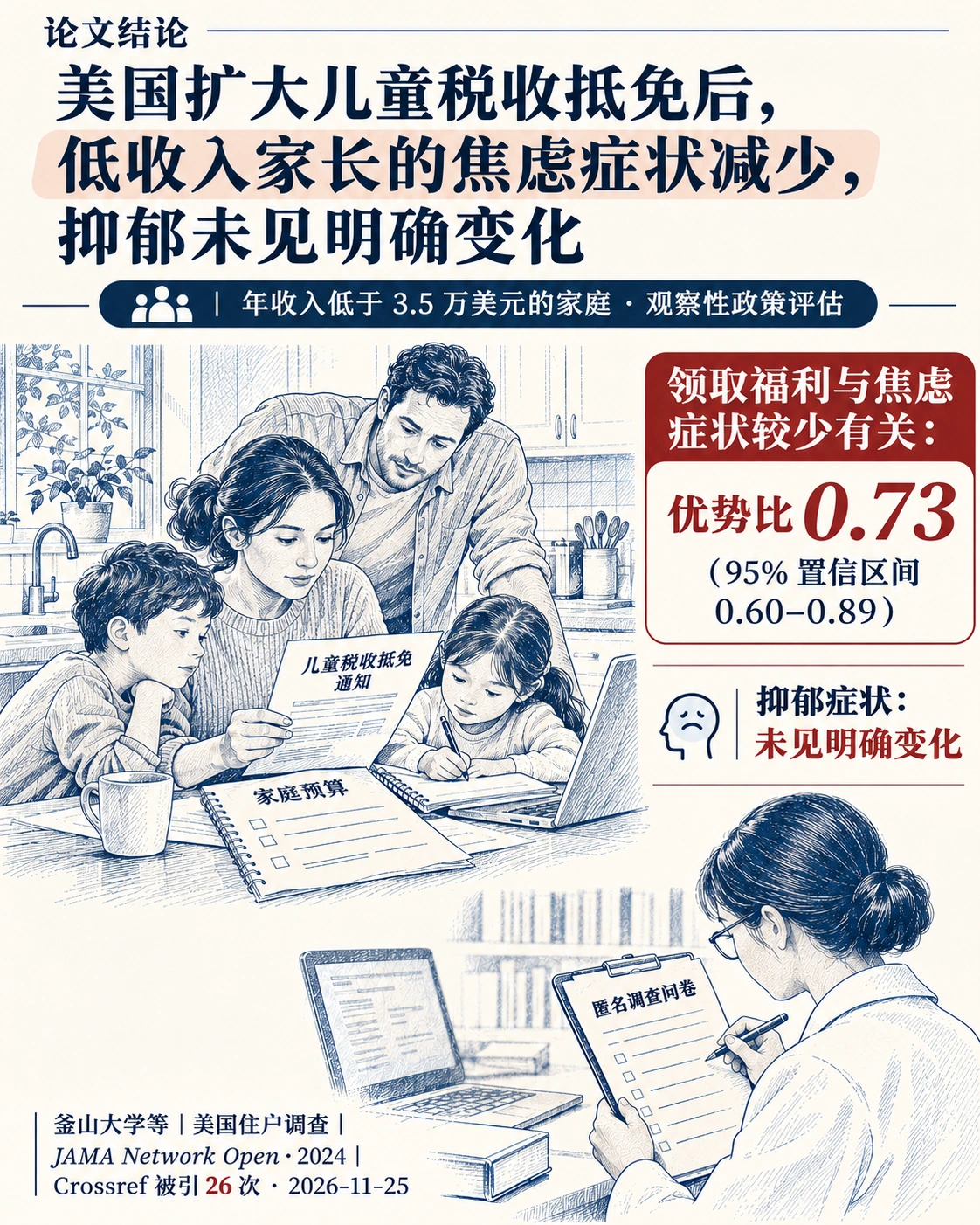
JAMA Network Open2024准实验研究Crossref 记录被引 26 次
怎样从一项家庭预算政策,问到家长的心理健康?
美国 2021 年把扩大的儿童税收抵免按月发放。面向低收入家庭的分析发现,领取福利与家长较少报告焦虑症状有关,抑郁症状没有显示明确变化。
推荐阅读的理由
额外收入的实际价值可能和它何时到账有关。这次政策把一部分福利改为按月发放,调查又在政策前后反复询问人们有没有焦虑或抑郁症状。作者利用领取资格、家庭收入及实施时段之间的差异,估计与发放政策相关的变化。
Expansion of Child Tax Credits and Mental Health of Parents With Low Income in 2021
作者摘要 · 中文编译
背景与目的 疫情期间,美国救援计划法通过 2021 年扩大的儿童税收抵免,为有孩子的家庭提供较多的月度现金福利。疫情带来的心理健康压力上升,这项措施可能缓解家长特别是低收入家庭的困难。研究以焦虑和抑郁症状考察政策与低收入家长心理健康的关联。
方法 研究使用美国 2021 年 4 月 14 日至 2022 年 1 月 10 日的住户脉搏调查,进行重复横断面分析。扩大的抵免于 2021 年 7 月 15 日至 12 月 15 日按月发放。研究把倾向评分匹配与三重差分结合,估计年收入低于 35,000 美元家庭的政策关联,用逻辑回归分析家长报告的焦虑和抑郁症状。
结果 加权样本包括 546,366 名成年人,平均年龄 43.02 岁(标准差 14.54),女性占 52.9%。最常见教育程度为高中及以下(36.0%),最常见家庭收入档为每年 50,000 至 74,999 美元(16.1%),67.3% 有工作。加权后每户平均有 0.92 个孩子(标准差 1.18)。在总体分析中,领取扩大的抵免与较低的焦虑症状优势有关,优势比 0.730(95% 置信区间 0.598 至 0.890)。这一关联在女性、工作年龄者(17 至 60 岁)、非西班牙裔白人和受教育程度较高者中更明显。政策扩围与抑郁症状未见关联。
结论 这些发现可以为政策制定者讨论是否将扩围永久化,或是否将其转为普惠项目,提供参考。
展开英文原摘要收起英文原摘要The 2021 Child Tax Credit (CTC) expansion, as part of the American Rescue Plan Act, offered financial relief through generous monthly tax benefits to families with children amid the COVID-19 pandemic. In light of heightened concerns about mental health during the pandemic, the expanded CTC may have alleviated parental mental health challenges, especially within families with low income. To investigate the association between the 2021 CTC expansion and mental health among parents with low income as measured by depression and anxiety symptoms. This repeated cross-sectional study used data from the Household Pulse Survey covering April 14, 2021, to January 10, 2022, in the US. A difference-in-difference-in-differences estimator combined with propensity score matching was used to estimate the association of the expanded CTC with mental health symptoms among households with income less than $35 000. The monthly payment of expanded CTC from July 15 to December 15, 2021. Parental mental health was measured by analyzing depression and anxiety symptoms using logistic regression. The weighted sample comprised 546 366 adults (mean [SD] age, 43.02 [14.54] years; 52.9% female). The most common education level was high school or less (36.0%), the highest frequency of household income distribution was $50 000 to $74 999 (16.1%), and the majority of the sample was employed (67.3%). The weighted mean (SD) number of children in the household was 0.92 (1.18). For the full sample, receiving expanded CTC benefits was associated with lower odds of experiencing anxiety symptoms (odds ratio, 0.730; 95% CI, 0.598-0.890). Subgroup analyses indicated that the positive associations of the policy with anxiety symptoms were particularly pronounced among the female, working-age (17-60 years), non-Hispanic White, and higher education groups. However, the policy expansion had no association with depression. These findings may provide valuable evidence for policy makers to consider when deliberating on the possibility of making the CTC expansion permanent or transforming it into a universal program.
Importance · The 2021 Child Tax Credit (CTC) expansion, as part of the American Rescue Plan Act, offered financial relief through generous monthly tax benefits to families with children amid the COVID-19 pandemic. In light of heightened concerns about mental health during the pandemic, the expanded CTC may have alleviated parental mental health challenges, especially within families with low income.
Objective · To investigate the association between the 2021 CTC expansion and mental health among parents with low income as measured by depression and anxiety symptoms.
Design, Setting, and Participants · This repeated cross-sectional study used data from the Household Pulse Survey covering April 14, 2021, to January 10, 2022, in the US. A difference-in-difference-in-differences estimator combined with propensity score matching was used to estimate the association of the expanded CTC with mental health symptoms among households with income less than $35 000.
Exposure · The monthly payment of expanded CTC from July 15 to December 15, 2021.
Main Outcomes and Measures · Parental mental health was measured by analyzing depression and anxiety symptoms using logistic regression.
Results · The weighted sample comprised 546 366 adults (mean [SD] age, 43.02 [14.54] years; 52.9% female). The most common education level was high school or less (36.0%), the highest frequency of household income distribution was $50 000 to $74 999 (16.1%), and the majority of the sample was employed (67.3%). The weighted mean (SD) number of children in the household was 0.92 (1.18). For the full sample, receiving expanded CTC benefits was associated with lower odds of experiencing anxiety symptoms (odds ratio, 0.730; 95% CI, 0.598-0.890). Subgroup analyses indicated that the positive associations of the policy with anxiety symptoms were particularly pronounced among the female, working-age (17-60 years), non-Hispanic White, and higher education groups. However, the policy expansion had no association with depression.
Conclusions and Relevance · These findings may provide valuable evidence for policy makers to consider when deliberating on the possibility of making the CTC expansion permanent or transforming it into a universal program.
Jaehyun Nam, Sarah Jiyoon Kwon
Copyright 2024 Nam J et al. JAMA Network Open.
焦虑与抑郁,两项结果分别怎样?
| 家长自报结局 | 与扩大的税收抵免的关系 |
|---|---|
| 焦虑症状 | 优势比 0.730(95% 置信区间 0.598 至 0.890) |
| 抑郁症状 | 未见明确关联 |
以家庭收入、是否有子女和政策前后的差异进行估计,不同问卷期抽到的可以是不同人。 核对作者图表
作者的结论
作者认为,这些发现为讨论是否延长儿童税收抵免扩围、或将其改成更普遍的项目提供了证据。研究显示的是调查中报告的症状,未涉及医生作出的焦虑症或抑郁症诊断。
研究团队与论文影响
韩国釜山大学等研究者使用美国住户脉搏调查。总体调查覆盖约 54.6 万名成年人,用匹配与三重差分估计年收入低于 3.5 万美元家庭的政策关联。
Crossref 收录本文引用 26 次。JAMA Network Open 在 2025 年度回顾中列出的期刊影响因子为 9.7。
单篇与期刊指标核查于 。
原文与延伸阅读
引用这篇文章与反馈纠错
研象编辑部.美国扩大儿童税收抵免后,低收入家长的焦虑症状减少,抑郁未见明确变化[EB/OL].研象,2026-11-25.https://yanxiang.hk/papers/child-tax-credit-parent-anxiety
发现数字、译文或出处有误,可以在邮件里指出相应段落,附上核对依据。