
未来气候下,较少寒冷与较多高温带来的死亡负担因地区而异
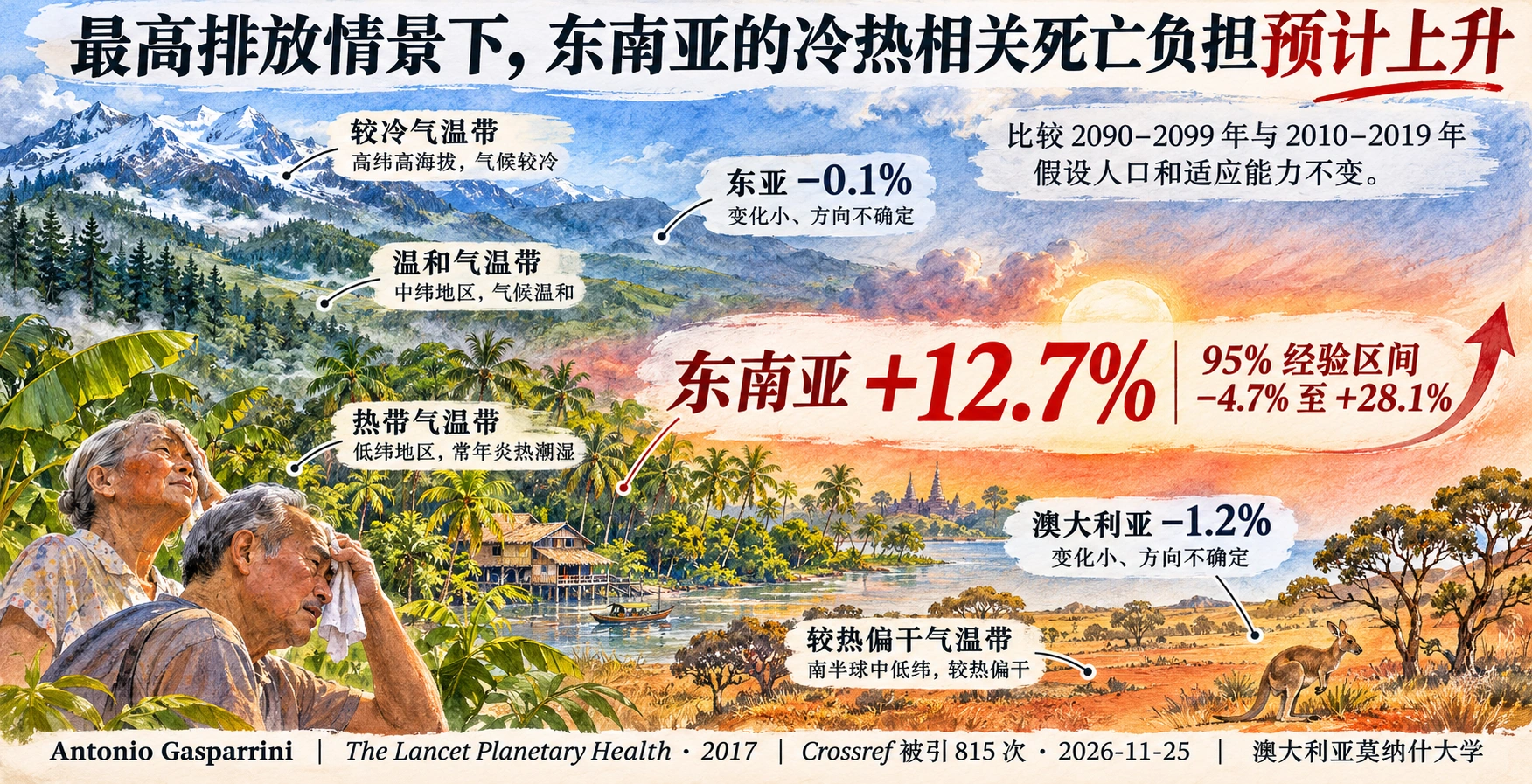
The Lancet Planetary Health2017人群负担估计Crossref 记录被引 815 次
变暖带来的热死亡增多,能被冷死亡减少抵消多少?
高排放可能给较暖和较贫困地区带来更大健康负担。在采取减排措施的情景下,预计可避免相当一部分与升温直接相关的健康影响。
推荐阅读的理由
只看酷热会漏掉另一半问题。作者在同一个模型里同时计算高温和低温的影响,并展示不同地区结果可能方向相反。
Projections of temperature-related excess mortality under climate change scenarios
作者摘要 · 中文编译
背景 气候、人口及当地对气温的敏感程度各异,预测变暖对死亡的净影响需要同时考虑冷热两端。
方法 作者分析 23 国 451 地约 8,588 万例死亡和每日气温,用五种气候模型、四个排放情景估计 1990 至 2099 年冷热相关超额死亡。估算假设当地人群规模及适应能力不变。
结果 高排放下,整体温度相关超额死亡预计增加,地区差别很大。最高排放情景中,2090 至 2099 年相对 2010 至 2019 年,澳大利亚估计净变化为 −1.2%,东亚为 −0.1%;中美洲为 +3.0%,东南亚为 +12.7%。这些地区估计的不确定区间都较宽,东南亚为 −4.7% 至 +28.1%。
结论 高排放可能给较暖和较贫困地区带来更大健康负担。在采取减排措施的情景下,预计可避免相当一部分与升温直接相关的健康影响。
展开英文原摘要收起英文原摘要Climate change can directly affect human health by varying exposure to non-optimal outdoor temperature. However, evidence on this direct impact at a global scale is limited, mainly due to issues in modelling and projecting complex and highly heterogeneous epidemiological relationships across different populations and climates. We collected observed daily time series of mean temperature and mortality counts for all causes or non-external causes only, in periods ranging from Jan 1, 1984, to Dec 31, 2015, from various locations across the globe through the Multi-Country Multi-City Collaborative Research Network. We estimated temperature-mortality relationships through a two-stage time series design. We generated current and future daily mean temperature series under four scenarios of climate change, determined by varying trajectories of greenhouse gas emissions, using five general circulation models. We projected excess mortality for cold and heat and their net change in 1990-2099 under each scenario of climate change, assuming no adaptation or population changes. Our dataset comprised 451 locations in 23 countries across nine regions of the world, including 85 879 895 deaths. Results indicate, on average, a net increase in temperature-related excess mortality under high-emission scenarios, although with important geographical differences. In temperate areas such as northern Europe, east Asia, and Australia, the less intense warming and large decrease in cold-related excess would induce a null or marginally negative net effect, with the net change in 2090-99 compared with 2010-19 ranging from -1·2% (empirical 95% CI -3·6 to 1·4) in Australia to -0·1% (-2·1 to 1·6) in east Asia under the highest emission scenario, although the decreasing trends would reverse during the course of the century. Conversely, warmer regions, such as the central and southern parts of America or Europe, and especially southeast Asia, would experience a sharp surge in heat-related impacts and extremely large net increases, with the net change at the end of the century ranging from 3·0% (-3·0 to 9·3) in Central America to 12·7% (-4·7 to 28·1) in southeast Asia under the highest emission scenario. Most of the health effects directly due to temperature increase could be avoided under scenarios involving mitigation strategies to limit emissions and further warming of the planet. This study shows the negative health impacts of climate change that, under high-emission scenarios, would disproportionately affect warmer and poorer regions of the world. Comparison with lower emission scenarios emphasises the importance of mitigation policies for limiting global warming and reducing the associated health risks. UK Medical Research Council.
BACKGROUND · Climate change can directly affect human health by varying exposure to non-optimal outdoor temperature. However, evidence on this direct impact at a global scale is limited, mainly due to issues in modelling and projecting complex and highly heterogeneous epidemiological relationships across different populations and climates.
METHODS · We collected observed daily time series of mean temperature and mortality counts for all causes or non-external causes only, in periods ranging from Jan 1, 1984, to Dec 31, 2015, from various locations across the globe through the Multi-Country Multi-City Collaborative Research Network. We estimated temperature-mortality relationships through a two-stage time series design. We generated current and future daily mean temperature series under four scenarios of climate change, determined by varying trajectories of greenhouse gas emissions, using five general circulation models. We projected excess mortality for cold and heat and their net change in 1990-2099 under each scenario of climate change, assuming no adaptation or population changes.
FINDINGS · Our dataset comprised 451 locations in 23 countries across nine regions of the world, including 85 879 895 deaths. Results indicate, on average, a net increase in temperature-related excess mortality under high-emission scenarios, although with important geographical differences. In temperate areas such as northern Europe, east Asia, and Australia, the less intense warming and large decrease in cold-related excess would induce a null or marginally negative net effect, with the net change in 2090-99 compared with 2010-19 ranging from -1·2% (empirical 95% CI -3·6 to 1·4) in Australia to -0·1% (-2·1 to 1·6) in east Asia under the highest emission scenario, although the decreasing trends would reverse during the course of the century. Conversely, warmer regions, such as the central and southern parts of America or Europe, and especially southeast Asia, would experience a sharp surge in heat-related impacts and extremely large net increases, with the net change at the end of the century ranging from 3·0% (-3·0 to 9·3) in Central America to 12·7% (-4·7 to 28·1) in southeast Asia under the highest emission scenario. Most of the health effects directly due to temperature increase could be avoided under scenarios involving mitigation strategies to limit emissions and further warming of the planet.
INTERPRETATION · This study shows the negative health impacts of climate change that, under high-emission scenarios, would disproportionately affect warmer and poorer regions of the world. Comparison with lower emission scenarios emphasises the importance of mitigation policies for limiting global warming and reducing the associated health risks.
FUNDING · UK Medical Research Council.
Antonio Gasparrini, Yuming Guo, Francesco Sera, Ana Maria Vicedo-Cabrera, Veronika Huber, Shilu Tong, Micheline de Sousa Zanotti Stagliorio Coelho, Paulo Hilario Nascimento Saldiva, Eric Lavigne, Patricia Matus Correa, Nicolas Valdes Ortega, Haidong Kan, Samuel Osorio, Jan Kyselý, Aleš Urban, Jouni J K Jaakkola, Niilo R I Ryti, Mathilde Pascal, Patrick G Goodman, Ariana Zeka, Paola Michelozzi, Matteo Scortichini, Masahiro Hashizume, Yasushi Honda, Magali Hurtado-Diaz, Julio Cesar Cruz, Xerxes Seposo, Ho Kim, Aurelio Tobias, Carmen Iñiguez, Bertil Forsberg, Daniel Oudin Åström, Martina S Ragettli, Yue Leon Guo, Chang-Fu Wu, Antonella Zanobetti, Joel Schwartz, Michelle L Bell, Tran Ngoc Dang, Dung Do Van, Clare Heaviside, Sotiris Vardoulakis, Shakoor Hajat, Andy Haines, Ben Armstrong
地区
| 地区 | 估计净变化 | 95% 经验区间 |
|---|---|---|
| 澳大利亚 | −1.2% | −3.6% 至 +1.4% |
| 中美洲 | +3.0% | −3.0% 至 +9.3% |
| 东南亚 | +12.7% | −4.7% 至 +28.1% |
作者的结论
高排放可能给较暖和较贫困地区带来更大健康负担。在采取减排措施的情景下,预计可避免相当一部分与升温直接相关的健康影响。
研究团队与论文影响
Antonio Gasparrini 等在《The Lancet Planetary Health》发表这项研究。论文署名单位包括澳大利亚莫纳什大学、上海交通大学。
Crossref 收录本文引用 815 次。
单篇与期刊指标核查于 。
原文与延伸阅读
引用这篇文章与反馈纠错
研象编辑部.未来气候下,较少寒冷与较多高温带来的死亡负担因地区而异[EB/OL].研象,2026-11-26.https://yanxiang.hk/papers/climate-scenarios-temperature-mortality
发现数字、译文或出处有误,可以在邮件里指出相应段落,附上核对依据。