
两个急诊科启用脓毒症预警后,治疗组合措施执行得更完整,院内死亡也更少
npj Digital Medicine2024准实验研究Crossref 记录被引 180 次
预警送到人手里后,照护有没有真的改变?
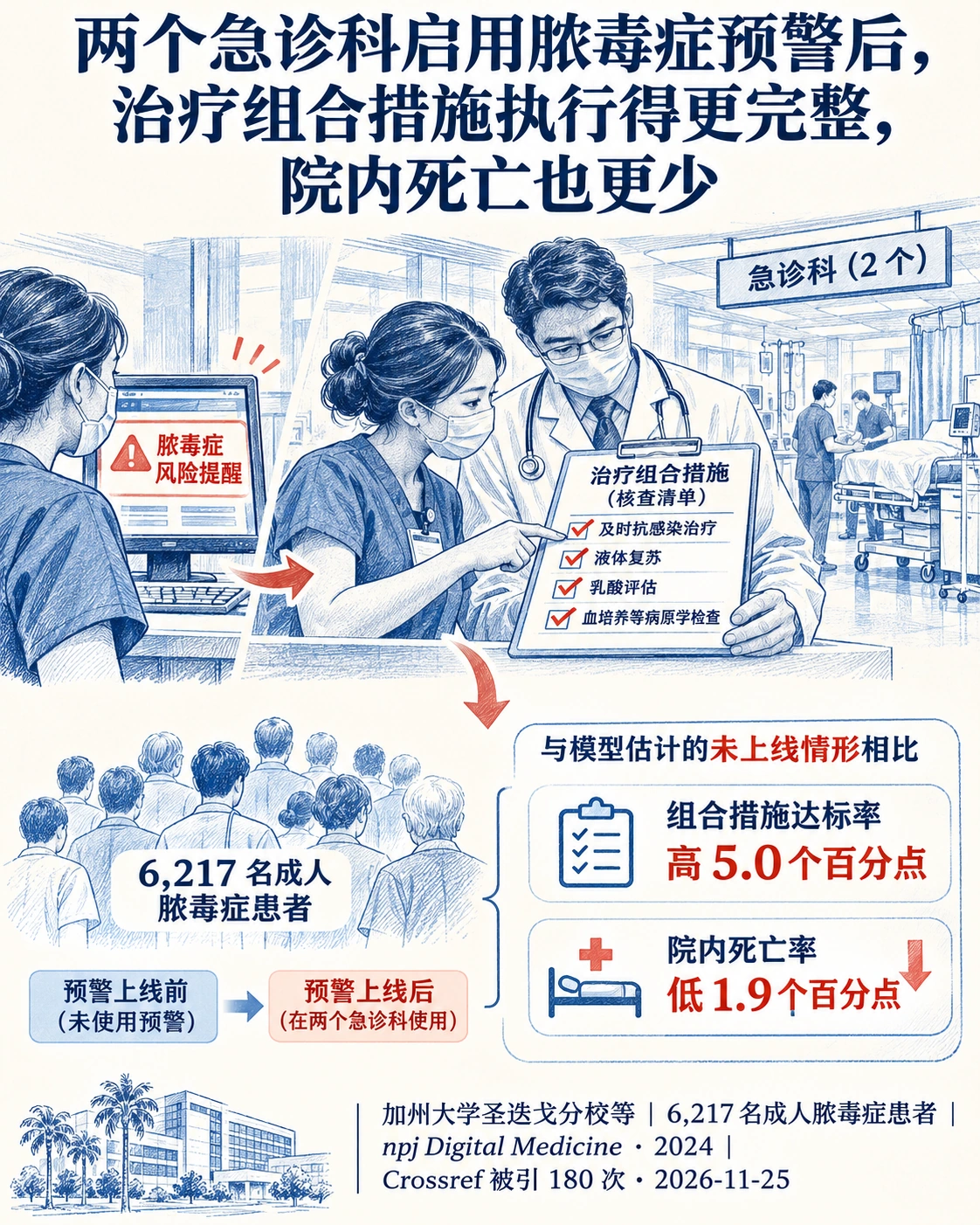
加州大学圣迭戈分校医疗系统的两个急诊科把脓毒症预警直接送给护士。上线后,院内死亡率为 9.5%,低于模型估算的未上线情形 11.4%;组合措施达标率则比估算值高 5 个百分点。
推荐阅读的理由
一套预警系统可以在回顾性测试里猜对病情,却未必能改变繁忙急诊的行动。这次研究跟到护士收到提醒之后,既看规范要求的一整组措施是否做齐,也看患者能否活着出院。它把预测工具与工作现场接在了一起。
Impact of a deep learning sepsis prediction model on quality of care and survival
作者摘要 · 中文编译
作者摘要 脓毒症是全球患病与死亡的重要原因。早期识别算法可能改善结局,但较少有研究观察它们在真实医疗环境中的影响。作者在加州大学圣迭戈分校医疗系统两个急诊科开展准实验性前后研究,评估深度学习脓毒症预测模型 COMPOSER。纳入 2021 年 1 月至 2023 年 4 月的 6,217 名成人脓毒症患者;干预是模型触发并推送给护士的临床提醒。
方法与结果 在上线前 705 天和上线后 145 天,研究考察院内死亡、脓毒症组合措施的达标情况、发病后 72 小时器官功能评分的变化、无重症监护天数和重症监护次数。作者用贝叶斯结构时间序列校正混杂因素。与未上线情形的预测相比,上线与院内死亡率绝对降低 1.9 个百分点相关(相对减少 17%,绝对降幅的 95% 区间 0.3 至 3.5 个百分点);组合措施达标率绝对提高 5.0 个百分点(相对提高 10%,区间 2.4 至 8.0 个百分点);72 小时器官功能评分的变化减少 4%(1.1% 至 7.1%)。
结论 作者认为,部署 COMPOSER 预警与院内死亡减少及组合措施达标率提高相关。
展开英文原摘要收起英文原摘要Sepsis remains a major cause of mortality and morbidity worldwide. Algorithms that assist with the early recognition of sepsis may improve outcomes, but relatively few studies have examined their impact on real-world patient outcomes. Our objective was to assess the impact of a deep-learning model (COMPOSER) for the early prediction of sepsis on patient outcomes. We completed a before-and-after quasi-experimental study at two distinct Emergency Departments (EDs) within the UC San Diego Health System. We included 6217 adult septic patients from 1/1/2021 through 4/30/2023. The exposure tested was a nurse-facing Best Practice Advisory (BPA) triggered by COMPOSER. In-hospital mortality, sepsis bundle compliance, 72-h change in sequential organ failure assessment (SOFA) score following sepsis onset, ICU-free days, and the number of ICU encounters were evaluated in the pre-intervention period (705 days) and the post-intervention period (145 days). The causal impact analysis was performed using a Bayesian structural time-series approach with confounder adjustments to assess the significance of the exposure at the 95% confidence level. The deployment of COMPOSER was significantly associated with a 1.9% absolute reduction (17% relative decrease) in in-hospital sepsis mortality (95% CI, 0.3%–3.5%), a 5.0% absolute increase (10% relative increase) in sepsis bundle compliance (95% CI, 2.4%–8.0%), and a 4% (95% CI, 1.1%–7.1%) reduction in 72-h SOFA change after sepsis onset in causal inference analysis. This study suggests that the deployment of COMPOSER for early prediction of sepsis was associated with a significant reduction in mortality and a significant increase in sepsis bundle compliance.
Sepsis remains a major cause of mortality and morbidity worldwide. Algorithms that assist with the early recognition of sepsis may improve outcomes, but relatively few studies have examined their impact on real-world patient outcomes. Our objective was to assess the impact of a deep-learning model (COMPOSER) for the early prediction of sepsis on patient outcomes. We completed a before-and-after quasi-experimental study at two distinct Emergency Departments (EDs) within the UC San Diego Health System. We included 6217 adult septic patients from 1/1/2021 through 4/30/2023. The exposure tested was a nurse-facing Best Practice Advisory (BPA) triggered by COMPOSER. In-hospital mortality, sepsis bundle compliance, 72-h change in sequential organ failure assessment (SOFA) score following sepsis onset, ICU-free days, and the number of ICU encounters were evaluated in the pre-intervention period (705 days) and the post-intervention period (145 days). The causal impact analysis was performed using a Bayesian structural time-series approach with confounder adjustments to assess the significance of the exposure at the 95% confidence level. The deployment of COMPOSER was significantly associated with a 1.9% absolute reduction (17% relative decrease) in in-hospital sepsis mortality (95% CI, 0.3%–3.5%), a 5.0% absolute increase (10% relative increase) in sepsis bundle compliance (95% CI, 2.4%–8.0%), and a 4% (95% CI, 1.1%–7.1%) reduction in 72-h SOFA change after sepsis onset in causal inference analysis. This study suggests that the deployment of COMPOSER for early prediction of sepsis was associated with a significant reduction in mortality and a significant increase in sepsis bundle compliance.
Aaron Boussina, Supreeth P Shashikumar, Atul Malhotra, Robert L Owens, Robert El-Kareh, Christopher A Longhurst, Kimberly Quintero, Allison Donahue, Theodore C Chan, Shamim Nemati, Gabriel Wardi
© The Author(s) 2024, corrected publication 2024
上线后观测到什么?若未上线,模型又预计怎样?
| 指标 | 上线前实测 | 未上线的预测值 | 上线后实测 |
|---|---|---|---|
| 院内死亡率 | 10.3% | 11.4% | 9.5% |
| 组合措施达标率 | 48.3% | 48.4% | 53.4% |
| 发病后 72 小时器官功能评分的平均变化 | 3.71 | 3.71 | 3.56 |
预测值来自校正混杂因素的贝叶斯结构时间序列模型。 核对作者图表
作者的结论
作者认为,实际部署脓毒症早期预警,与院内死亡减少及脓毒症组合措施达标率提高有关。这里的对照来自上线前资料推算,研究没有把患者随机分配到有、无预警组。
研究团队与论文影响
美国加州大学圣迭戈分校等在同一医疗系统的两个急诊科开展前后对照研究,纳入 6,217 名成人脓毒症患者,比较上线前 705 天和上线后 145 天。
Crossref 收录本文引用 180 次。出版商统计本文访问约 4.8 万次。
单篇与期刊指标核查于 。
原文与延伸阅读
引用这篇文章与反馈纠错
研象编辑部.两个急诊科启用脓毒症预警后,治疗组合措施执行得更完整,院内死亡也更少[EB/OL].研象,2026-11-25.https://yanxiang.hk/papers/composer-emergency-sepsis-alert
发现数字、译文或出处有误,可以在邮件里指出相应段落,附上核对依据。