
戴多区离焦眼镜的孩子,两年内近视加深慢了约一半
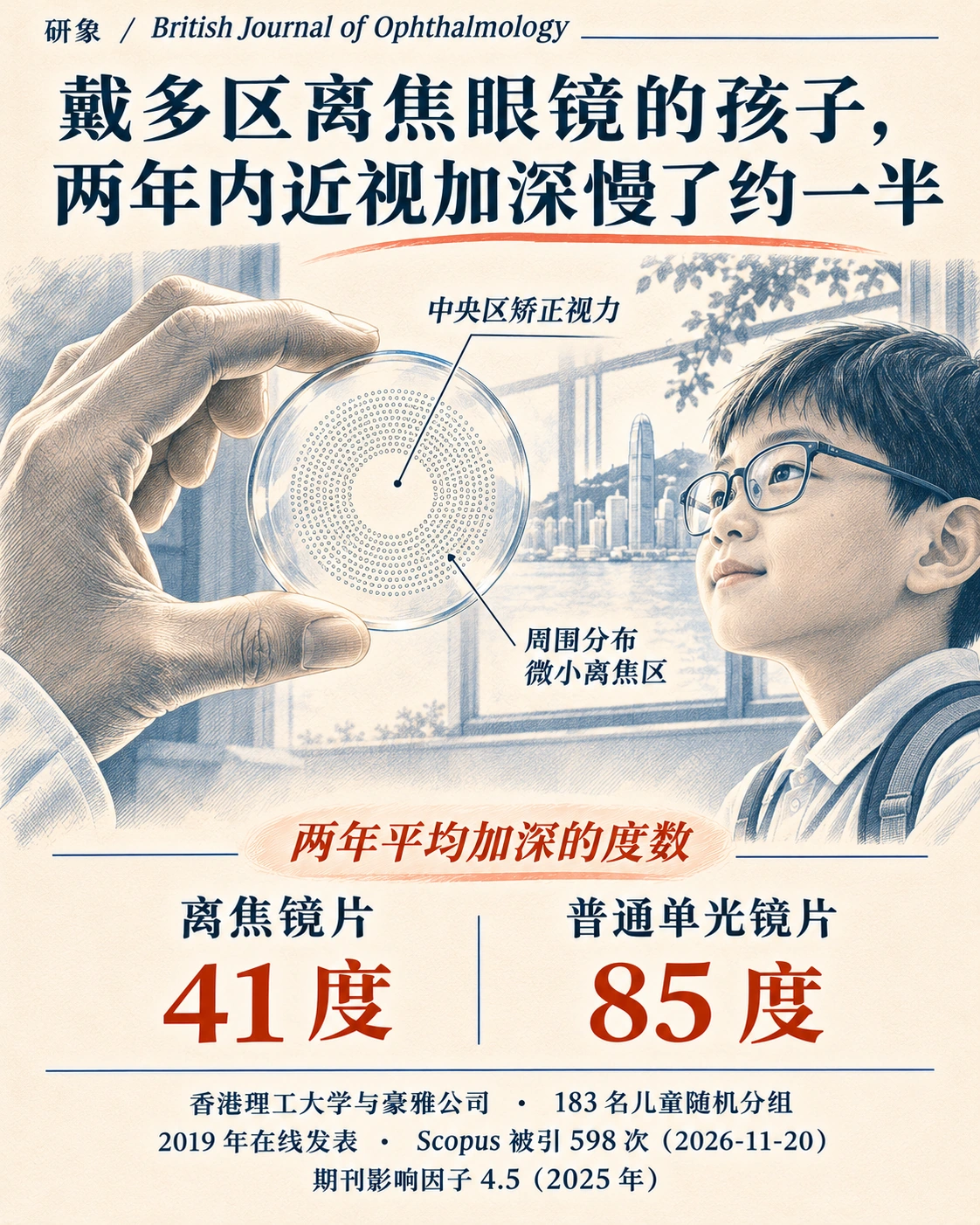
British Journal of Ophthalmology2019随机对照试验研究团队与论文影响
看得清黑板以后,眼睛还会怎样变?
同样是戴眼镜上学,一组孩子两年里平均加深了 85 度,另一组只加深了 41 度。差别来自镜片上围绕中央清晰区的一圈微小光学分区。
推荐阅读的理由
常规配镜后,如果孩子能看清黑板,这次矫正就起了作用。要知道近视有没有少加深,还得过一段时间再量。研究团队每半年检查一次屈光度,还量了从眼球前端到眼底的距离,也就是眼轴。离焦镜片组两年平均增长 0.21 毫米,普通镜片组增长 0.55 毫米。两种测量指向同一件事。
Defocus Incorporated Multiple Segments (DIMS) spectacle lenses slow myopia progression: a 2-year randomised clinical trial
中文摘要(研象译)
目的 检验多区离焦(DIMS)框架眼镜镜片能否减慢儿童近视加深。
方法 这项为期两年的双盲随机对照试验纳入 183 名 8 至 13 岁的中国儿童。他们近视 100 至 500 度,散光不超过 150 度。随机分组后,93 人戴 DIMS 镜片,90 人戴普通单光镜片。DIMS 镜片包含多个能产生 +3.50 D 近视性离焦的小分区。研究者每半年测量一次屈光度(用药放松眼睛调节后自动验光)和眼轴长度。
结果 160 名儿童完成研究,其中离焦镜片组 79 人,普通镜片组 81 人。两年内,两组平均屈光度变化分别为 −0.41±0.06 D 和 −0.85±0.08 D,眼轴分别增长 0.21±0.02 毫米和 0.55±0.02 毫米。此处的 ± 表示标准误。与普通镜片相比,离焦镜片组近视加深慢了 52%(原摘要所列平均差 −0.44±0.09 D,95% 置信区间 −0.73 至 −0.37,p<0.0001),眼轴增长少了 62%(平均差 0.34±0.04 毫米,95% 置信区间 0.22 至 0.37,p<0.0001)。两年内近视没有加深的孩子,离焦镜片组占 21.5%,普通镜片组占 7.4%。
结论 日常佩戴 DIMS 镜片显著减慢了近视儿童的度数加深和眼轴增长。研究结果显示,在保持视物清晰的同时持续提供近视性离焦,可以减慢近视进展。
试验注册 NCT02206217。
关键词 近视、近视性离焦、近视控制、同时视、框架眼镜镜片。
展开英文原摘要收起英文原摘要To determine if ‘Defocus Incorporated Multiple Segments’ (DIMS) spectacle lenses slow childhood myopia progression. A 2-year double-masked randomised controlled trial was carried out in 183 Chinese children aged 8–13 years, with myopia between −1.00 and −5.00 D and astigmatism ≤1.50 D. Children were randomly assigned to wear DIMS (n=93) or single vision (SV) spectacle lenses (n=90). DIMS lens incorporated multiple segments with myopic defocus of +3.50 D. Refractive error (cycloplegic autorefraction) and axial length were measured at 6month intervals. 160 children completed the study, n=79 in the DIMS group and n=81 in the SV group. Average (SE) myopic progressions over 2 years were −0.41±0.06 D in the DIMS group and −0.85±0.08 D in the SV group. Mean (SE) axial elongation was 0.21±0.02 mm and 0.55±0.02 mm in the DIMS and SV groups, respectively. Myopia progressed 52% more slowly for children in the DIMS group compared with those in the SV group (mean difference −0.44±0.09 D, 95% CI −0.73 to −0.37, p<0.0001). Likewise, children in the DIMS group had less axial elongation by 62% than those in the SV group (mean difference 0.34±0.04 mm, 95% CI 0.22 to 0.37, p<0.0001). 21.5% children who wore DIMS lenses had no myopia progression over 2 years, but only 7.4% for those who wore SV lenses. Daily wear of the DIMS lens significantly retarded myopia progression and axial elongation in myopic children. Our results demonstrated simultaneous clear vision with constant myopic defocus can slow myopia progression. NCT02206217. Keywords: myopia, myopic defocus, myopia control, simultaneous vision, spectacle lens
Aim · To determine if ‘Defocus Incorporated Multiple Segments’ (DIMS) spectacle lenses slow childhood myopia progression.
Methods · A 2-year double-masked randomised controlled trial was carried out in 183 Chinese children aged 8–13 years, with myopia between −1.00 and −5.00 D and astigmatism ≤1.50 D. Children were randomly assigned to wear DIMS (n=93) or single vision (SV) spectacle lenses (n=90). DIMS lens incorporated multiple segments with myopic defocus of +3.50 D. Refractive error (cycloplegic autorefraction) and axial length were measured at 6month intervals.
Results · 160 children completed the study, n=79 in the DIMS group and n=81 in the SV group. Average (SE) myopic progressions over 2 years were −0.41±0.06 D in the DIMS group and −0.85±0.08 D in the SV group. Mean (SE) axial elongation was 0.21±0.02 mm and 0.55±0.02 mm in the DIMS and SV groups, respectively. Myopia progressed 52% more slowly for children in the DIMS group compared with those in the SV group (mean difference −0.44±0.09 D, 95% CI −0.73 to −0.37, p<0.0001). Likewise, children in the DIMS group had less axial elongation by 62% than those in the SV group (mean difference 0.34±0.04 mm, 95% CI 0.22 to 0.37, p<0.0001). 21.5% children who wore DIMS lenses had no myopia progression over 2 years, but only 7.4% for those who wore SV lenses.
Conclusions · Daily wear of the DIMS lens significantly retarded myopia progression and axial elongation in myopic children. Our results demonstrated simultaneous clear vision with constant myopic defocus can slow myopia progression.
Trial registration number · NCT02206217.
Keywords: myopia, myopic defocus, myopia control, simultaneous vision, spectacle lens
Carly Siu Yin Lam, Wing Chun Tang, Dennis Yan-yin Tse, Roger Pak Kin Lee, Rachel Ka Man Chun, Keigo Hasegawa, Hua Qi, Takashi Hatanaka, Chi Ho To
© Author(s) (or their employer(s)) 2020. Re-use permitted under CC BY-NC. No commercial re-use. See rights and permissions. Published by BMJ.
两年后,两种镜片相差多少?
| 每组的平均变化 | 多区离焦镜片 | 普通单光镜片 |
|---|---|---|
| 近视加深 | 41 度 | 85 度 |
| 眼轴增长 | 0.21 毫米 | 0.55 毫米 |
原文图 3 为模型调整后的结果。常说的 100 度等于 1 个屈光度(D)。主图将 −0.41 D、−0.85 D 写成加深 41 度和 85 度。 核对作者图表
作者如何解释
作者认为,这款镜片在提供清晰视力的同时持续产生近视性离焦,日常佩戴能减慢近视儿童的度数加深和眼轴增长。
研究团队与论文出处
香港理工大学近视研究中心与日本豪雅公司合作。183 名香港近视儿童随机分组,160 名完成两年随访。豪雅参与镜片设计,提供研究经费、镜片和镜架。
理大馆藏页列出本文在 Scopus 被引 598 次,数据更新于 2026 年 11 月 20 日。该馆藏条目另列 342 次浏览、447 次下载。期刊 2025 年影响因子为 4.5。
单篇与期刊指标核查于 。
原文与延伸阅读
引用这篇文章与反馈纠错
研象编辑部.戴多区离焦眼镜的孩子,两年内近视加深慢了约一半[EB/OL].研象,2026-11-25.https://yanxiang.hk/papers/dims-myopia-children
发现数字、译文或出处有误,可以在邮件里指出相应段落,附上核对依据。