
把多人的遗传差异写进同一份人类参考图谱,短读长数据能辨出更多结构变异
Nature2023图谱与数据库Crossref 记录被引 1308 次
同一份测序数据,为什么换一张参考图就能看出更多东西?
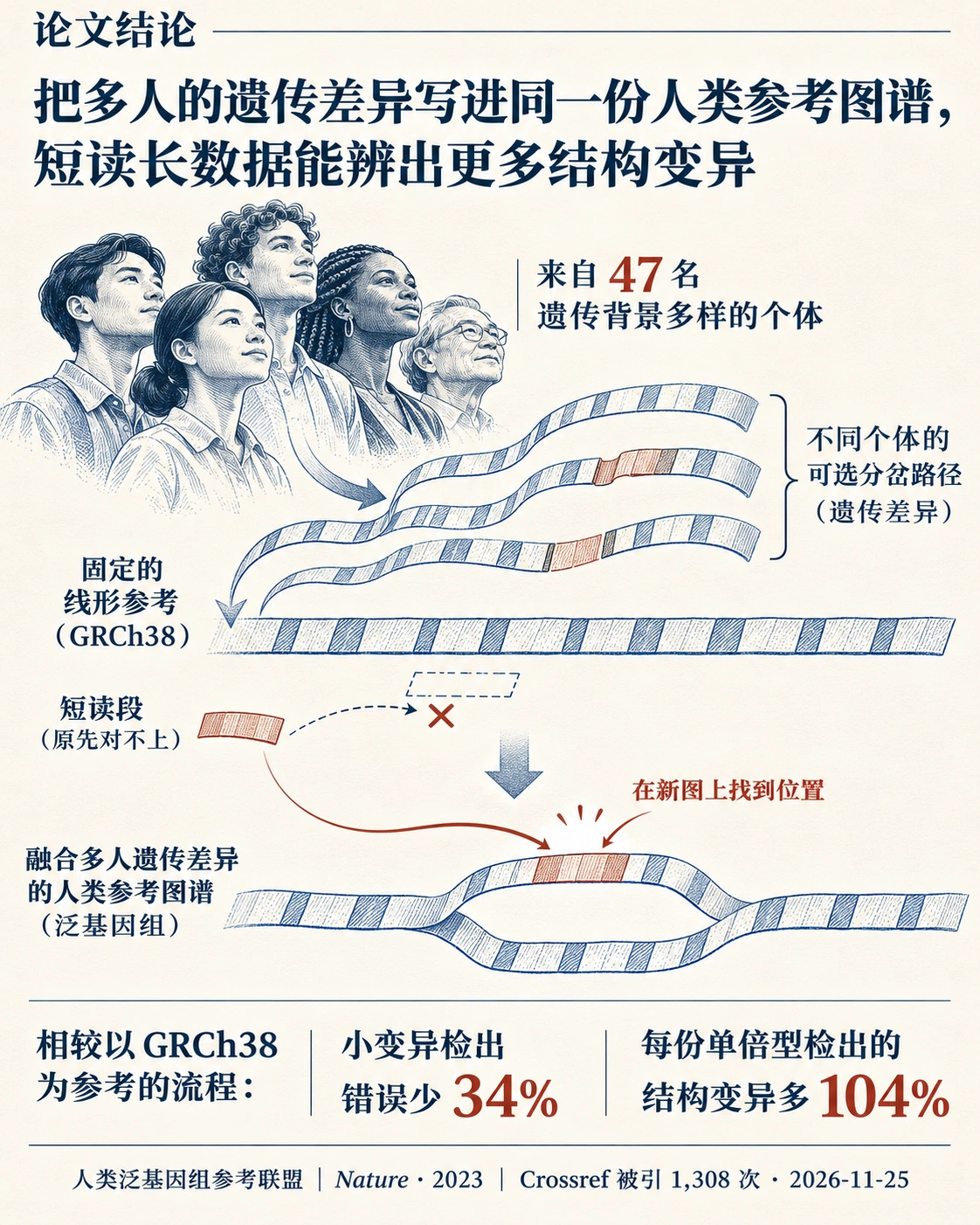
把许多人的遗传差异放进一张可分岔的参考图,同一批短读长测序数据便能识别原来容易遗漏的变异。相较于使用 GRCh38 的流程,每份单倍型检出的结构变异增加了 104%。
推荐阅读的理由
短读长测序把 DNA 读成短片段。要知道一段变化发生在哪里,先得在参考序列里找到它的位置。如果某人带有一段参考序列里没有的 DNA,这一步就可能对不上。泛基因组把许多人在同一位置可能有的不同序列都收进图里,一段原本无处安放的读段,现在可能有路可循。
A draft human pangenome reference
作者摘要 · 中文编译
作者摘要 人类泛基因组参考联盟在此发表首份人类泛基因组参考草图。研究从遗传背景多样的人群中获取 47 份区分了父母来源的二倍体基因组组装。每份组装覆盖各自预期序列的 99% 以上,在结构和单个碱基层面的准确率均超过 99%。研究者将这些组装进行比对,构建了能容纳已知变异与单倍型的参考草图,并在结构复杂的位点发现新的等位基因。与已有参考 GRCh38 相比,新草图增加了 1.19 亿碱基对的常染色质多态序列及 1,115 个基因重复,新增序列约 9,000 万碱基对来自结构变异。用新参考分析短读长数据,与采用 GRCh38 的流程相比,小变异检出错误减少 34%,每份单倍型检出的结构变异数增加 104%,使研究者能对每个样本中绝大多数结构变异等位基因进行分型。
展开英文原摘要收起英文原摘要Here the Human Pangenome Reference Consortium presents a first draft of the human pangenome reference. The pangenome contains 47 phased, diploid assemblies from a cohort of genetically diverse individuals1. These assemblies cover more than 99% of the expected sequence in each genome and are more than 99% accurate at the structural and base pair levels. Based on alignments of the assemblies, we generate a draft pangenome that captures known variants and haplotypes and reveals new alleles at structurally complex loci. We also add 119 million base pairs of euchromatic polymorphic sequences and 1,115 gene duplications relative to the existing reference GRCh38. Roughly 90 million of the additional base pairs are derived from structural variation. Using our draft pangenome to analyse short-read data reduced small variant discovery errors by 34% and increased the number of structural variants detected per haplotype by 104% compared with GRCh38-based workflows, which enabled the typing of the vast majority of structural variant alleles per sample.
Here the Human Pangenome Reference Consortium presents a first draft of the human pangenome reference. The pangenome contains 47 phased, diploid assemblies from a cohort of genetically diverse individuals1. These assemblies cover more than 99% of the expected sequence in each genome and are more than 99% accurate at the structural and base pair levels. Based on alignments of the assemblies, we generate a draft pangenome that captures known variants and haplotypes and reveals new alleles at structurally complex loci. We also add 119 million base pairs of euchromatic polymorphic sequences and 1,115 gene duplications relative to the existing reference GRCh38. Roughly 90 million of the additional base pairs are derived from structural variation. Using our draft pangenome to analyse short-read data reduced small variant discovery errors by 34% and increased the number of structural variants detected per haplotype by 104% compared with GRCh38-based workflows, which enabled the typing of the vast majority of structural variant alleles per sample.
Wen-Wei Liao, Mobin Asri, Jana Ebler, Daniel Doerr, Marina Haukness, Glenn Hickey, Shuangjia Lu, Julian K Lucas, Jean Monlong, Haley J Abel, Silvia Buonaiuto, Xian H Chang, Haoyu Cheng, Justin Chu, Vincenza Colonna, Jordan M Eizenga, Xiaowen Feng, Christian Fischer, Robert S Fulton, Shilpa Garg, Cristian Groza, Andrea Guarracino, William T Harvey, Simon Heumos, Kerstin Howe, Miten Jain, Tsung-Yu Lu, Charles Markello, Fergal J Martin, Matthew W Mitchell, Katherine M Munson, Moses Njagi Mwaniki, Adam M Novak, Hugh E Olsen, Trevor Pesout, David Porubsky, Pjotr Prins, Jonas A Sibbesen, Jouni Sirén, Chad Tomlinson, Flavia Villani, Mitchell R Vollger, Lucinda L Antonacci-Fulton, Gunjan Baid, Carl A Baker, Anastasiya Belyaeva, Konstantinos Billis, Andrew Carroll, Pi-Chuan Chang, Sarah Cody, Daniel E Cook, Robert M Cook-Deegan, Omar E Cornejo, Mark Diekhans, Peter Ebert, Susan Fairley, Olivier Fedrigo, Adam L Felsenfeld, Giulio Formenti, Adam Frankish, Yan Gao, Nanibaa' A Garrison, Carlos Garcia Giron, Richard E Green, Leanne Haggerty, Kendra Hoekzema, Thibaut Hourlier, Hanlee P Ji, Eimear E Kenny, Barbara A Koenig, Alexey Kolesnikov, Jan O Korbel, Jennifer Kordosky, Sergey Koren, HoJoon Lee, Alexandra P Lewis, Hugo Magalhães, Santiago Marco-Sola, Pierre Marijon, Ann McCartney, Jennifer McDaniel, Jacquelyn Mountcastle, Maria Nattestad, Sergey Nurk, Nathan D Olson, Alice B Popejoy, Daniela Puiu, Mikko Rautiainen, Allison A Regier, Arang Rhie, Samuel Sacco, Ashley D Sanders, Valerie A Schneider, Baergen I Schultz, Kishwar Shafin, Michael W Smith, Heidi J Sofia, Ahmad N Abou Tayoun, Françoise Thibaud-Nissen, Francesca Floriana Tricomi, Justin Wagner, Brian Walenz, Jonathan M D Wood, Aleksey V Zimin, Guillaume Bourque, Mark J P Chaisson, Paul Flicek, Adam M Phillippy, Justin M Zook, Evan E Eichler, David Haussler, Ting Wang, Erich D Jarvis, Karen H Miga, Erik Garrison, Tobias Marschall, Ira M Hall, Heng Li, Benedict Paten
© The Author(s) 2023
换用泛基因组参考,原文报告了哪些变化?
| 项目 | 与 GRCh38 参考流程的比较 |
|---|---|
| 常染色质新增多态序列 | 1.19 亿碱基对,其中约 9,000 万来自结构变异 |
| 新增基因重复 | 1,115 个 |
| 小变异检出错误 | 减少 34% |
| 每份单倍型检出的结构变异数 | 增加 104% |
参考草图的结构见原文图 3,短读长分析与基准比较见图 6。 核对作者图表
作者的结论
作者展示了一份可以用于实际分析的泛基因组参考草图。它既记录了原参考里缺少的序列,也让既有短读长数据能更可靠地辨认变异。47 人仍只代表人类遗传多样性的一部分。
研究团队与论文影响
人类泛基因组参考联盟的多机构合作,署名包括耶鲁大学医学院等。论文发表于 Nature。它同时交付了可复用的参考资源和与原参考工作流程直接比较的结果。
Crossref 收录本文引用 1308 次。Nature 文章指标页显示本文约 38.5 万次访问。该刊 2025 年影响因子为 56.1。
单篇与期刊指标核查于 。
原文与延伸阅读
引用这篇文章与反馈纠错
研象编辑部.把多人的遗传差异写进同一份人类参考图谱,短读长数据能辨出更多结构变异[EB/OL].研象,2026-11-25.https://yanxiang.hk/papers/human-pangenome-draft
发现数字、译文或出处有误,可以在邮件里指出相应段落,附上核对依据。