
印度眼底筛查中,AI 偶尔低估严重程度,复核的重症患者仍全部达到转诊条件
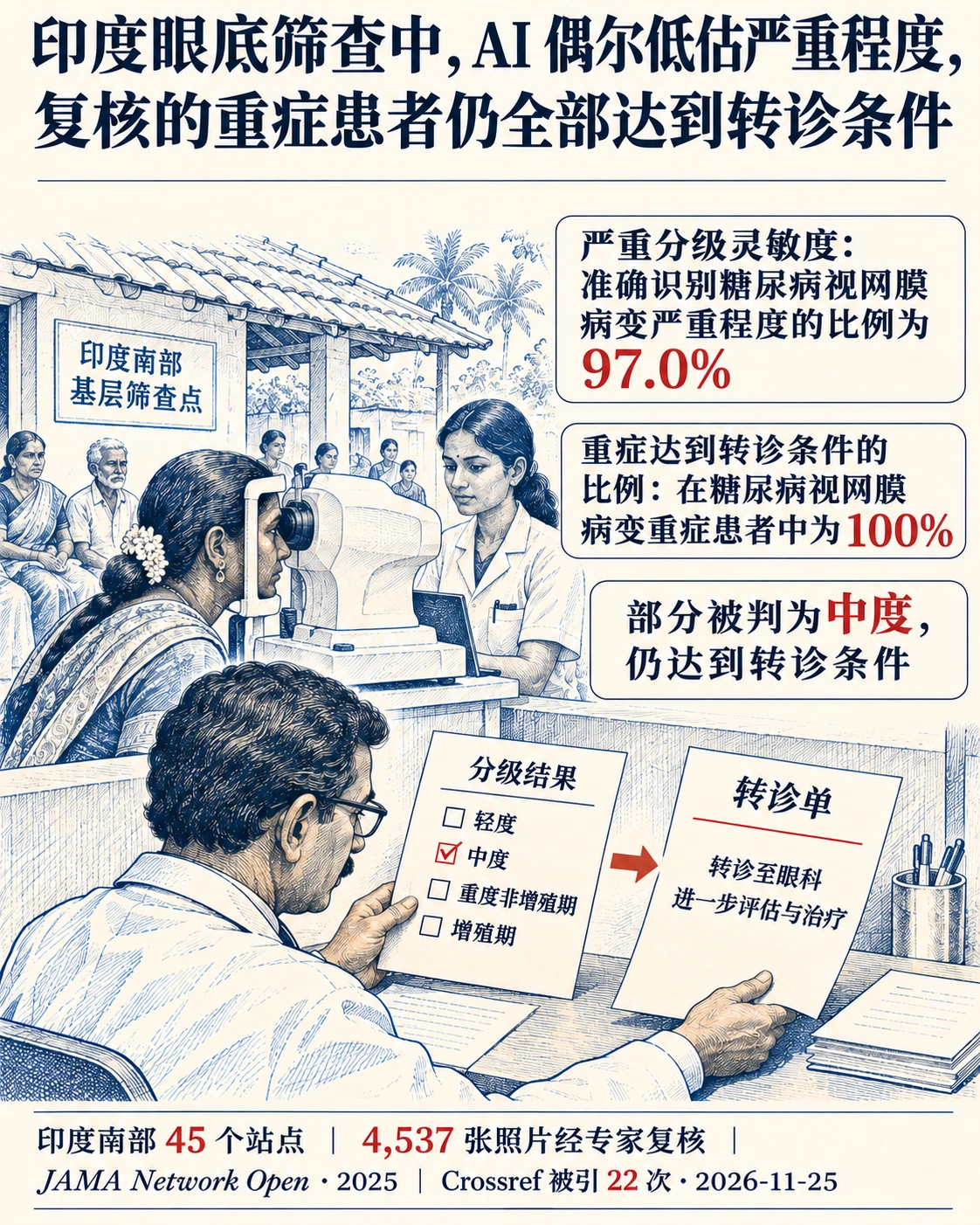
JAMA Network Open2025诊断准确性研究Crossref 记录被引 22 次
分级偶尔出错,为什么转诊仍能覆盖全部重症?
在印度南部日常筛查的抽样复核中,AI 准确识别重度或增殖期糖尿病视网膜病变的灵敏度为 97.0%。少数被低估为中度的重症仍达转诊条件,复核的重症患者全部进入了眼科转诊流程。
推荐阅读的理由
转诊规则在中度病变时就会触发。于是,一张重度病变照片即使被 AI 低判为中度,患者仍会被建议去眼科。这篇论文把“分级答对”和“该转诊的人得到转诊建议”分开统计。
Performance of a Deep Learning Diabetic Retinopathy Algorithm in India
作者摘要 · 中文编译
背景与目的 已有前瞻性研究评估 AI 发现糖尿病视网膜病变和糖尿病黄斑水肿的准确度,但实际部署后的临床表现很少发表。作者评估 ARDA 自动视网膜疾病评估算法在印度 Aravind 眼科医院投入使用后的表现。
设计与结局 这项横断面分析从印度南部 45 个站点 2019 年 1 月 1 日至 2023 年 7 月 31 日接受 ARDA 筛查的患者中随机抽样,约占眼底照片的 1%。美国眼科医生复核病变和黄斑水肿分级,形成裁定结果,再与算法比较。主要分析是算法对重度非增殖期或增殖期病变的灵敏度和特异度。次要分析针对威胁视力的病变,含黄斑水肿或上述两类严重病变。
结果 4,537 名患者各有一张经裁定的照片。平均年龄 55.2 岁(标准差 11.9),2,272 人(50.1%)为男性。在 3,941 名照片可分级者中,683 人(17.3%)有任一糖网病变,146 人(3.7%)为重度非增殖期或增殖期,109 人(2.8%)为增殖期,398 人(10.1%)有威胁视力的病变。算法识别重度非增殖期或增殖期的灵敏度为 97.0%(95% 置信区间 92.6% 至 99.2%),特异度 96.4%(95.7% 至 97.0%),阳性、阴性预测值分别为 50.7%、99.9%。对这类重症,临床上会导致漏转的漏判率为 0%;一些人被低估为中度,但仍会转诊。对威胁视力的病变,灵敏度为 95.9%(93.0% 至 97.4%),特异度 94.9%(94.1% 至 95.7%),阳性和阴性预测值分别为 67.9%、99.5%。
结论 重度非增殖期和增殖期病变的灵敏度与特异度均超过 96%,这两类患者全部被纳入眼科转诊范围。这是该系统在印度已筛查 60 万人后的初步上市后报告,支持按监管建议持续监测并发表算法的临床表现。
展开英文原摘要收起英文原摘要While prospective studies have investigated the accuracy of artificial intelligence (AI) for detection of diabetic retinopathy (DR) and diabetic macular edema (DME), to date, little published data exist on the clinical performance of these algorithms. To evaluate the clinical performance of an automated retinal disease assessment (ARDA) algorithm in the postdeployment setting at Aravind Eye Hospital in India. This cross-sectional analysis involved an approximate 1% sample of fundus photographs from patients screened using ARDA. Images were graded via adjudication by US ophthalmologists for DR and DME, and ARDA’s output was compared against the adjudicated grades at 45 sites in Southern India. Patients were randomly selected between January 1, 2019, and July 31, 2023. Primary analyses were the sensitivity and specificity of ARDA for severe nonproliferative DR (NPDR) or proliferative DR (PDR). Secondary analyses focused on sensitivity and specificity for sight-threatening DR (STDR) (DME or severe NPDR or PDR). Among the 4537 patients with 4537 images with adjudicated grades, mean (SD) age was 55.2 (11.9) years and 2272 (50.1%) were male. Among the 3941 patients with gradable photographs, 683 (17.3%) had any DR, 146 (3.7%) had severe NPDR or PDR, 109 (2.8%) had PDR, and 398 (10.1%) had STDR. ARDA’s sensitivity and specificity for severe NPDR or PDR were 97.0% (95% CI, 92.6%-99.2%) and 96.4% (95% CI, 95.7%-97.0%), respectively. Positive predictive value (PPV) was 50.7% and negative predictive value (NPV) was 99.9%. The clinically important miss rate for severe NPDR or PDR was 0% (eg, some patients with severe NPDR or PDR were interpreted as having moderate DR and referred to clinic). ARDA’s sensitivity for STDR was 95.9% (95% CI, 93.0%-97.4%) and specificity was 94.9% (95% CI, 94.1%-95.7%); PPV and NPV were 67.9% and 99.5%, respectively. In this cross-sectional study investigating the clinical performance of ARDA, sensitivity and specificity for severe NPDR and PDR exceeded 96% and caught 100% of patients with severe NPDR and PDR for ophthalmology referral. This preliminary large-scale postmarketing report of the performance of ARDA after screening 600 000 patients in India underscores the importance of monitoring and publication an algorithm's clinical performance, consistent with recommendations by regulatory bodies.
Importance · While prospective studies have investigated the accuracy of artificial intelligence (AI) for detection of diabetic retinopathy (DR) and diabetic macular edema (DME), to date, little published data exist on the clinical performance of these algorithms.
Objective · To evaluate the clinical performance of an automated retinal disease assessment (ARDA) algorithm in the postdeployment setting at Aravind Eye Hospital in India.
Design, Setting, and Participants · This cross-sectional analysis involved an approximate 1% sample of fundus photographs from patients screened using ARDA. Images were graded via adjudication by US ophthalmologists for DR and DME, and ARDA’s output was compared against the adjudicated grades at 45 sites in Southern India. Patients were randomly selected between January 1, 2019, and July 31, 2023.
Main Outcomes and Measures · Primary analyses were the sensitivity and specificity of ARDA for severe nonproliferative DR (NPDR) or proliferative DR (PDR). Secondary analyses focused on sensitivity and specificity for sight-threatening DR (STDR) (DME or severe NPDR or PDR).
Results · Among the 4537 patients with 4537 images with adjudicated grades, mean (SD) age was 55.2 (11.9) years and 2272 (50.1%) were male. Among the 3941 patients with gradable photographs, 683 (17.3%) had any DR, 146 (3.7%) had severe NPDR or PDR, 109 (2.8%) had PDR, and 398 (10.1%) had STDR. ARDA’s sensitivity and specificity for severe NPDR or PDR were 97.0% (95% CI, 92.6%-99.2%) and 96.4% (95% CI, 95.7%-97.0%), respectively. Positive predictive value (PPV) was 50.7% and negative predictive value (NPV) was 99.9%. The clinically important miss rate for severe NPDR or PDR was 0% (eg, some patients with severe NPDR or PDR were interpreted as having moderate DR and referred to clinic). ARDA’s sensitivity for STDR was 95.9% (95% CI, 93.0%-97.4%) and specificity was 94.9% (95% CI, 94.1%-95.7%); PPV and NPV were 67.9% and 99.5%, respectively.
Conclusions and Relevance · In this cross-sectional study investigating the clinical performance of ARDA, sensitivity and specificity for severe NPDR and PDR exceeded 96% and caught 100% of patients with severe NPDR and PDR for ophthalmology referral. This preliminary large-scale postmarketing report of the performance of ARDA after screening 600 000 patients in India underscores the importance of monitoring and publication an algorithm's clinical performance, consistent with recommendations by regulatory bodies.
Arthur Brant, Preeti Singh, Xiang Yin, Lu Yang, Jay Nayar, Divleen Jeji, Yossi Matias, Greg S Corrado, Dale R Webster, Sunny Virmani, Anchintha Meenu, Naresh Babu Kannan, Jonathan Krause, Florence Thng, Lily Peng, Yun Liu, Kasumi Widner, Kim Ramasamy
Copyright 2025 Brant A et al. JAMA Network Open.
要发现哪一类病变,决定怎样读这组数字
| 判定目标 | 灵敏度 | 特异度 | 阳性预测值 |
|---|---|---|---|
| 重度非增殖期或增殖期病变 | 97.0% | 96.4% | 50.7% |
| 威胁视力的病变,含黄斑水肿 | 95.9% | 94.9% | 67.9% |
灵敏度数真有病者中被检出的比例,阳性预测值数判为阳性者中有多少经专家证实。对应阴性预测值分别为 99.9% 和 99.5%。 核对作者图表
作者的结论
作者认为,这份印度真实应用中的初步报告显示,ARDA 对重度非增殖期和增殖期病变的灵敏度和特异度都超过 96%,复核样本里的这类患者都符合系统转诊条件。作者主张持续监测并公开算法部署后的临床表现。
研究团队与论文影响
印度 Aravind 眼科医院等团队研究系统部署后的表现。在超过 60 万人接受筛查的背景下,研究随机抽取约 1% 的图像,由美国眼科医生独立评估并作最终裁定。比较数字来自抽样复核。
Crossref 收录本文引用 22 次。JAMA Network Open 在 2025 年度回顾中列出的期刊影响因子为 9.7。
单篇与期刊指标核查于 。
原文与延伸阅读
引用这篇文章与反馈纠错
研象编辑部.印度眼底筛查中,AI 偶尔低估严重程度,复核的重症患者仍全部达到转诊条件[EB/OL].研象,2026-11-25.https://yanxiang.hk/papers/india-retina-ai-deployment
发现数字、译文或出处有误,可以在邮件里指出相应段落,附上核对依据。