
随访长达三十年,长期植物性饮食评分与绝经后女性髋部骨折风险未见明确关联
JAMA Network Open2024队列研究Crossref 记录被引 14 次
同样叫植物性饮食,拿哪一年的菜单来算很重要
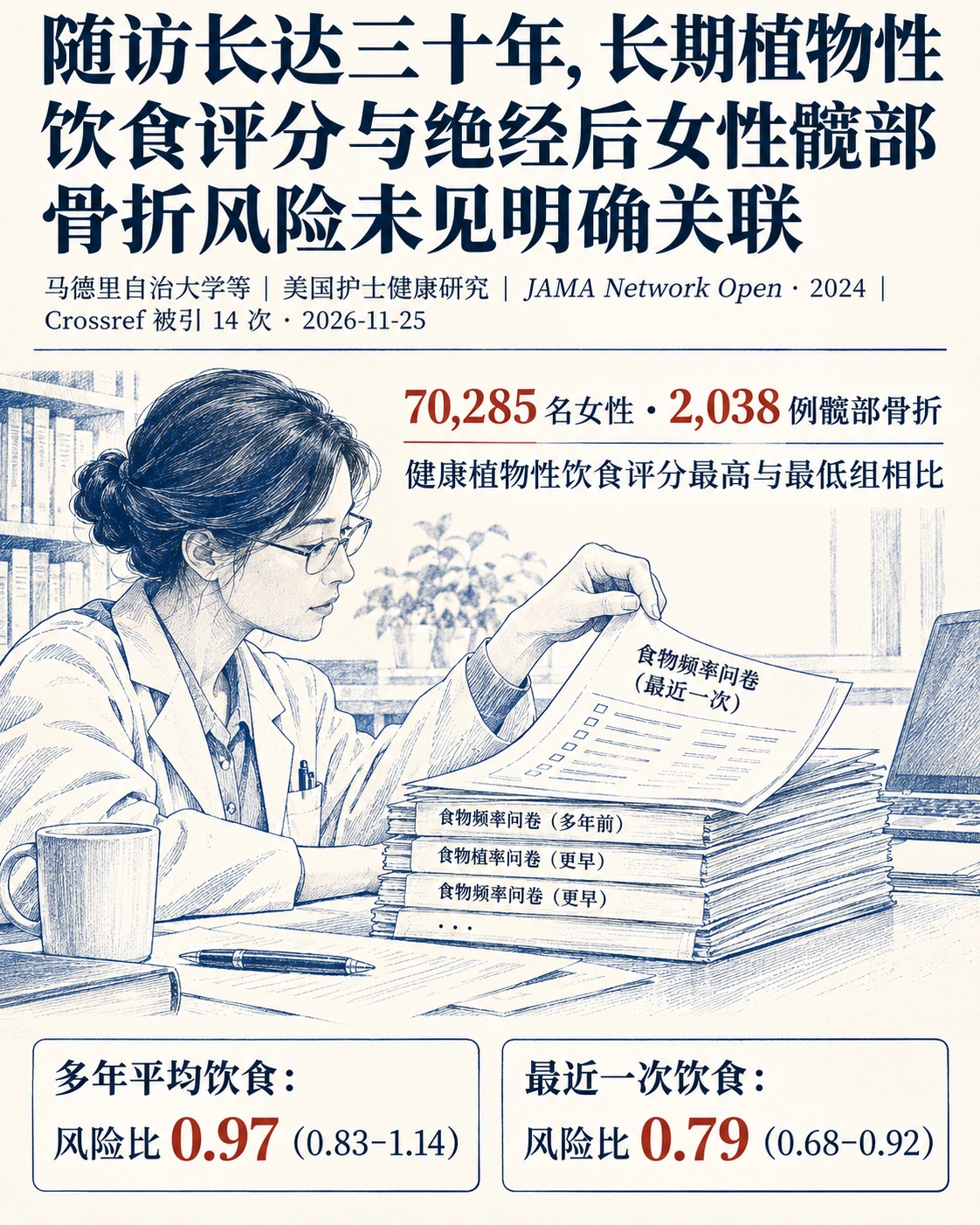
在 70,285 名绝经后女性中,将多年饮食记录取平均后,无论更偏向健康还是较不健康的植物性食物,髋部骨折风险都未见明确差异。只看最近一次饮食时,结果却出现了方向相反的关联。
推荐阅读的理由
研究者每四年收一份饮食问卷,可以算一个人多年的平均饮食,也可以只看她发生骨折前最近的一份。后者显示健康植物性饮食评分较高者风险较低,而较不健康植物性饮食评分较高者风险较高。作者也提出,健康状况改变可能会先影响最近的吃法。
Plant-Based Diets and Risk of Hip Fracture in Postmenopausal Women
作者摘要 · 中文编译
背景与目的 以往研究发现素食与较低骨密度、较高骨折风险有关,但没有区分所吃植物食物的质量。作者在美国护士健康研究中考察植物性饮食质量与绝经后女性髋部骨折的关系,纳入的吃法也包括杂食。
设计 研究使用 70,285 名女性 1984 至 2014 年的队列资料,2023 年 1 至 7 月分析。每两年通过问卷自报髋部骨折,每四年用经验证的半定量食物频率问卷评估饮食。健康植物性饮食指数为全谷、水果、蔬菜、坚果、豆类、植物油、茶或咖啡正向计分,对果汁、甜饮料、精制谷物、薯类、甜食和动物性食物反向计分。较不健康植物性饮食指数则给较不健康植物食物正向计分,给健康植物食物和动物性食物反向计分。将 18 类食物的五分位得分相加,两种指数理论范围均为 18 至 90,越高表示越符合对应吃法。研究用含时变协变量的 Cox 模型计算风险比和 95% 置信区间。
结果 参与者基线平均年龄 54.92 岁(标准差 4.48),全为白人女性。最长 30 年随访中发生 2,038 例髋部骨折。按长期饮食比较最高与最低五分之一,健康指数的风险比为 0.97(95% 置信区间 0.83 至 1.14),较不健康指数为 1.02(0.87 至 1.20),均无明确关联。只看最近一次饮食,健康指数最高者风险低 21%(风险比 0.79,0.68 至 0.92,趋势检验 P=0.02),较不健康指数最高者风险高 28%(1.28,1.09 至 1.51,趋势检验 P=0.008)。
结论 长期采用健康或较不健康植物性饮食与髋部骨折风险均没有明确关联。较近期摄入观察到的关联来自短期饮食效应、反向因果或两者兼有,仍待澄清。
展开英文原摘要收起英文原摘要Previous research has found that vegetarian diets are associated with lower bone mineral density and higher risk of fractures, but these studies did not differentiate the quality of the plant-based foods. To examine the association between the quality of plant-based diets (not necessarily vegan but also omnivorous) and hip fracture risk among postmenopausal women in the Nurses’ Health Study. This cohort study analyzed data from 70 285 postmenopausal women who participated in the US Nurses’ Health Study from 1984 through 2014. Data were analyzed from January 1 to July 31, 2023. Hip fractures were self-reported on biennial questionnaires. Diet was assessed every 4 years using a validated semiquantitative food frequency questionnaire. Plant-based diet quality was assessed using 2 previously established indices: the healthful Plant-Based Diet Index (hPDI), for which healthy plant foods (whole grains, fruits, vegetables, nuts, legumes, vegetable oils, and tea or coffee) received positive scores, whereas less healthy plant foods (fruit juices, sweetened beverages, refined grains, potatoes, and sweets or desserts) and animal foods received reversed scores; and the unhealthful Plant-Based Diet Index (uPDI), for which positive scores were given to less healthy plant foods and reversed scores to healthy plant and animal foods. Quintile scores of 18 food groups were summed, with a theoretical range for both indices of 18 to 90 (highest adherence). Cox proportional hazards regression with time-varying covariates was used to compute hazard ratios (HRs) and 95% CIs for hip fracture. In total, 70 285 participants (mean [SD] age, 54.92 [4.48] years; 100% White women) were included, and 2038 cases of hip fracture were ascertained during the study and for up to 30 years of follow-up. Neither the hPDI (HR for highest vs lowest quintile, 0.97 [95% CI, 0.83-1.14]) nor the uPDI (HR for highest vs lowest quintile, 1.02 [95% CI, 0.87-1.20]) for long-term diet adherence was associated with hip fracture risk. However, when examining recent intake for the highest vs lowest quintiles, the hPDI was associated with 21% lower risk of hip fracture (HR, 0.79 [95% CI, 0.68-0.92]; P = .02 for trend), and the uPDI was associated with 28% higher risk (1.28 [95% CI, 1.09-1.51]; P = .008 for trend). Findings of this cohort study indicated that long-term adherence to healthful or unhealthful plant-based diets as assessed by hPDI and uPDI scores was not associated with hip fracture risk. Future research should clarify whether the associations observed with recent dietary intake are due to short-term effects of these dietary patterns, reverse causality, or both.
Importance · Previous research has found that vegetarian diets are associated with lower bone mineral density and higher risk of fractures, but these studies did not differentiate the quality of the plant-based foods.
Objective · To examine the association between the quality of plant-based diets (not necessarily vegan but also omnivorous) and hip fracture risk among postmenopausal women in the Nurses’ Health Study.
Design, Setting, and Participants · This cohort study analyzed data from 70 285 postmenopausal women who participated in the US Nurses’ Health Study from 1984 through 2014. Data were analyzed from January 1 to July 31, 2023.
Main outcomes and Measures · Hip fractures were self-reported on biennial questionnaires. Diet was assessed every 4 years using a validated semiquantitative food frequency questionnaire. Plant-based diet quality was assessed using 2 previously established indices: the healthful Plant-Based Diet Index (hPDI), for which healthy plant foods (whole grains, fruits, vegetables, nuts, legumes, vegetable oils, and tea or coffee) received positive scores, whereas less healthy plant foods (fruit juices, sweetened beverages, refined grains, potatoes, and sweets or desserts) and animal foods received reversed scores; and the unhealthful Plant-Based Diet Index (uPDI), for which positive scores were given to less healthy plant foods and reversed scores to healthy plant and animal foods. Quintile scores of 18 food groups were summed, with a theoretical range for both indices of 18 to 90 (highest adherence). Cox proportional hazards regression with time-varying covariates was used to compute hazard ratios (HRs) and 95% CIs for hip fracture.
Results · In total, 70 285 participants (mean [SD] age, 54.92 [4.48] years; 100% White women) were included, and 2038 cases of hip fracture were ascertained during the study and for up to 30 years of follow-up. Neither the hPDI (HR for highest vs lowest quintile, 0.97 [95% CI, 0.83-1.14]) nor the uPDI (HR for highest vs lowest quintile, 1.02 [95% CI, 0.87-1.20]) for long-term diet adherence was associated with hip fracture risk. However, when examining recent intake for the highest vs lowest quintiles, the hPDI was associated with 21% lower risk of hip fracture (HR, 0.79 [95% CI, 0.68-0.92]; P = .02 for trend), and the uPDI was associated with 28% higher risk (1.28 [95% CI, 1.09-1.51]; P = .008 for trend).
Conclusions and Relevance · Findings of this cohort study indicated that long-term adherence to healthful or unhealthful plant-based diets as assessed by hPDI and uPDI scores was not associated with hip fracture risk. Future research should clarify whether the associations observed with recent dietary intake are due to short-term effects of these dietary patterns, reverse causality, or both.
Mercedes Sotos-Prieto, Fernando Rodriguez-Artalejo, Teresa T Fung, Haakon E Meyer, Frank B Hu, Walter C Willett, Shilpa N Bhupathiraju
Copyright 2024 Sotos-Prieto M et al. JAMA Network Open.
哪一种吃法,用多长的饮食记录来判断?
| 最高五分之一对最低五分之一的风险比 | 长期平均饮食 | 最近一次饮食 |
|---|---|---|
| 健康植物性饮食指数 | 0.97(0.83 至 1.14) | 0.79(0.68 至 0.92) |
| 较不健康植物性饮食指数 | 1.02(0.87 至 1.20) | 1.28(1.09 至 1.51) |
括号内为 95% 置信区间。长期饮食见表 2,最近一次饮食见表 3。 核对作者图表
作者的结论
作者认为,长期坚持两类植物性饮食与髋部骨折风险均无明确关联。最近饮食的关联,可能来自短期影响,也可能是健康变化先改变了饮食,需后续研究区分。
研究团队与论文影响
马德里自治大学等团队分析美国护士健康研究的长期记录,观察 1984 至 2014 年 70,285 名绝经后女性,期间共记录 2,038 例髋部骨折。
Crossref 收录本文引用 14 次。JAMA Network Open 在 2025 年度回顾中列出的期刊影响因子为 9.7。
单篇与期刊指标核查于 。
原文与延伸阅读
引用这篇文章与反馈纠错
研象编辑部.随访长达三十年,长期植物性饮食评分与绝经后女性髋部骨折风险未见明确关联[EB/OL].研象,2026-11-25.https://yanxiang.hk/papers/plant-diet-hip-fracture
发现数字、译文或出处有误,可以在邮件里指出相应段落,附上核对依据。