
局限性前列腺癌患者中,植物性食物吃得较多者,病情进展风险较低
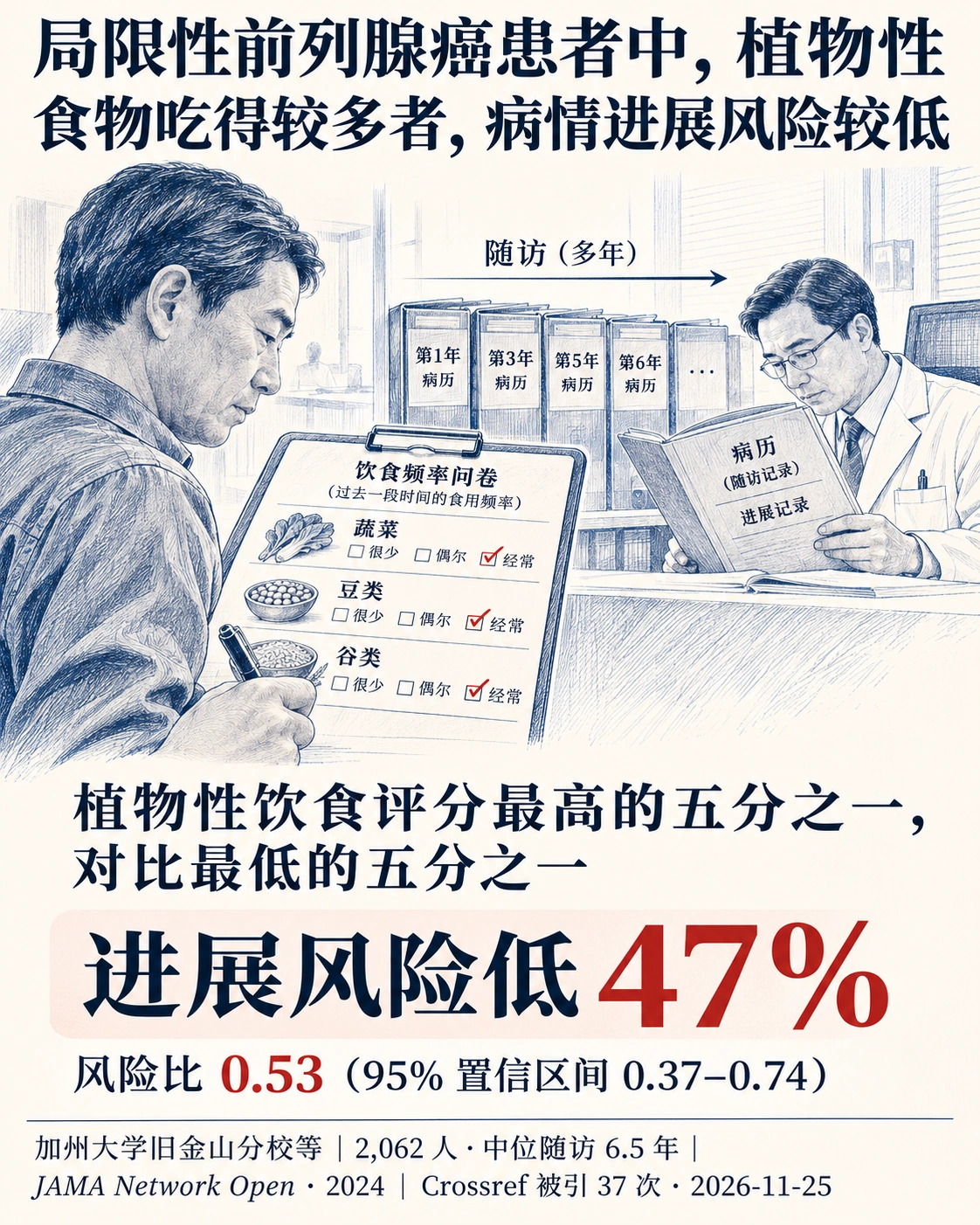
JAMA Network Open2024队列研究Crossref 记录被引 37 次
这里说的“进展”,患者实际经历了什么?
在美国 2,062 名未发生转移的前列腺癌患者中,确诊后植物性饮食评分最高的五分之一与最低的五分之一相比,后来的进展风险低 47%。
推荐阅读的理由
研究随访的是癌症复发、开始第二线治疗、骨转移或死于前列腺癌。患者先完成食物频率问卷,再由团队追踪这些事件。这使人能看到饮食习惯与后续病程的关系。给某位患者改变食谱会带来多大疗效,单凭这项观察研究还算不出来。
Plant-Based Diets and Disease Progression in Men With Prostate Cancer
作者摘要 · 中文编译
背景与目的 植物性饮食有多种健康和环境方面的益处,包括初级预防致死性前列腺癌。前列腺癌确诊后,这类饮食与进展和前列腺癌死亡的关系了解较少。
设计与结局 这项纵向观察队列包括美国 43 家泌尿科机构在 1999 至 2018 年招募的 CaPSURE 饮食与生活方式子研究参与者,均为经活检证实、未转移的男性患者(分期不超过 T3a)。2004 至 2016 年,参与者填写含验证过的食物频率问卷在内的详细问卷。2022 年 8 月至 2023 年 4 月分析。研究者计算植物性饮食总指数和健康植物性饮食指数。主要结局为前列腺癌进展,包括复发、第二次治疗、骨转移或前列腺癌死亡;次要结局为死于前列腺癌。
结果 2,062 名参与者年龄中位数为 65 岁(四分位间距 59 至 70)。61 人(3%)自报为非裔美国人,3 人(不足 1%)为美洲印第安人或阿拉斯加原住民,9 人(不足 1%)为亚裔或太平洋岛民,15 人(1%)为拉丁裔,1,959 人(95%)为白人。从确诊到填问卷的时间中位数为 31.3 个月(15.9 至 62.0)。问卷后中位随访 6.5 年(1.3 至 12.8),共观察到 190 次进展和 61 例前列腺癌死亡。植物性饮食总指数最高五分之一对最低五分之一,进展风险低 47%(风险比 0.53,95% 置信区间 0.37 至 0.74,趋势检验 P=0.003)。健康植物性饮食指数与总体进展风险没有明确关系。在确诊时 Gleason 评分至少 7 分的 680 人中,该指数最高组进展风险低 55%(风险比 0.45,0.25 至 0.81,趋势检验 P=0.01);评分低于 7 分者未见这一关联。
结论 在这项 2,062 名前列腺癌患者的队列研究中,确诊后植物性食物吃得较多与较低的进展风险有关。作者认为,可为患者提供营养评估和咨询,以建立健康饮食习惯、支持身心状况和整体健康。
展开英文原摘要收起英文原摘要Plant-based diets are associated with many health and environmental benefits, including primary prevention of fatal prostate cancer, but less is known about postdiagnostic plant-based diet patterns in individuals with prostate cancer. To examine whether postdiagnostic plant-based dietary patterns are associated with risk of prostate cancer progression and prostate cancer–specific mortality. This longitudinal observational cohort study included men with biopsy-proven nonmetastatic prostate cancer (stage ≤T3a) from the diet and lifestyle substudy within the Cancer of the Prostate Strategic Urologic Research Endeavor (CaPSURE) enrolled at 43 urology practices across the US from 1999 to 2018. Participants completed a comprehensive diet and lifestyle questionnaire (including a validated food frequency questionnaire [FFQ]) between 2004 and 2016. Data were analyzed from August 2022 to April 2023. Overall plant-based diet index (PDI) and healthful plant-based diet index (hPDI) scores were calculated from the FFQ. The primary outcome was prostate cancer progression (recurrence, secondary treatment, bone metastases, or prostate cancer–specific mortality). The secondary outcome was prostate cancer–specific mortality. Among 2062 participants (median [IQR] age, 65.0 [59.0-70.0] years), 61 (3%) identified as African American, 3 (<1%) identified as American Indian or Alaska Native, 9 (<1%) identified as Asian or Pacific Islander, 15 (1%) identified as Latino, and 1959 (95%) identified as White. Median (IQR) time from prostate cancer diagnosis to FFQ was 31.3 (15.9-62.0) months after diagnosis. During a median (IQR) follow-up of 6.5 (1.3-12.8) years after the FFQ, 190 progression events and 61 prostate cancer–specific mortality events were observed. Men scoring in the highest vs lowest quintile of PDI had a 47% lower risk of progression (HR, 0.53; 95% CI, 0.37-0.74; P for trend = .003). The hPDI was not associated with risk of progression overall. However, among 680 individuals with Gleason grade 7 or higher at diagnosis, the highest hPDI quintile was associated with a 55% lower risk of progression compared with the lowest hPDI quintile (HR 0.45; 95% CI, 0.25-0.81; P for trend = .01); no association was observed in individuals with Gleason grade less than 7. In this cohort study of 2062 men with prostate cancer, higher intake of plant foods after prostate cancer diagnosis was associated with lower risk of cancer progression. These findings suggest nutritional assessment and counseling may be recommended to patients with prostate cancer to help establish healthy dietary practices and support well-being and overall health.
Importance · Plant-based diets are associated with many health and environmental benefits, including primary prevention of fatal prostate cancer, but less is known about postdiagnostic plant-based diet patterns in individuals with prostate cancer.
Objective · To examine whether postdiagnostic plant-based dietary patterns are associated with risk of prostate cancer progression and prostate cancer–specific mortality.
Design, Setting, and Participants · This longitudinal observational cohort study included men with biopsy-proven nonmetastatic prostate cancer (stage ≤T3a) from the diet and lifestyle substudy within the Cancer of the Prostate Strategic Urologic Research Endeavor (CaPSURE) enrolled at 43 urology practices across the US from 1999 to 2018. Participants completed a comprehensive diet and lifestyle questionnaire (including a validated food frequency questionnaire [FFQ]) between 2004 and 2016. Data were analyzed from August 2022 to April 2023.
Exposures · Overall plant-based diet index (PDI) and healthful plant-based diet index (hPDI) scores were calculated from the FFQ.
Main Outcomes and Measures · The primary outcome was prostate cancer progression (recurrence, secondary treatment, bone metastases, or prostate cancer–specific mortality). The secondary outcome was prostate cancer–specific mortality.
Results · Among 2062 participants (median [IQR] age, 65.0 [59.0-70.0] years), 61 (3%) identified as African American, 3 (<1%) identified as American Indian or Alaska Native, 9 (<1%) identified as Asian or Pacific Islander, 15 (1%) identified as Latino, and 1959 (95%) identified as White. Median (IQR) time from prostate cancer diagnosis to FFQ was 31.3 (15.9-62.0) months after diagnosis. During a median (IQR) follow-up of 6.5 (1.3-12.8) years after the FFQ, 190 progression events and 61 prostate cancer–specific mortality events were observed. Men scoring in the highest vs lowest quintile of PDI had a 47% lower risk of progression (HR, 0.53; 95% CI, 0.37-0.74; P for trend = .003). The hPDI was not associated with risk of progression overall. However, among 680 individuals with Gleason grade 7 or higher at diagnosis, the highest hPDI quintile was associated with a 55% lower risk of progression compared with the lowest hPDI quintile (HR 0.45; 95% CI, 0.25-0.81; P for trend = .01); no association was observed in individuals with Gleason grade less than 7.
Conclusions and Relevance · In this cohort study of 2062 men with prostate cancer, higher intake of plant foods after prostate cancer diagnosis was associated with lower risk of cancer progression. These findings suggest nutritional assessment and counseling may be recommended to patients with prostate cancer to help establish healthy dietary practices and support well-being and overall health.
Vivian N Liu, Erin L Van Blarigan, Li Zhang, Rebecca E Graff, Stacy Loeb, Crystal S Langlais, Janet E Cowan, Peter R Carroll, June M Chan, Stacey A Kenfield
Copyright 2024 Liu VN et al. JAMA Network Open.
一次饮食问卷之后,研究队伍观察到了什么?
| 读数 | 结果 |
|---|---|
| 完成饮食评估 | 2,062 人 |
| 问卷后中位随访 | 6.5 年 |
| 随访中病情进展/前列腺癌死亡 | 190 次/61 例 |
| 植物性饮食总评分最高组对最低组的进展风险比 | 0.53(95% 置信区间 0.37 至 0.74) |
作者另算了更看重健康植物食物的评分,该评分与全体参与者进展风险的关系未达显著。 核对作者图表
作者的结论
作者认为,前列腺癌确诊后,吃较多植物性食物与较低的进展风险有关。营养评估和咨询可以帮助患者建立健康的饮食习惯,支持整体健康。
研究团队与论文影响
加州大学旧金山分校等团队使用美国 CaPSURE 队列,覆盖 43 家泌尿科诊疗机构。入组对象都由活检确诊,癌症尚未发生远处转移。
Crossref 收录本文引用 37 次。JAMA Network Open 在 2025 年度回顾中列出的期刊影响因子为 9.7。
单篇与期刊指标核查于 。
原文与延伸阅读
引用这篇文章与反馈纠错
研象编辑部.局限性前列腺癌患者中,植物性食物吃得较多者,病情进展风险较低[EB/OL].研象,2026-11-25.https://yanxiang.hk/papers/plant-diet-prostate-progression
发现数字、译文或出处有误,可以在邮件里指出相应段落,附上核对依据。