
一晚睡眠的多种生理信号,能帮助区分谁更早出现哪些疾病
Nature Medicine2026预测模型Crossref 记录被引 83 次
人已经醒了,昨夜的记录还能回答什么?
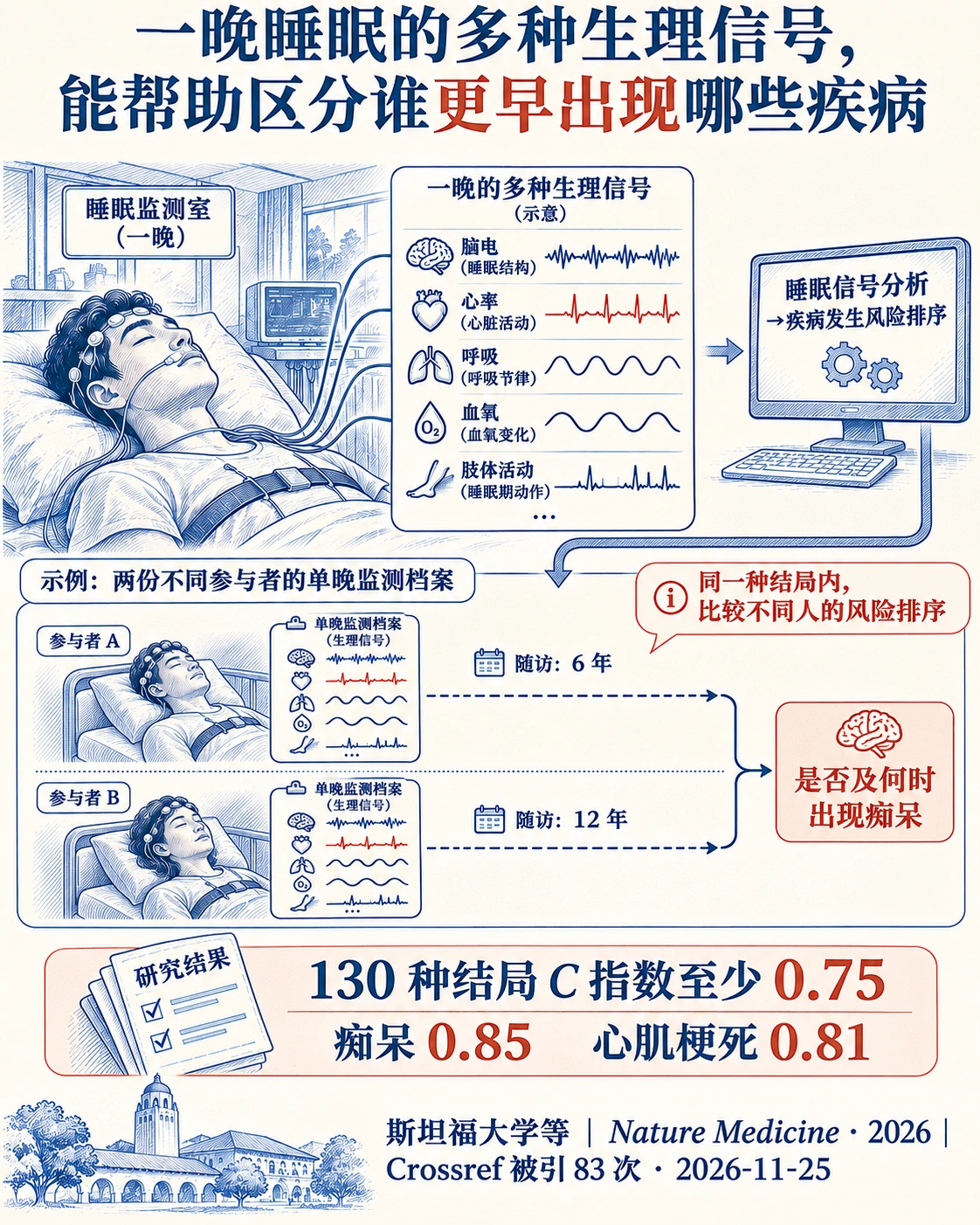
一晚多导睡眠监测同时记录大脑、呼吸和心脏等活动。SleepFM 将这些信号一起分析后,能把后来较早出现某些疾病的人排到较高风险位置,130 种结局的 C 指数至少为 0.75。
推荐阅读的理由
睡眠报告常用来判断睡到了哪个阶段、有没有呼吸暂停。作者把同一夜的多种信号与此后多年的诊断记录接起来,改问谁会更早出现疾病。比如痴呆的 C 指数为 0.85,评的是对可比较的人能否排对风险先后。它不表示受检者有 85% 的概率患痴呆。
A multimodal sleep foundation model for disease prediction
作者摘要 · 中文编译
作者摘要 睡眠对身心健康很重要,但睡眠与疾病的复杂关系还没有得到充分解释。多导睡眠监测能记录丰富的生理信号,是分析睡眠的标准手段;由于设备配置不同、结果推广困难、多种信号难以整合,这些记录仍未被充分利用。作者开发了多模态睡眠基础模型 SleepFM,用一种能够适应不同监测配置的对比学习方法训练。它从多个队列约 6.5 万名参与者、超过 58.5 万小时的睡眠记录中学习生理与时间特征。
结果 用单晚记录,模型对 130 种结局的风险排序达到至少 0.75 的 C 指数,经过多重比较校正后 P 值仍小于 0.01。代表性结果包括全因死亡 0.84、痴呆 0.85、心肌梗死 0.81、心力衰竭 0.80、慢性肾病 0.79、卒中及心房颤动均为 0.78。在未参与预训练的睡眠心脏健康研究中,模型也有较好的迁移表现。在传统睡眠任务上,它的表现可与 U-Sleep 和 YASA 等专用方法相较:睡眠分期的平均 F1 分数为 0.70 至 0.78,识别呼吸暂停严重程度以及是否存在呼吸暂停的准确率分别为 0.69 和 0.87。
结论 结果表明,基础模型能从多种睡眠信号中学习共有规律,用较少标注实现可扩展的睡眠分析及疾病风险预测。
展开英文原摘要收起英文原摘要Sleep is a fundamental biological process with broad implications for physical and mental health, yet its complex relationship with disease remains poorly understood. Polysomnography (PSG)—the gold standard for sleep analysis—captures rich physiological signals but is underutilized due to challenges in standardization, generalizability and multimodal integration. To address these challenges, we developed SleepFM, a multimodal sleep foundation model trained with a new contrastive learning approach that accommodates multiple PSG configurations. Trained on a curated dataset of over 585,000 hours of PSG recordings from approximately 65,000 participants across several cohorts, SleepFM produces latent sleep representations that capture the physiological and temporal structure of sleep and enable accurate prediction of future disease risk. From one night of sleep, SleepFM accurately predicts 130 conditions with a C-Index of at least 0.75 (Bonferroni-corrected P < 0.01), including all-cause mortality (C-Index, 0.84), dementia (0.85), myocardial infarction (0.81), heart failure (0.80), chronic kidney disease (0.79), stroke (0.78) and atrial fibrillation (0.78). Moreover, the model demonstrates strong transfer learning performance on a dataset from the Sleep Heart Health Study—a dataset that was excluded from pretraining—and performs competitively with specialized sleep-staging models such as U-Sleep and YASA on common sleep analysis tasks, achieving mean F1 scores of 0.70–0.78 for sleep staging and accuracies of 0.69 and 0.87 for classifying sleep apnea severity and presence. This work shows that foundation models can learn the language of sleep from multimodal sleep recordings, enabling scalable, label-efficient analysis and disease prediction.
Sleep is a fundamental biological process with broad implications for physical and mental health, yet its complex relationship with disease remains poorly understood. Polysomnography (PSG)—the gold standard for sleep analysis—captures rich physiological signals but is underutilized due to challenges in standardization, generalizability and multimodal integration. To address these challenges, we developed SleepFM, a multimodal sleep foundation model trained with a new contrastive learning approach that accommodates multiple PSG configurations. Trained on a curated dataset of over 585,000 hours of PSG recordings from approximately 65,000 participants across several cohorts, SleepFM produces latent sleep representations that capture the physiological and temporal structure of sleep and enable accurate prediction of future disease risk. From one night of sleep, SleepFM accurately predicts 130 conditions with a C-Index of at least 0.75 (Bonferroni-corrected P < 0.01), including all-cause mortality (C-Index, 0.84), dementia (0.85), myocardial infarction (0.81), heart failure (0.80), chronic kidney disease (0.79), stroke (0.78) and atrial fibrillation (0.78). Moreover, the model demonstrates strong transfer learning performance on a dataset from the Sleep Heart Health Study—a dataset that was excluded from pretraining—and performs competitively with specialized sleep-staging models such as U-Sleep and YASA on common sleep analysis tasks, achieving mean F1 scores of 0.70–0.78 for sleep staging and accuracies of 0.69 and 0.87 for classifying sleep apnea severity and presence. This work shows that foundation models can learn the language of sleep from multimodal sleep recordings, enabling scalable, label-efficient analysis and disease prediction.
Rahul Thapa, Magnus Ruud Kjaer, Bryan He, Ian Covert, Hyatt Moore Iv, Umaer Hanif, Gauri Ganjoo, M Brandon Westover, Poul Jennum, Andreas Brink-Kjaer, Emmanuel Mignot, James Zou
© The Author(s) 2026
从一晚睡眠记录估计后续风险
| 结局 | C 指数 |
|---|---|
| 痴呆 | 0.85 |
| 全因死亡 | 0.84 |
| 心肌梗死/心力衰竭 | 0.81/0.80 |
| 慢性肾病 | 0.79 |
| 卒中/心房颤动 | 0.78/0.78 |
原文图 2 在留出的 5,019 人测试集中展示各疾病的表现。 核对作者图表
作者的结论
作者认为,大规模睡眠记录可以训练出能迁移到多种任务的模型,包括睡眠分期、睡眠呼吸暂停识别和日后患病风险排序。
研究团队与论文影响
斯坦福大学等团队汇集约 6.5 万人的 58.5 万余小时睡眠记录。训练用到多个队列,并在未参与预训练的美国睡眠心脏健康研究数据中检验迁移表现。
Crossref 收录本文引用 83 次。出版商统计本文访问约 31.6 万次。Nature Medicine 的 2025 年期刊影响因子为 52.3。
单篇与期刊指标核查于 。
原文与延伸阅读
引用这篇文章与反馈纠错
研象编辑部.一晚睡眠的多种生理信号,能帮助区分谁更早出现哪些疾病[EB/OL].研象,2026-11-25.https://yanxiang.hk/papers/sleepfm
发现数字、译文或出处有误,可以在邮件里指出相应段落,附上核对依据。