
17 岁前接种四价 HPV 疫苗,13 至 15 年后宫颈癌发病率仍较低
The BMJ2026观察性研究Crossref 记录被引 15 次
当初接种疫苗的女孩成年后,还能看到保护吗?
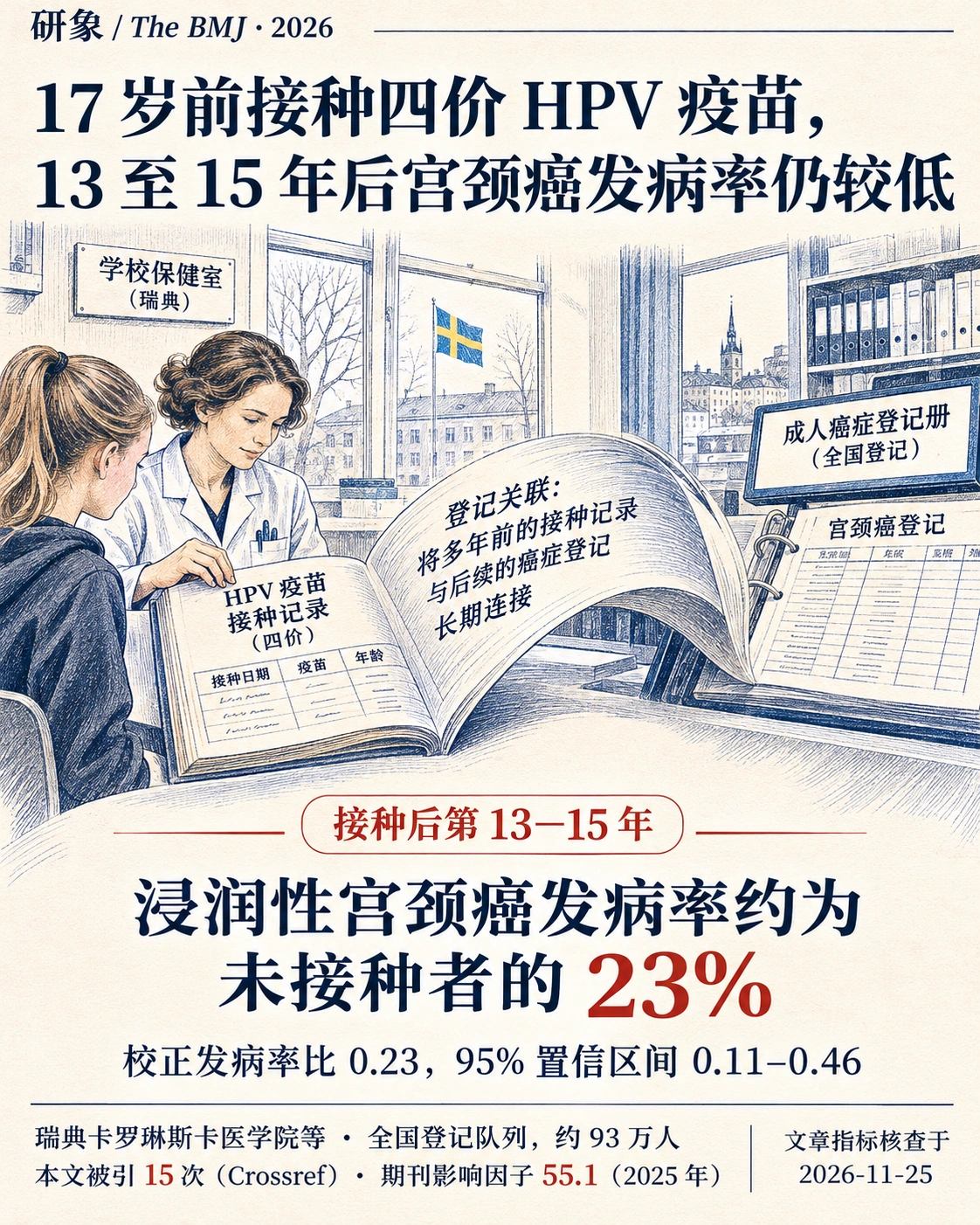
瑞典把多年前的 HPV 疫苗接种记录与全国癌症登记相连。在 17 岁前开始接种四价疫苗的人中,接种后第 13 至 15 年,浸润性宫颈癌的发病率仍约为未接种者的 23%。
推荐阅读的理由
一次抗体检查回答不了十多年后会发生多少宫颈癌。作者等到最早几批接种者成年,以登记中真正发生的浸润性宫颈癌作比较。读图时要盯住分母:23% 是两组发病率的比值。这个数字告诉我们两组相差多少,也保留了接种后仍可能发病这一事实。
Extended follow-up of invasive cervical cancer risk after quadrivalent HPV vaccination: nationwide, register based study
作者摘要 · 中文编译
目的 评估接种四价 HPV 疫苗后浸润性宫颈癌的长期风险,观察风险是否随接种时间而改变,并评估接种项目在人群层面的影响。
设计与人群 瑞典全国登记队列,最长随访 18 年,研究期间为 2006 年 1 月 1 日至 2023 年 12 月 31 日。纳入 926,362 名在瑞典居住的女孩和女性,开始随访时均未接种 HPV 疫苗,也未诊断浸润性宫颈癌。按出生年份和可获得的接种方式,分为 1985 至 1988 年出生的自行接种队列、1989 至 1992 年出生的补贴队列、1993 至 1998 年出生的补种队列,以及 1999 至 2001 年出生的学校项目队列。
主要指标 用泊松回归估算接种者与未接种者的浸润性宫颈癌发病率比,校正年龄、日历时间、社会人口因素和病史。研究者还按接种后三年一个区间、首次接种年龄分别分析,并比较不同出生队列。
结果 随访中 365,502 人(39.5%)接种过至少一剂四价疫苗。共发现 930 例浸润性宫颈癌,接种者 97 例,未接种者 833 例。相对未接种者,17 岁前接种人群整个随访期的充分校正发病率比为 0.21(95% 置信区间 0.13 至 0.32),第 13 至 15 年仍为 0.23(0.11 至 0.46)。17 岁及以上接种者整个随访期为 0.63(0.49 至 0.81),第 10 至 12 年为 0.54(0.33 至 0.86),第 13 至 15 年为 0.23(0.08 至 0.60)。校正协变量后,学校项目队列比自行接种队列的宫颈癌风险低 72%(95% 置信区间 11% 至 91%,发病率比 0.28,95% 置信区间 0.09 至 0.89)。
结论 四价 HPV 疫苗接种者显著较低的浸润性宫颈癌风险贯穿长期随访,未见保护减弱的迹象。在人群层面,学校项目队列的发病率低于自行接种队列。
展开英文原摘要收起英文原摘要To evaluate the long term risk of invasive cervical cancer after receiving the quadrivalent human papillomavirus (HPV) vaccine, how risk varies by time since vaccination, and to assess the population level impact of HPV vaccination programmes. Nationwide register based cohort study with up to 18 years of follow-up. Sweden, from 1 January 2006 to 31 December 2023. 926 362 girls and women residing in Sweden between 2006 and 2023, born in 1985-88 (opportunistic cohort), 1989-92 (subsidised cohort), 1993-98 (catch-up cohort), or 1999-2001 (school based cohort), and with no previous HPV vaccination or diagnosis of invasive cervical cancer at the start of follow-up. Incidence rate ratios of invasive cervical cancer among vaccinated women versus unvaccinated women were estimated using Poisson regression, adjusting for age, calendar time, sociodemographic factors, and medical histories. Incidence rate ratios were further assessed by time since vaccination, stratified into three year intervals (eg, 1-3, 4-6 years), and by age at vaccination, as well as additional analyses by birth cohorts. During follow-up, 365 502 (39.5%) girls and women received at least one dose of the quadrivalent HPV vaccine. 930 cases of invasive cervical cancer were identified, including 97 in vaccinated and 833 cases in unvaccinated individuals. Among participants vaccinated before 17 years, the overall fully adjusted incidence rate ratios compared with the unvaccinated group was 0.21 (95% confidence interval (CI) 0.13 to 0.32), with sustained protection for 13-15 years after vaccination (incidence rate ratio 0.23, 95% CI 0.11 to 0.46). For individuals vaccinated at 17 years or older, the overall fully adjusted incidence rate ratio was 0.63 (95% CI 0.49 to 0.81) compared with the unvaccinated group, with significant incidence reductions observed during years 10-12 (incidence rate ratio 0.54, 95% CI 0.33 to 0.86), and years 13-15 (incidence rate ratio 0.23, 95% CI 0.08 to 0.60) after vaccination. Compared with the opportunistic cohort, the school based cohort had a 72% (95% CI 11% to 91%) lower risk of cervical cancer after adjustment for covariates (incidence rate ratio 0.28, 95% CI 0.09 to 0.89). A significantly reduced risk of invasive cervical cancer following quadrivalent HPV vaccination persisted throughout long term follow-up, with no indication of waning protection. School based cohorts showed lower incidence of cervical cancer at the population level than the opportunistic cohort.
Objectives · To evaluate the long term risk of invasive cervical cancer after receiving the quadrivalent human papillomavirus (HPV) vaccine, how risk varies by time since vaccination, and to assess the population level impact of HPV vaccination programmes.
Design · Nationwide register based cohort study with up to 18 years of follow-up.
Setting · Sweden, from 1 January 2006 to 31 December 2023.
Participants · 926 362 girls and women residing in Sweden between 2006 and 2023, born in 1985-88 (opportunistic cohort), 1989-92 (subsidised cohort), 1993-98 (catch-up cohort), or 1999-2001 (school based cohort), and with no previous HPV vaccination or diagnosis of invasive cervical cancer at the start of follow-up.
Main outcome measures · Incidence rate ratios of invasive cervical cancer among vaccinated women versus unvaccinated women were estimated using Poisson regression, adjusting for age, calendar time, sociodemographic factors, and medical histories. Incidence rate ratios were further assessed by time since vaccination, stratified into three year intervals (eg, 1-3, 4-6 years), and by age at vaccination, as well as additional analyses by birth cohorts.
Results · During follow-up, 365 502 (39.5%) girls and women received at least one dose of the quadrivalent HPV vaccine. 930 cases of invasive cervical cancer were identified, including 97 in vaccinated and 833 cases in unvaccinated individuals. Among participants vaccinated before 17 years, the overall fully adjusted incidence rate ratios compared with the unvaccinated group was 0.21 (95% confidence interval (CI) 0.13 to 0.32), with sustained protection for 13-15 years after vaccination (incidence rate ratio 0.23, 95% CI 0.11 to 0.46). For individuals vaccinated at 17 years or older, the overall fully adjusted incidence rate ratio was 0.63 (95% CI 0.49 to 0.81) compared with the unvaccinated group, with significant incidence reductions observed during years 10-12 (incidence rate ratio 0.54, 95% CI 0.33 to 0.86), and years 13-15 (incidence rate ratio 0.23, 95% CI 0.08 to 0.60) after vaccination. Compared with the opportunistic cohort, the school based cohort had a 72% (95% CI 11% to 91%) lower risk of cervical cancer after adjustment for covariates (incidence rate ratio 0.28, 95% CI 0.09 to 0.89).
Conclusions · A significantly reduced risk of invasive cervical cancer following quadrivalent HPV vaccination persisted throughout long term follow-up, with no indication of waning protection. School based cohorts showed lower incidence of cervical cancer at the population level than the opportunistic cohort.
Shiqiang Wu, Yunyang Deng, Tiia Lepp, Lina Schollin Ask, Pär Sparen, Mark Clements, Joakim Dillner, Jiayao Lei
© The Author(s). Published by BMJ.
按开始接种的年龄和随访时间比较
| 首次接种四价疫苗的年龄 | 整个随访期发病率比 | 接种后第 13 至 15 年 |
|---|---|---|
| 17 岁前 | 0.21(0.13–0.32) | 0.23(0.11–0.46) |
| 17 岁及以上 | 0.63(0.49–0.81) | 0.23(0.08–0.60) |
原文图 3、表 2。每个数均与未接种者相比,括号为 95% 置信区间。观察性比较已对年龄、日历年份、社会人口特征和病史作校正。 核对作者图表
作者的结论
作者认为,四价 HPV 疫苗接种者较低的浸润性宫颈癌发病率持续到长期随访,尚未观察到保护随时间衰减。按学校项目覆盖的出生队列,在人群层面的发病率也较低。
研究团队与论文影响
瑞典卡罗琳斯卡医学院、瑞典公共卫生署等合作,连接了人口、接种和癌症登记资料。这项全国队列覆盖 926,362 名女孩和女性,观察期最长 18 年。
Crossref 记录本文被引 15 次。《英国医学杂志》的 2025 年期刊影响因子为 55.1。
单篇与期刊指标核查于 。
原文与延伸阅读
引用这篇文章与反馈纠错
研象编辑部.17 岁前接种四价 HPV 疫苗,13 至 15 年后宫颈癌发病率仍较低[EB/OL].研象,2026-11-25.https://yanxiang.hk/papers/sweden-hpv-long-follow-up
发现数字、译文或出处有误,可以在邮件里指出相应段落,附上核对依据。