
英国饮料征税后,成人和儿童从整天饮食中吃进的游离糖都减少了
Journal of Epidemiology and Community Health2024准实验研究Crossref 记录被引 29 次
饮料里的糖少了,人们会从其他食物补回来吗?
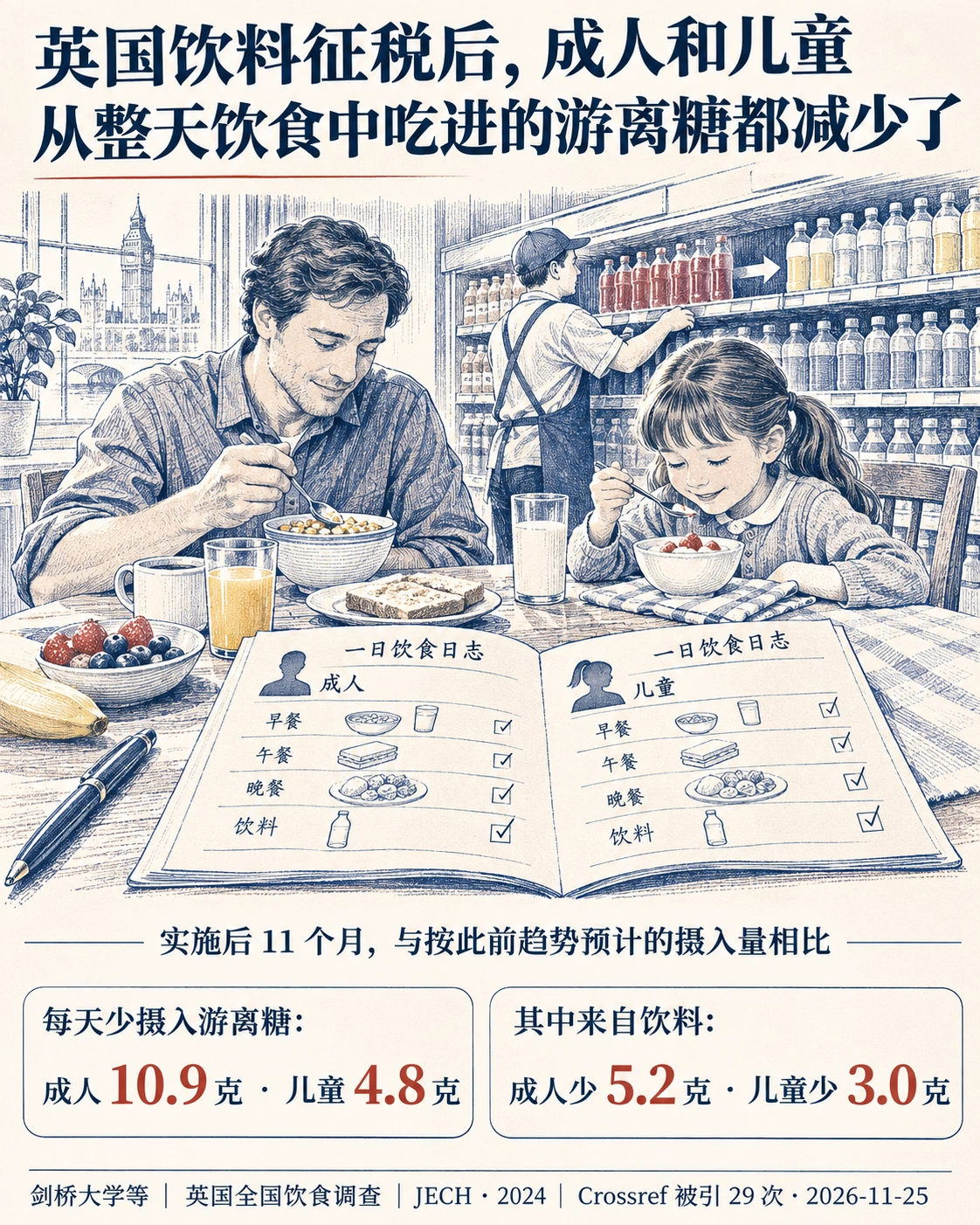
英国向软饮料生产商按含糖量分级征税。实施 11 个月后,与延续原有趋势的估计相比,成人平均每天少吃进 10.9 克游离糖,儿童少 4.8 克。
推荐阅读的理由
饮料销量只能回答买了什么。作者另取了居民的饮食记录,分别加总饮料中的游离糖和全天食物、饮料中的游离糖。两种加总方法都看到下降。游离糖包括加入食品的糖,以及蜂蜜、糖浆和果汁中本来就有的糖。
Estimated changes in free sugar consumption one year after the UK soft drinks industry levy came into force: controlled interrupted time series analysis of the National Diet and Nutrition Survey (2011-2019)
作者摘要 · 中文编译
背景 英国于 2016 年 3 月宣布、2018 年 4 月实施软饮料行业税,鼓励生产商降低饮料含糖量。这是首项从个人摄入量考察该税与游离糖消费变化的研究。
方法 作者用 2011 至 2019 年的受控中断时间序列,分析政策实施 11 个月后,全膳食及单独来自软饮料的游离糖摄入。全国饮食与营养调查提供了有全国代表性的成人样本 7,999 人和儿童样本 7,656 人(原文年龄口径分别为超过 18 岁及 1.5 至 19 岁)。研究比较实际观察与假定政策从未宣布、实施时的推算,模型用蛋白质摄入量作对照,并考虑邻近时点之间的相关性。
结果 考虑政策宣布前趋势后,儿童全天游离糖摄入平均每日少 4.8 克(95% 置信区间 0.6 至 9.1),成人少 10.9 克(7.8 至 13.9)。只计算饮料,儿童少 3.0 克(0.1 至 5.8),成人少 5.2 克(4.2 至 6.1)。研究期间游离糖占全天热量的比例有所下降,但与无政策情景的估计差异未达统计学显著。
结论 作者认为,行业税使成人与儿童从饮食中摄入的游离糖减少。游离糖占总热量的比例相对无税情景没有明确变化,可能因为减少游离糖的同时,总热量摄入也减少了。
展开英文原摘要收起英文原摘要The UK soft drinks industry levy (SDIL) was announced in March 2016 and implemented in April 2018, encouraging manufacturers to reduce the sugar content of soft drinks. This is the first study to investigate changes in individual-level consumption of free sugars in relation to the SDIL. We used controlled interrupted time series (2011–2019) to explore changes in the consumption of free sugars in the whole diet and from soft drinks alone 11 months after SDIL implementation in a nationally representative sample of adults (>18 years; n=7999) and children (1.5–19 years; n=7656) drawn from the UK National Diet and Nutrition Survey. Estimates were based on differences between observed data and a counterfactual scenario of no SDIL announcement/implementation. Models included protein consumption (control) and accounted for autocorrelation. Accounting for trends prior to the SDIL announcement, there were absolute reductions in the daily consumption of free sugars from the whole diet in children and adults of 4.8 g (95% CI 0.6 to 9.1) and 10.9 g (95% CI 7.8 to 13.9), respectively. Comparable reductions in free sugar consumption from drinks alone were 3.0 g (95% CI 0.1 to 5.8) and 5.2 g (95% CI 4.2 to 6.1). The percentage of total dietary energy from free sugars declined over the study period but was not significantly different from the counterfactual. The SDIL led to significant reductions in dietary free sugar consumption in children and adults. Energy from free sugar as a percentage of total energy did not change relative to the counterfactual, which could be due to simultaneous reductions in total energy intake associated with reductions in dietary free sugar.
Background · The UK soft drinks industry levy (SDIL) was announced in March 2016 and implemented in April 2018, encouraging manufacturers to reduce the sugar content of soft drinks. This is the first study to investigate changes in individual-level consumption of free sugars in relation to the SDIL.
Methods · We used controlled interrupted time series (2011–2019) to explore changes in the consumption of free sugars in the whole diet and from soft drinks alone 11 months after SDIL implementation in a nationally representative sample of adults (>18 years; n=7999) and children (1.5–19 years; n=7656) drawn from the UK National Diet and Nutrition Survey. Estimates were based on differences between observed data and a counterfactual scenario of no SDIL announcement/implementation. Models included protein consumption (control) and accounted for autocorrelation.
Results · Accounting for trends prior to the SDIL announcement, there were absolute reductions in the daily consumption of free sugars from the whole diet in children and adults of 4.8 g (95% CI 0.6 to 9.1) and 10.9 g (95% CI 7.8 to 13.9), respectively. Comparable reductions in free sugar consumption from drinks alone were 3.0 g (95% CI 0.1 to 5.8) and 5.2 g (95% CI 4.2 to 6.1). The percentage of total dietary energy from free sugars declined over the study period but was not significantly different from the counterfactual.
Conclusion · The SDIL led to significant reductions in dietary free sugar consumption in children and adults. Energy from free sugar as a percentage of total energy did not change relative to the counterfactual, which could be due to simultaneous reductions in total energy intake associated with reductions in dietary free sugar.
Nina Trivedy Rogers, Steven Cummins, Catrin P Jones, Oliver Mytton, Mike Rayner, Harry Rutter, Martin White, Jean Adams
© Author(s) (or their employer(s)) 2024. Re-use permitted under CC BY. Published by BMJ.
与未宣布、未实施税收的预计情形相比,每天少了多少糖?
| 来源 | 儿童 | 成人 |
|---|---|---|
| 全部食物和饮料 | 少 4.8 克(0.6 至 9.1) | 少 10.9 克(7.8 至 13.9) |
| 只计算软饮料 | 少 3.0 克(0.1 至 5.8) | 少 5.2 克(4.2 至 6.1) |
括号内为减少量的 95% 置信区间。 核对作者图表
作者的结论
作者认为,软饮料行业税与成人和儿童饮食中的游离糖摄入减少有关。游离糖供应的热量占全天热量的比例与无税情景没有明确差异,作者提出一种解释:全天摄入的总热量也可能同步下降。
研究团队与论文影响
剑桥大学等团队使用英国全国饮食与营养调查的多个年度样本,以政策宣布前趋势作为比较基准,并用蛋白质摄入量作对照。研究能看到居民吃下去的糖,涵盖饮料以外的食物。
Crossref 收录本文引用 29 次。
单篇与期刊指标核查于 。
原文与延伸阅读
引用这篇文章与反馈纠错
研象编辑部.英国饮料征税后,成人和儿童从整天饮食中吃进的游离糖都减少了[EB/OL].研象,2026-11-25.https://yanxiang.hk/papers/uk-drink-levy-free-sugars
发现数字、译文或出处有误,可以在邮件里指出相应段落,附上核对依据。