
电话里做活动计划或练正念,香港独居老人一年后的孤独评分低于日常聊天组
JAMA Network Open2026随机对照试验Crossref 记录被引 6 次
已经有人打电话,谈话内容还重要吗?
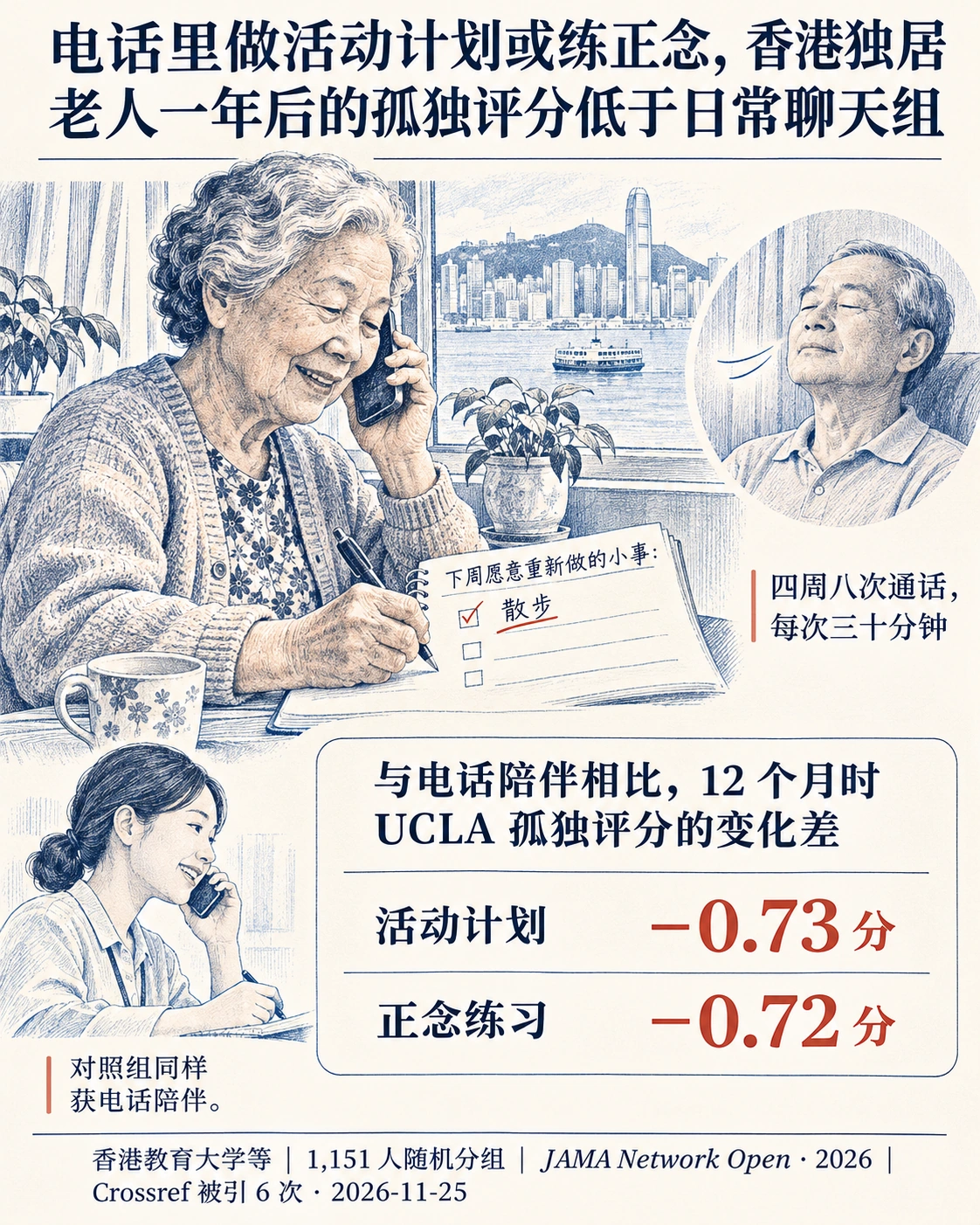
香港一项随机试验里,三组独居老人都有人打电话来。与电话陪伴相比,在电话中安排有意义的活动或练习正念的老人,一年后孤独评分的改善幅度略大。
推荐阅读的理由
对照组也有人关心和陪伴。另两组用同样长度的通话练具体技能:一种是选一件愿意做的事并安排时间,另一种是练习把注意力带回当下。这样的对照让研究者能估计,除了有人陪着聊天,练习本身还可能带来多少变化。
Behavioral Activation and Mindfulness Interventions in Reducing Loneliness and Improving Well-Being in Older Adults: The HEAL-HOA Randomized Clinical Trial
作者摘要 · 中文编译
背景与目的 晚年孤独是重要的公共卫生问题,干预的长期效果和作用途径仍待了解。研究评估由非专业辅导员通过电话提供行为激活和正念练习,在 12 个月内对孤独和幸福感的影响,并考察社会隔离是否在其中起部分作用。
设计 HEAL-HOA 是一项三组、评估者盲法的随机试验,开展于 2021 年 4 月 1 日至 2024 年 4 月 28 日。参与者年满 65 岁、独居、缺少数字接入,感到孤独且经济困难。团队从香港公共屋邨、社区中心、长者学苑及口耳相传招募,以 1∶1∶1 方案分配至电话行为激活、电话正念或电话陪伴(注意力对照)。各组均由受训辅导员在四周内提供八次电话,每次 30 分钟。
测量 主要结局是两种量表测得的孤独感,分别为 UCLA 和 De Jong Gierveld 量表。次要结局包括压力感、社会支持、睡眠质量、生活满意度、焦虑、抑郁症状和心理幸福感。研究在开始时和随访 1、3、6、12 个月评估,并分析社会隔离的中介作用。
结果 筛查 4,152 人后,1,151 人随机分组。平均年龄 76.6 岁(标准差 7.8);843 人(73.2%)为女性,965 人(83.8%)至少有一种慢性病。行为激活组 335 人,正念组 460 人,陪伴组 356 人。用线性混合模型按最初分组分析,与陪伴组相比,12 个月时行为激活组 UCLA 孤独评分变化差为 −0.73 分(95% 置信区间 −1.29 至 −0.16,P=0.01),另一量表为 −0.13 分(−0.23 至 −0.03,P=0.01);正念组 UCLA 量表为 −0.72 分(−1.24 至 −0.20,P=0.003)。睡眠质量、心理幸福感和生活满意度等次要结局也有显著改善。对两项干预,六个月时社会隔离的变化分别解释了行为激活组总效应的 0.13(13.5%)和正念组的 0.18(18.0%)。
结论 作者认为,通过电话实施的短程行为激活和正念干预,能在一年内持续减轻高风险老人的孤独并改善幸福感,部分作用可能经由社会隔离变化产生。今后应研究它们在香港以外的适用性和成本效果。注册号 ChiCTR2300072909。
展开英文原摘要收起英文原摘要Late-life loneliness is a serious public health concern, yet the long-term efficacy and mechanisms of interventions to alleviate it remain underexplored. To evaluate the 12-month effectiveness of lay counselor-delivered, telephone-based behavioral activation and mindfulness interventions in reducing loneliness and enhancing well-being among at-risk older adults and to examine whether social isolation mediates these effects. The Helping Alleviate Loneliness in Hong Kong Older Adults (HEAL-HOA) was a 3-arm, assessor-blinded randomized clinical trial conducted from April 1, 2021, to April 28, 2024. Eligible participants 65 years or older who were living alone, digitally excluded, lonely, and experiencing financial hardship were recruited from public housing estates, community centers, academies for older adults, and word of mouth. Participants were randomized 1:1:1 to receive telephone-delivered behavioral activation (Tele-BA), telephone-delivered mindfulness (Tele-MF), or telephone-delivered befriending (Tele-BF [attention control]). Participants received eight 30-minute sessions delivered by trained lay counselors via telephone for 4 weeks. The primary outcome was loneliness, measured using the UCLA Loneliness Scale (UCLA-LS) and the De Jong Gierveld Loneliness Scale (DJGL). Secondary outcomes included perceived stress, social support, sleep quality, life satisfaction, anxiety, depressive symptoms, and psychological well-being. Social isolation was examined as a mediator. Outcomes were assessed at baseline and at 1, 3, 6, and 12 months of follow-up. Of 4152 individuals screened, 1151 participants (mean [SD] age, 76.6 [7.8] years; 843 [73.2%] female; 965 [83.8%] with ≥1 chronic illness) were randomized (Tele-BA, 335 [29.1%]; Tele-MF, 460 [40.0%]; Tele-BF, 356 [30.9%]). Intention-to-treat analyses using linear mixed-effects models showed significant between-group changes in loneliness at 12 months for Tele-BA (UCLA-LS: mean difference [MD], −0.73; 95% CI, −1.29 to −0.16; P = .01; DJGL: MD, −0.13; 95% CI, −0.23 to −0.03; P = .01) and Tele-MF (UCLA-LS: MD, −0.72; 95% CI, −1.24 to −0.20; P = .003) compared with Tele-BF. Secondary outcomes, including sleep quality, psychological well-being, and life satisfaction, also improved significantly. Social isolation at 6 months partially mediated the effect on loneliness (UCLA-LS) for both interventions at 12 months (accounting for 0.13 [13.5%] and 0.18 [18.0%] of the total effects for Tele-BA and Tele-MF, respectively). In this randomized clinical trial, brief telephone-delivered behavioral activation and mindfulness interventions by lay counselors sustainably reduced loneliness and enhanced well-being during 12 months in at-risk older adults, with social isolation as a partial mediator. These scalable interventions offered effective solutions for combating late-life loneliness. Future research should investigate the applicability of these interventions outside the Hong Kong context as well as their cost-effectiveness. Identifier: ChiCTR2300072909
Importance · Late-life loneliness is a serious public health concern, yet the long-term efficacy and mechanisms of interventions to alleviate it remain underexplored.
Objective · To evaluate the 12-month effectiveness of lay counselor-delivered, telephone-based behavioral activation and mindfulness interventions in reducing loneliness and enhancing well-being among at-risk older adults and to examine whether social isolation mediates these effects.
Design, Setting, and Participants · The Helping Alleviate Loneliness in Hong Kong Older Adults (HEAL-HOA) was a 3-arm, assessor-blinded randomized clinical trial conducted from April 1, 2021, to April 28, 2024. Eligible participants 65 years or older who were living alone, digitally excluded, lonely, and experiencing financial hardship were recruited from public housing estates, community centers, academies for older adults, and word of mouth. Participants were randomized 1:1:1 to receive telephone-delivered behavioral activation (Tele-BA), telephone-delivered mindfulness (Tele-MF), or telephone-delivered befriending (Tele-BF [attention control]).
Interventions · Participants received eight 30-minute sessions delivered by trained lay counselors via telephone for 4 weeks.
Main Outcomes and Measures · The primary outcome was loneliness, measured using the UCLA Loneliness Scale (UCLA-LS) and the De Jong Gierveld Loneliness Scale (DJGL). Secondary outcomes included perceived stress, social support, sleep quality, life satisfaction, anxiety, depressive symptoms, and psychological well-being. Social isolation was examined as a mediator. Outcomes were assessed at baseline and at 1, 3, 6, and 12 months of follow-up.
Results · Of 4152 individuals screened, 1151 participants (mean [SD] age, 76.6 [7.8] years; 843 [73.2%] female; 965 [83.8%] with ≥1 chronic illness) were randomized (Tele-BA, 335 [29.1%]; Tele-MF, 460 [40.0%]; Tele-BF, 356 [30.9%]). Intention-to-treat analyses using linear mixed-effects models showed significant between-group changes in loneliness at 12 months for Tele-BA (UCLA-LS: mean difference [MD], −0.73; 95% CI, −1.29 to −0.16; P = .01; DJGL: MD, −0.13; 95% CI, −0.23 to −0.03; P = .01) and Tele-MF (UCLA-LS: MD, −0.72; 95% CI, −1.24 to −0.20; P = .003) compared with Tele-BF. Secondary outcomes, including sleep quality, psychological well-being, and life satisfaction, also improved significantly. Social isolation at 6 months partially mediated the effect on loneliness (UCLA-LS) for both interventions at 12 months (accounting for 0.13 [13.5%] and 0.18 [18.0%] of the total effects for Tele-BA and Tele-MF, respectively).
Conclusions and Relevance · In this randomized clinical trial, brief telephone-delivered behavioral activation and mindfulness interventions by lay counselors sustainably reduced loneliness and enhanced well-being during 12 months in at-risk older adults, with social isolation as a partial mediator. These scalable interventions offered effective solutions for combating late-life loneliness. Future research should investigate the applicability of these interventions outside the Hong Kong context as well as their cost-effectiveness.
Trial Registration · Identifier: ChiCTR2300072909
Vivien Foong Yee Tang, Da Jiang, Jojo Yan Yan Kwok, Dannii Yuen-Lan Yeung, Namkee G Choi, Lisa M Warner, Rainbow Tin Hung Ho, Kee-Lee Chou
Copyright 2026 Tang VFY et al. JAMA Network Open.
两种电话干预与电话陪伴相比,孤独感差多少?
| 量表上的变化差 | 活动计划 | 正念练习 |
|---|---|---|
| UCLA 孤独量表 | −0.73 分(−1.29 至 −0.16) | −0.72 分(−1.24 至 −0.20) |
| De Jong Gierveld 孤独量表 | −0.13 分(−0.23 至 −0.03) | −0.03 分(−0.13 至 0.06) |
按最初分组分析,括号内为 95% 置信区间。两种量表的计分范围不同。 核对作者图表
作者的结论
作者认为,经培训的非专业辅导员可以用短程电话干预缓解高风险老人的孤独,部分效果可能与社会隔离减少有关。研究也提出两个实际问题:在香港以外是否同样适用,以及推广需要多少成本。
研究团队与论文影响
香港教育大学等团队通过公共屋邨、社区中心、长者学苑和口耳相传招募参与者。入组者独居、缺少数字接入并有经济困难。电话让平时难以上网求助的人也能参加。
Crossref 收录本文引用 6 次。JAMA Network Open 在 2025 年度回顾中列出的期刊影响因子为 9.7。
单篇与期刊指标核查于 。
原文与延伸阅读
引用这篇文章与反馈纠错
研象编辑部.电话里做活动计划或练正念,香港独居老人一年后的孤独评分低于日常聊天组[EB/OL].研象,2026-11-25.https://yanxiang.hk/papers/hong-kong-telephone-loneliness
发现数字、译文或出处有误,可以在邮件里指出相应段落,附上核对依据。