
老年人的社会联系在四年里进一步减少,随后死亡、失能和痴呆的风险都较高
JAMA Network Open2024队列研究Crossref 记录被引 104 次
同一个人四年间失去了多少联系,一次问卷看不见。
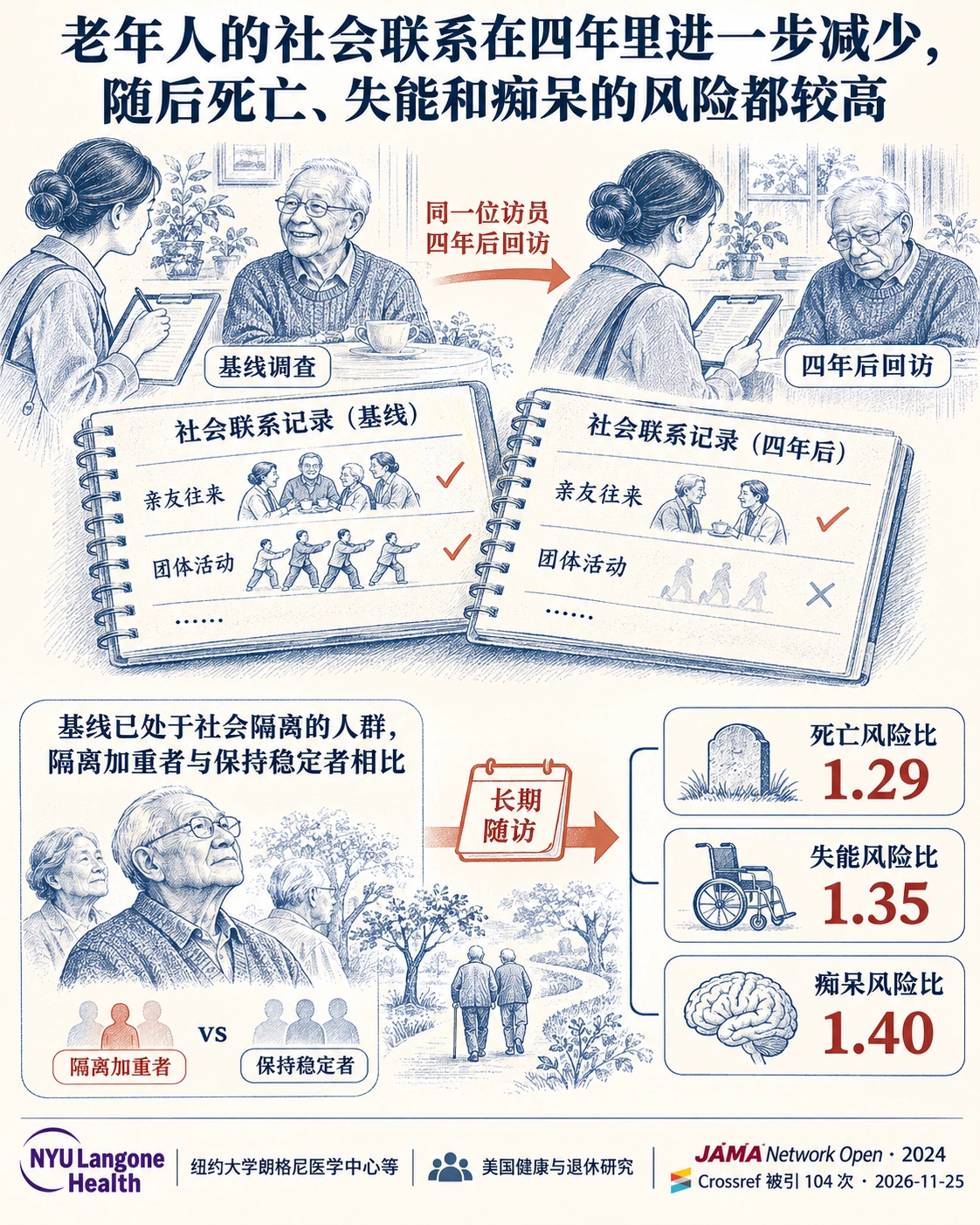
同一批美国中老年人相隔四年两次报告社会联系。相比隔离程度保持稳定的人,隔离加重者随后死亡、失能和痴呆的风险都较高,无论他们起初是否已与社会疏离。
推荐阅读的理由
一个人原本就少参加活动,另一个人过去常与朋友来往、近几年却逐渐断了联系。若只问今天有多少来往,两人的答案可能一样。研究将两次调查配对,才能从起点相近的人中挑出社会联系继续变少的一组,观察他们后来的健康状况。
Social Isolation Changes and Long-Term Outcomes Among Older Adults
作者摘要 · 中文编译
背景与目的 单次测得的社会隔离与不良健康结局之间的关系已有较多证据,但社会隔离的变化意味着什么,尚不清楚。作者考察社会隔离变化与死亡、身体及认知功能、心血管病和中风的关系。
设计 纳入美国健康与退休研究 2006 至 2020 年符合条件的 13,649 人。用 Steptoe 五项社会隔离指数比较基线与四年后的状态,先按基线是否隔离分层,再把变化分为减轻、稳定及加重。考察死亡、自报日常活动依赖,以及借助 Medicare 记录确认的阿尔茨海默病及相关痴呆、心血管病和中风。计算发生率,并用加权生存模型调整混杂因素。
结果 全队列基线平均年龄 65.3 岁(标准差 9.5),8,011 人(58.7%)为女性。在基线已隔离者中,隔离加重一组有 693 人,死亡率为每千人年 68.19(95% 置信区间 60.89 至 76.36);稳定一组有 1,796 人,为 44.02(40.47 至 47.88);减轻一组有 2,067 人,为 37.77(34.73 至 41.09)。加重与稳定相比,死亡、失能和痴呆的调整后风险比分别为 1.29(1.09 至 1.51)、1.35(1.09 至 1.67)、1.40(1.02 至 1.93)。基线未隔离者也见到相近的总体模式。
结论 无论起初是否隔离,隔离程度加重均与随后死亡、失能及痴呆风险上升相关。作者强调了防止中老年人社会隔离加重的重要性。
展开英文原摘要收起英文原摘要While the association between cross-sectional measures of social isolation and adverse health outcomes is well established, less is known about the association between changes in social isolation and health outcomes. To assess changes of social isolation and mortality, physical function, cognitive function, cardiovascular disease (CVD), and stroke. In a cohort design, social isolation changes in 4 years and subsequent risk of mortality and other outcomes were assessed using the 13 649 eligible Health and Retirement Study (HRS) respondents from the 2006 to 2020 waves. Data were analyzed from October 11, 2023, to April 26, 2024. The main exposure was the change in social isolation measured by the Steptoe 5-item Social Isolation Index from the initial assessment to a second assessment conducted 4 years later. Participants were classified into decreased isolation, stable, or increased isolation groups, stratified by their baseline isolation status. The primary outcomes were mortality, self-reported dependencies in activities of daily living, Alzheimer disease and Alzheimer disease–related dementia, CVD, and stroke. Dementia, CVD, and stroke were assessed using HRS-linked Medicare records. Incidence rates (IRs) of each group were estimated and a Cox proportional hazards regression model was used, with inverse-probability treatment weighting to adjust for confounders. Among 13 649 participants (mean [SD] age at baseline, 65.3 [9.5] years; 8011 [58.7%] women) isolated at baseline, those with increased isolation had higher mortality (n = 693; IR = 68.19; 95% CI, 60.89-76.36 per 1000 person-years) than those who were stable (n = 1796; IR = 44.02; 95% CI, 40.47-47.88 person-years) or had decreased isolation (n = 2067; IR = 37.77; 95% CI, 34.73-41.09 person-years) isolation. Increased isolation was associated with higher risks of mortality (adjusted hazard ratio [AHR], 1.29; 95% CI, 1.09-1.51), disability (AHR, 1.35; 95% CI, 1.09-1.67), and dementia (AHR, 1.40; 95% CI, 1.02-1.93) compared with stable isolation. Similar findings were observed among socially nonisolated participants at baseline. In this cohort study, increased isolation was associated with elevated risks of mortality, disability, and dementia, irrespective of baseline isolation status. These results underscore the importance of interventions targeting the prevention of increased isolation among older adults to mitigate its adverse effects on mortality, as well as physical and cognitive function decline.
Importance · While the association between cross-sectional measures of social isolation and adverse health outcomes is well established, less is known about the association between changes in social isolation and health outcomes.
Objective · To assess changes of social isolation and mortality, physical function, cognitive function, cardiovascular disease (CVD), and stroke.
Design, Setting, and Participants · In a cohort design, social isolation changes in 4 years and subsequent risk of mortality and other outcomes were assessed using the 13 649 eligible Health and Retirement Study (HRS) respondents from the 2006 to 2020 waves. Data were analyzed from October 11, 2023, to April 26, 2024.
Exposure · The main exposure was the change in social isolation measured by the Steptoe 5-item Social Isolation Index from the initial assessment to a second assessment conducted 4 years later. Participants were classified into decreased isolation, stable, or increased isolation groups, stratified by their baseline isolation status.
Main Outcomes and Measures · The primary outcomes were mortality, self-reported dependencies in activities of daily living, Alzheimer disease and Alzheimer disease–related dementia, CVD, and stroke. Dementia, CVD, and stroke were assessed using HRS-linked Medicare records. Incidence rates (IRs) of each group were estimated and a Cox proportional hazards regression model was used, with inverse-probability treatment weighting to adjust for confounders.
Results · Among 13 649 participants (mean [SD] age at baseline, 65.3 [9.5] years; 8011 [58.7%] women) isolated at baseline, those with increased isolation had higher mortality (n = 693; IR = 68.19; 95% CI, 60.89-76.36 per 1000 person-years) than those who were stable (n = 1796; IR = 44.02; 95% CI, 40.47-47.88 person-years) or had decreased isolation (n = 2067; IR = 37.77; 95% CI, 34.73-41.09 person-years) isolation. Increased isolation was associated with higher risks of mortality (adjusted hazard ratio [AHR], 1.29; 95% CI, 1.09-1.51), disability (AHR, 1.35; 95% CI, 1.09-1.67), and dementia (AHR, 1.40; 95% CI, 1.02-1.93) compared with stable isolation. Similar findings were observed among socially nonisolated participants at baseline.
Conclusions and Relevance · In this cohort study, increased isolation was associated with elevated risks of mortality, disability, and dementia, irrespective of baseline isolation status. These results underscore the importance of interventions targeting the prevention of increased isolation among older adults to mitigate its adverse effects on mortality, as well as physical and cognitive function decline.
Chen Lyu, Katherine Siu, Ian Xu, Iman Osman, Judy Zhong
Copyright 2024 Lyu C et al. JAMA Network Open.
基线已隔离的人,隔离加重者和稳定者有何不同?
| 随访结局 | 调整后风险比(95% 置信区间) |
|---|---|
| 死亡 | 1.29(1.09 至 1.51) |
| 失能 | 1.35(1.09 至 1.67) |
| 痴呆 | 1.40(1.02 至 1.93) |
隔离程度由生活安排、亲友往来和社会活动等五项反映;指标描述社会联系,和主观孤独感有区别。 核对作者图表
作者的结论
作者认为,社会隔离继续加重,与死亡、失能和痴呆风险较高相关,值得研究怎样防止中老年人的社会联系继续流失。研究呈现了随后发生的健康差异,不能确定单靠增加接触便能消除这些差异。
研究团队与论文影响
纽约大学朗格尼医学中心等分析美国健康与退休研究 2006 至 2020 年调查,并把问卷与 Medicare 医疗记录连接起来,全队列 13,649 人。
Crossref 收录本文引用 104 次。JAMA Network Open 在 2025 年度回顾中列出的期刊影响因子为 9.7。
单篇与期刊指标核查于 。
原文与延伸阅读
引用这篇文章与反馈纠错
研象编辑部.老年人的社会联系在四年里进一步减少,随后死亡、失能和痴呆的风险都较高[EB/OL].研象,2026-11-25.https://yanxiang.hk/papers/social-isolation-change-aging
发现数字、译文或出处有误,可以在邮件里指出相应段落,附上核对依据。