
孕期血中胎盘生长因子很低,能提示一批可能需要提前分娩的人
JAMA Network Open2024诊断准确性研究Crossref 记录被引 33 次
同一个 57 人,为什么要读两次?
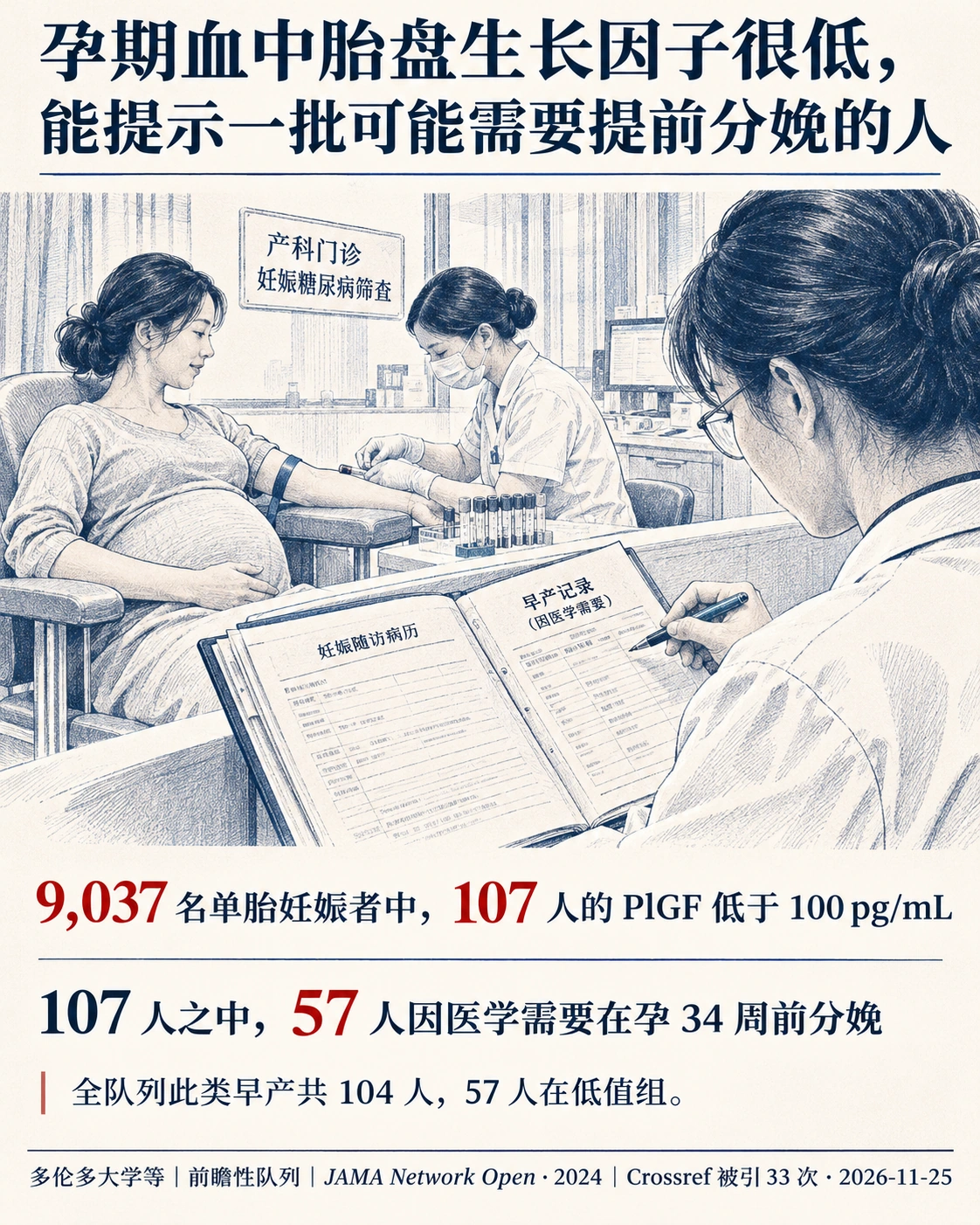
在多伦多一项 9,037 人的孕期队列中,有 107 人血中胎盘生长因子很低,其中 57 人后来因医学需要在孕 34 周前分娩。
推荐阅读的理由
从检验室看,107 名低值者中有 57 人后来因医学需要很早分娩。从产房倒过来看,全院队列共有 104 例这样的分娩,其中 57 人此前测出低值。前一个分母关系到怎样解释一张阳性化验单,后一个关系到这项检测能找出多少高风险孕妇。
Midpregnancy Placental Growth Factor Screening and Early Preterm Birth
作者摘要 · 中文编译
目的 孕 34 周之前出生的婴儿面临很高的健康风险。目前没有通用筛查策略,使有效干预难以定向提供。研究评估在孕中期筛查胎盘生长因子(PlGF)能否识别早期早产高风险妊娠。
设计 2020 至 2023 年,一家城市三级医疗中心前瞻性纳入由产科医生、家庭医生或助产士提供普遍可及产前照护的单胎妊娠者。参加者在常规妊娠糖尿病筛查时(通常孕 24 至 28 周)测 PlGF。数据于 2024 年 1 至 5 月分析。重点比较低于 100 pg/mL 者。主要结局为所有孕 34 周前分娩,次要结局包括因医学需要提前分娩、自然早产、子痫前期、死胎和小于胎龄儿。
结果 9,037 名孕妇中有 156 人(1.7%)在孕 34 周前分娩,52 人为自然早产,104 人因医学需要提前分娩。PlGF 区分有无早期早产的曲线下面积为 0.80(95% 置信区间 0.75 至 0.85)。低 PlGF 的阳性似然比为 79.400(53.434 至 115.137),阴性似然比为 0.606(0.494 至 0.742),特异度为 99.5%(99.3% 至 99.6%),阴性预测值为 98.9%(98.8% 至 99.1%)。低于 100 pg/mL 者从检测到分娩的时间较短,超过一半在检测后 50 天内分娩。低值者占后来发生死胎者的三成以上(校正相对风险 36.78,95% 置信区间 18.63 至 72.60),占因医学需要在 34 周前分娩者的一半以上(92.11,64.83 至 130.87)。对后一结局的曲线下面积为 0.90(0.85 至 0.94)。
结论 在常规妊娠糖尿病筛查时发现 PlGF 很低,可能是识别早期早产风险的有力工具,尤以因医学需要提前分娩为甚。将三级医疗资源更有针对性地投向这组人,可能改善母婴结局。
展开英文原摘要收起英文原摘要Early preterm birth (ie, at less than 34 weeks’ gestation) confers a high risk for adverse health outcomes, yet no universal screening strategy exists, preventing targeted delivery of effective interventions. To evaluate the ability of midpregnancy placental growth factor (PlGF) screening to identify pregnancies at highest risk for early preterm birth. This prospective cohort study was conducted at an urban, tertiary care center from 2020 to 2023. Participants were unselected, pregnant people with singleton pregnancies, receiving universal-access prenatal care from obstetricians, family physicians, or midwives, who underwent a PlGF test at the time of routine gestational diabetes screening, typically at 24 to 28 weeks’ gestation. Data were analyzed from January to May 2024. PlGF level less than 100 pg/mL at the time of gestational diabetes screen. The primary outcome was all early preterm birth, defined as less than 34 weeks’ gestation. Secondary outcomes included iatrogenic preterm birth, spontaneous preterm birth, preeclampsia, stillbirth, and small-for-gestational-age birth weight. Among 9037 unique pregnant individuals, 156 (1.7%) experienced early preterm birth (52 spontaneous births; 104 iatrogenic births). The area under the curve (AUC) for PlGF and early preterm birth was 0.80 (95% CI, 0.75-0.85). Low PlGF level was associated with early preterm birth (positive likelihood ratio [LR], 79.400 [95% CI, 53.434-115.137]; negative LR, 0.606 [95% CI, 0.494-0.742]; specificity, 99.5% [95% CI, 99.3%-99.6%]; negative predictive value, 98.9% [95% CI, 98.8%-99.1%]). Time to birth from PlGF test was significantly reduced among patients with a PlGF level less than 100 pg/mL, among whom more than 50% delivered within 50 days of testing. Individuals with a low PlGF level made up more than 30% of subsequent stillbirths (aRR, 36.78 [95% CI, 18.63-72.60]) and more than half of patients requiring iatrogenic early preterm birth (aRR, 92.11 [95% CI, 64.83-130.87]). The AUC for iatrogenic early preterm birth was 0.90 (95% CI, 0.85-0.94). These findings suggest that low PlGF level (<100 pg/mL), identified at the time of routine gestational diabetes screening, may be a powerful clinical tool to identify pregnant people at risk of early preterm birth, especially in iatrogenic births. Strategic redirection of tertiary health care resources to this high-risk group could improve maternal and perinatal outcomes.
Importance · Early preterm birth (ie, at less than 34 weeks’ gestation) confers a high risk for adverse health outcomes, yet no universal screening strategy exists, preventing targeted delivery of effective interventions.
Objective · To evaluate the ability of midpregnancy placental growth factor (PlGF) screening to identify pregnancies at highest risk for early preterm birth.
Design, Setting, and Participants · This prospective cohort study was conducted at an urban, tertiary care center from 2020 to 2023. Participants were unselected, pregnant people with singleton pregnancies, receiving universal-access prenatal care from obstetricians, family physicians, or midwives, who underwent a PlGF test at the time of routine gestational diabetes screening, typically at 24 to 28 weeks’ gestation. Data were analyzed from January to May 2024.
Exposure · PlGF level less than 100 pg/mL at the time of gestational diabetes screen.
Main Outcomes and Measures · The primary outcome was all early preterm birth, defined as less than 34 weeks’ gestation. Secondary outcomes included iatrogenic preterm birth, spontaneous preterm birth, preeclampsia, stillbirth, and small-for-gestational-age birth weight.
Results · Among 9037 unique pregnant individuals, 156 (1.7%) experienced early preterm birth (52 spontaneous births; 104 iatrogenic births). The area under the curve (AUC) for PlGF and early preterm birth was 0.80 (95% CI, 0.75-0.85). Low PlGF level was associated with early preterm birth (positive likelihood ratio [LR], 79.400 [95% CI, 53.434-115.137]; negative LR, 0.606 [95% CI, 0.494-0.742]; specificity, 99.5% [95% CI, 99.3%-99.6%]; negative predictive value, 98.9% [95% CI, 98.8%-99.1%]). Time to birth from PlGF test was significantly reduced among patients with a PlGF level less than 100 pg/mL, among whom more than 50% delivered within 50 days of testing. Individuals with a low PlGF level made up more than 30% of subsequent stillbirths (aRR, 36.78 [95% CI, 18.63-72.60]) and more than half of patients requiring iatrogenic early preterm birth (aRR, 92.11 [95% CI, 64.83-130.87]). The AUC for iatrogenic early preterm birth was 0.90 (95% CI, 0.85-0.94).
Conclusions and Relevance · These findings suggest that low PlGF level (<100 pg/mL), identified at the time of routine gestational diabetes screening, may be a powerful clinical tool to identify pregnant people at risk of early preterm birth, especially in iatrogenic births. Strategic redirection of tertiary health care resources to this high-risk group could improve maternal and perinatal outcomes.
Rachel A Gladstone, Sumaiya Ahmed, Ella Huszti, Kelsey McLaughlin, John W Snelgrove, Jennifer Taher, Sebastian R Hobson, Rory C Windrim, Kellie E Murphy, John C Kingdom
Copyright 2024 Gladstone RA et al. JAMA Network Open.
同一批孕妇中,低值和其他结果分别对应多少早产?
| 孕 34 周前分娩 | PlGF 低于 100(107 人) | PlGF 至少 100(8,930 人) |
|---|---|---|
| 因医学需要提前分娩 | 57 人(53.3%) | 47 人(0.5%) |
| 自然早产 | 5 人(4.7%) | 47 人(0.5%) |
浓度单位为 pg/mL,人数及比例据表 3。两类早产合计 156 例。 核对作者图表
作者的结论
作者认为,在常规妊娠糖尿病筛查时加测胎盘生长因子,可能有助于识别早期早产风险高的人,尤其是因母体或胎儿状况而需要提前分娩的人。把专科资源更有针对性地提供给这组人,能否改善结局,尚需检验。
研究团队与论文影响
多伦多大学母胎医学团队在一家城市三级医疗中心前瞻性纳入常规产检的单胎妊娠者。取血时并不知道后来谁会早产。作者区分了自然发动的早产和医疗团队因病情需要而决定的提前分娩。
Crossref 收录本文引用 33 次。JAMA Network Open 在 2025 年度回顾中列出的期刊影响因子为 9.7。
单篇与期刊指标核查于 。
原文与延伸阅读
引用这篇文章与反馈纠错
研象编辑部.孕期血中胎盘生长因子很低,能提示一批可能需要提前分娩的人[EB/OL].研象,2026-11-25.https://yanxiang.hk/papers/placental-growth-factor-preterm-screen
发现数字、译文或出处有误,可以在邮件里指出相应段落,附上核对依据。