
AI 辅助两名医生读乳腺片,每筛查一万人多检出约十例癌
Nature Medicine2025观察性研究研究团队与论文影响
医生和 AI 看到了对方漏掉的什么?
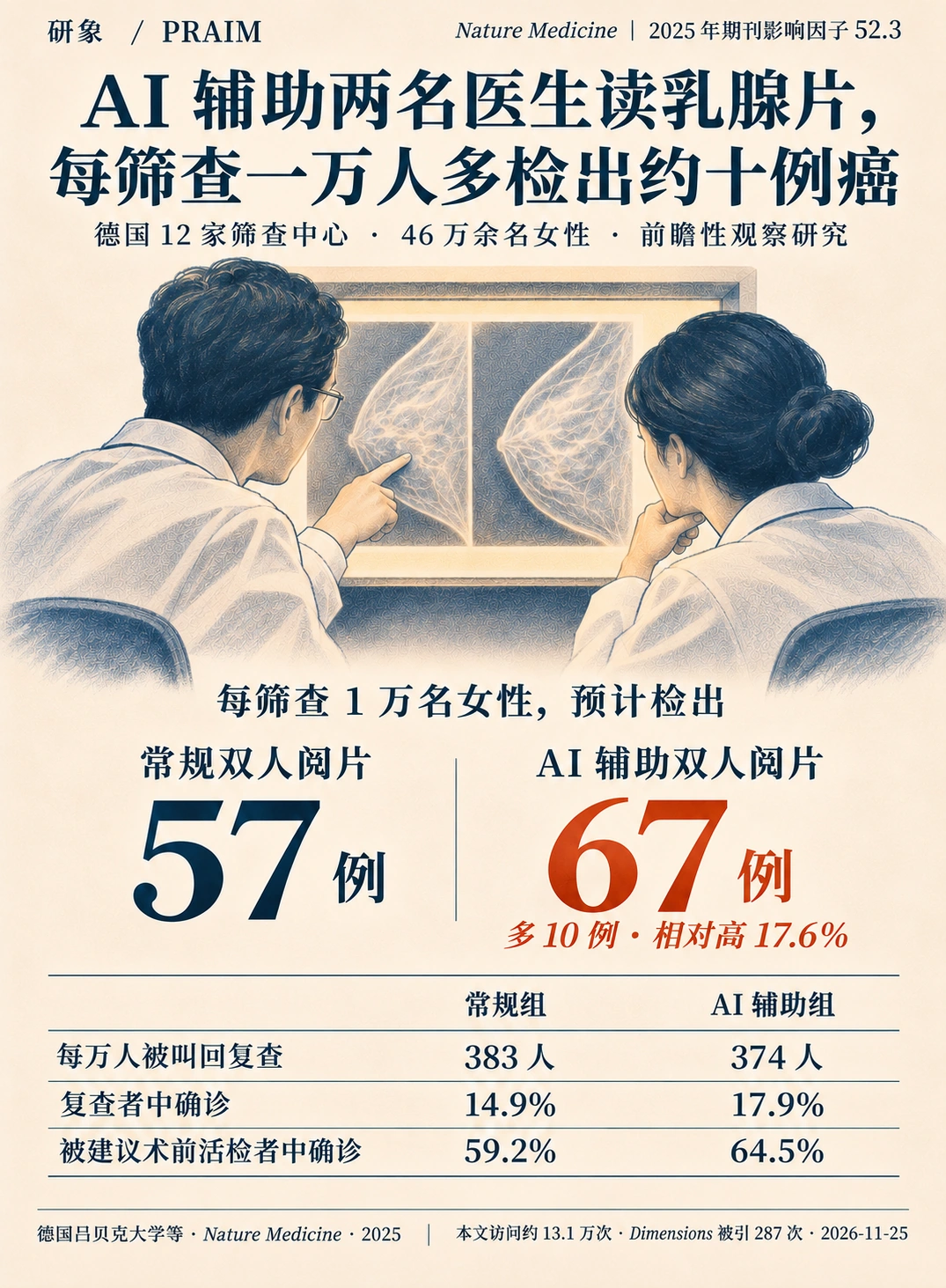
在德国的乳腺筛查中,两名医生有 AI 辅助时,每筛查一万名女性约多检出十例癌。被叫回复查的人数相近,复查后确诊的比例更高。
推荐阅读的理由
原文展示了两张真实乳腺片。一张起初被两位医生判为正常,AI 提醒他们回看右乳一小块纹理扭曲的区域,后来证实为浸润癌。另一张被 AI 标为正常,两位医生却都注意到了肿块,复查也证实为浸润癌。整个研究中,医生采纳软件提醒后发现了 204 例癌,也在软件标为正常的片中检出了 20 例。
Nationwide real-world implementation of AI for cancer detection in population-based mammography screening
作者摘要 · 中文编译
此前对乳腺 X 线片的回顾性研究显示,人工智能(AI)有望帮助筛查,但前瞻性研究仍然很少。PRAIM 是一项多中心观察性实施研究,采用非劣效设计,在真实的筛查工作中比较 AI 辅助双人阅片与常规双人阅片。参加者是在德国 12 个中心接受有组织乳腺 X 线筛查的 50 至 69 岁女性。放射科医生自行选择是否使用 AI。2021 年 7 月至 2023 年 2 月,119 名放射科医生为 463,094 名女性完成筛查,其中 260,739 人的阅片使用了 AI。
AI 辅助组每筛查 1,000 人检出 6.7 例乳腺癌,对照组为 5.7 例。AI 辅助组相对高出 17.6%(95% 置信区间为 +5.7% 至 +30.8%),差异有统计学意义。AI 辅助组每 1,000 人中有 37.4 人被叫回来做进一步检查,对照组为 38.3 人。AI 辅助组的召回率在数值上略低,达到了预设的非劣效标准(相对差异为 −2.5%,95% 置信区间为 −6.5% 至 +1.7%)。
在被召回的女性中,最终确诊乳腺癌的估计比例,AI 辅助组为 17.9%,对照组为 14.9%。在被建议接受术前活检的女性中,这一比例分别为 64.5% 和 59.2%。这两组比例分别是召回和活检的阳性预测值(PPV)。
与常规双人阅片相比,AI 辅助双人阅片与较高的乳腺癌检出率相关,同时未对召回率产生不利影响。作者认为,这一结果有力地提示 AI 可以改善乳腺 X 线筛查的表现。
展开英文原摘要收起英文原摘要Artificial intelligence (AI) in mammography screening has shown promise in retrospective evaluations, but few prospective studies exist. PRAIM is an observational, multicenter, real-world, noninferiority, implementation study comparing the performance of AI-supported double reading to standard double reading (without AI) among women (50–69 years old) undergoing organized mammography screening at 12 sites in Germany. Radiologists in this study voluntarily chose whether to use the AI system. From July 2021 to February 2023, a total of 463,094 women were screened (260,739 with AI support) by 119 radiologists. Radiologists in the AI-supported screening group achieved a breast cancer detection rate of 6.7 per 1,000, which was 17.6% (95% confidence interval: +5.7%, +30.8%) higher than and statistically superior to the rate (5.7 per 1,000) achieved in the control group. The recall rate in the AI group was 37.4 per 1,000, which was lower than and noninferior to that (38.3 per 1,000) in the control group (percentage difference: −2.5% (−6.5%, +1.7%)). The positive predictive value (PPV) of recall was 17.9% in the AI group compared to 14.9% in the control group. The PPV of biopsy was 64.5% in the AI group versus 59.2% in the control group. Compared to standard double reading, AI-supported double reading was associated with a higher breast cancer detection rate without negatively affecting the recall rate, strongly indicating that AI can improve mammography screening metrics.
Artificial intelligence (AI) in mammography screening has shown promise in retrospective evaluations, but few prospective studies exist. PRAIM is an observational, multicenter, real-world, noninferiority, implementation study comparing the performance of AI-supported double reading to standard double reading (without AI) among women (50–69 years old) undergoing organized mammography screening at 12 sites in Germany. Radiologists in this study voluntarily chose whether to use the AI system. From July 2021 to February 2023, a total of 463,094 women were screened (260,739 with AI support) by 119 radiologists. Radiologists in the AI-supported screening group achieved a breast cancer detection rate of 6.7 per 1,000, which was 17.6% (95% confidence interval: +5.7%, +30.8%) higher than and statistically superior to the rate (5.7 per 1,000) achieved in the control group. The recall rate in the AI group was 37.4 per 1,000, which was lower than and noninferior to that (38.3 per 1,000) in the control group (percentage difference: −2.5% (−6.5%, +1.7%)). The positive predictive value (PPV) of recall was 17.9% in the AI group compared to 14.9% in the control group. The PPV of biopsy was 64.5% in the AI group versus 59.2% in the control group. Compared to standard double reading, AI-supported double reading was associated with a higher breast cancer detection rate without negatively affecting the recall rate, strongly indicating that AI can improve mammography screening metrics.
Nora Eisemann, Stefan Bunk, Trasias Mukama, Hannah Baltus, Susanne A Elsner, Timo Gomille, Gerold Hecht, Sylvia Heywang-Köbrunner, Regine Rathmann, Katja Siegmann-Luz, Thilo Töllner, Toni Werner Vomweg, Christian Leibig, Alexander Katalinic
© The Author(s) 2025
在同样数量的受检女性中,最终发现多少癌?
| 指标(校正估计) | 常规双人阅片 | AI 辅助双人阅片 |
|---|---|---|
| 每千名女性检出乳腺癌 | 5.7 例 | 6.7 例 |
| 每千名女性被叫回复查 | 38.3 人 | 37.4 人 |
| 复查者中确诊乳腺癌 | 14.9% | 17.9% |
| 被建议术前活检者中确诊 | 59.2% | 64.5% |
据表 3。检出率相对高 17.6%(95% 置信区间 5.7% 至 30.8%),召回率的相对差异为 −2.5%(−6.5% 至 1.7%)。 核对作者图表
作者的结论
作者认为,对两名医生的常规阅片增加 AI 辅助,有望改善乳腺癌筛查。辅助组的癌症检出率较高,召回率达到作者预设的非劣效标准。被叫回复查或被建议接受活检的人中,确诊比例也更高。两轮筛查之间才确诊的癌会不会减少,还要看后续随访。
研究团队与论文影响
德国吕贝克大学的 Nora Eisemann 等与全国 12 家筛查中心合作。119 名放射科医生在日常工作中自行决定是否使用 AI。研究团队记录了 46 万余名女性的筛查,并对两组病例和读片组合的差异作了校正。软件开发商 Vara 提供资助,并参与研究设计、数据收集与解释及写作。
出版商统计本文访问约 13.1 万次,Dimensions 收录引用 287 次。Nature Medicine 的 2025 年期刊影响因子为 52.3。
单篇与期刊指标核查于 。
原文与延伸阅读
引用这篇文章与反馈纠错
研象编辑部.AI 辅助两名医生读乳腺片,每筛查一万人多检出约十例癌[EB/OL].研象,2026-11-25.https://yanxiang.hk/papers/praim
发现数字、译文或出处有误,可以在邮件里指出相应段落,附上核对依据。
两篇对读
德国 PRAIM 数的是这一轮筛查多查出多少癌症,瑞典 MASAI 追踪的是两次筛查之间还有多少人确诊。把两篇连起来,才能分清当场多发现病例和后来少出现间期癌这两个问题。
AI 辅助筛查更灵敏,间期癌发生率达到非劣效标准