
提前约好门诊并发提醒,产后四个月内看过家庭医生的人更多
JAMA Network Open2024随机对照试验Crossref 记录被引 30 次
同样有家庭医生,为什么还会错过产后随访?
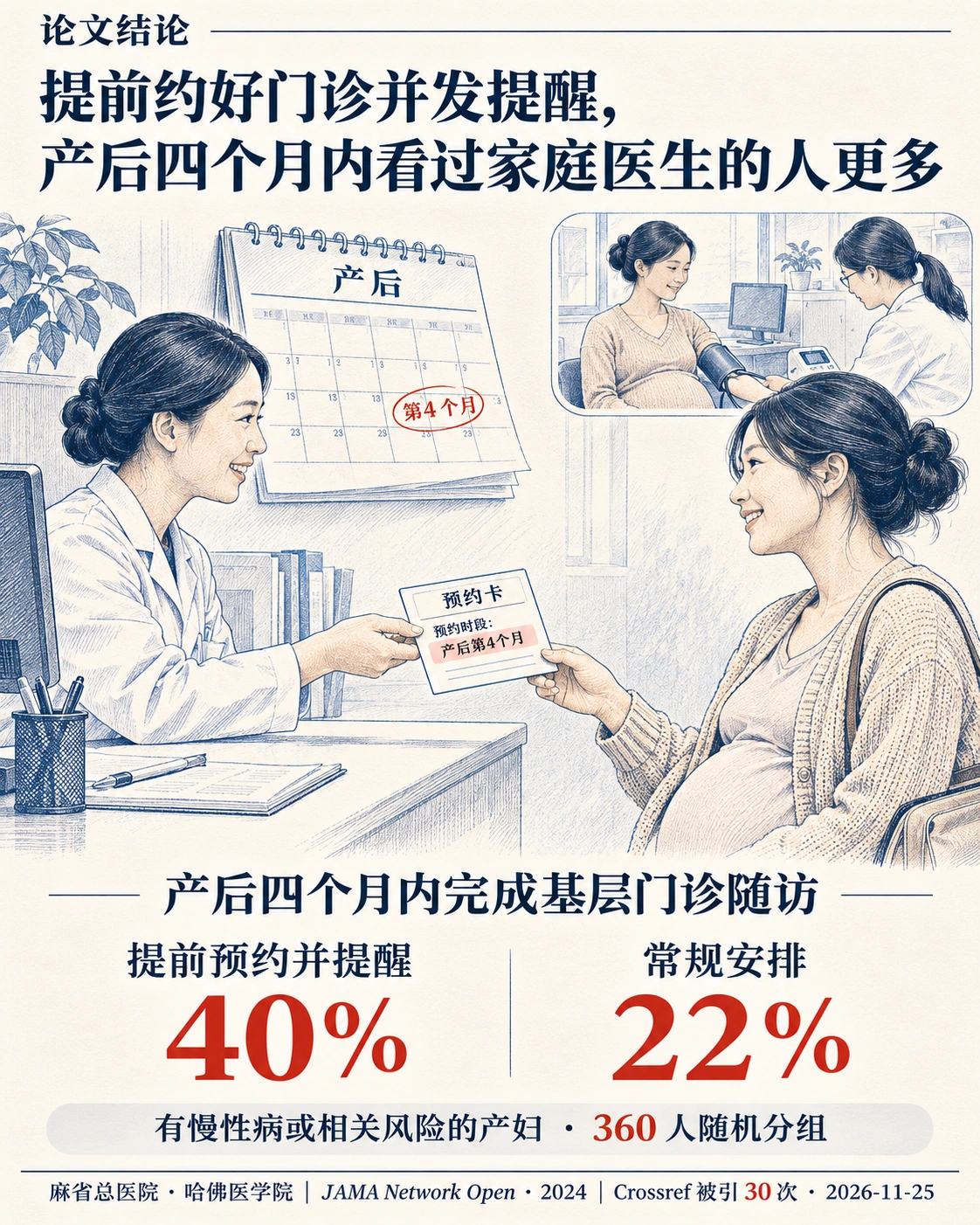
对有慢性病或相关风险的产妇,工作人员代约基层门诊并发提醒。四个月内完成随访的比例为 40%,对照组为 22%。
推荐阅读的理由
试验纳入的人在病历里都已经有基层医生。对照组收到建议自行随访的信息,干预组可以让工作人员代为预约,也可以拒绝或更改时间。区别在于,产妇带新生儿回家后,是要自己从头联系诊所,还是已经有一个约好的时段。
Postpartum Primary Care Engagement Using Default Scheduling and Tailored Messaging: A Randomized Clinical Trial
作者摘要 · 中文编译
背景与目的 超过三成孕妇至少有一种慢性病,近两成出现妊娠糖尿病或妊娠相关高血压。她们在孕期得到密切监测,分娩后转回基层医疗却常遇到障碍。研究考察,减少自行办预约的负担、补足随访信息,能否让更多人产后看上基层医生。
设计与干预 2022 年 11 月 3 日至 2023 年 10 月 11 日,一家学术医疗中心所属的一个医院门诊和五个社区产科门诊开展个人随机试验。对象为讲英语或西班牙语、怀孕或近期生产的成年人。她们的病历列有基层医生,且有肥胖、焦虑、抑郁、糖尿病、慢性高血压、妊娠糖尿病或妊娠相关高血压。干预组合采用行为经济学思路,默认代约产后基层门诊,并提供针对性信息。
主要结局 研究者在预产期约五个月后查阅电子病历,按最初分组比较产后四个月内因常规照护或慢性病管理而实际完成基层就诊的比例。
结果 360 人随机分组,对照组 176 人、干预组 184 人。平均年龄 34.1 岁(标准差 4.9);入组孕周中位数 36.3 周(四分位间距 34.0 至 38.6)。自报种族或族裔为亚裔 6.8%、黑人 7.4%、白人 68.6%、多种族或其他 15.0%。75.4% 有焦虑或抑郁,16.1% 有慢性或妊娠相关高血压,19.5% 有糖尿病或妊娠糖尿病,40.8% 孕前体质指数至少为 30,21.2% 以医疗补助计划为主要医保。对照组四个月内的就诊率为 22.0%(期刊正式版所列 95% 置信区间 6.4% 至 28.8%),干预组为 40.0%(95% 置信区间 33.1% 至 47.4%)。按随机分层校正后,干预使就诊率提高 18.7 个百分点(95% 置信区间 9.1 至 28.2)。干预组产后再住院较少(1.7% 对 5.8%),基层门诊血压检查(42.8% 对 28.3%)、体重评估(42.8% 对 27.7%)和抑郁筛查(32.8% 对 16.8%)更多。
结论 作者认为,产后转回基层医疗缺少支持,使改善近期和远期健康的机会流失。降低患者办手续的负担,可能是投入相对较少而效果较大的办法。试验注册号 NCT05543265。
展开英文原摘要收起英文原摘要More than 30% of pregnant people have at least 1 chronic medical condition, and nearly 20% develop gestational diabetes or pregnancy-related hypertension, increasing the risk of future chronic disease. While these individuals are often monitored closely during pregnancy, they face major barriers when transitioning to primary care following delivery, due in part to a lack of health care support for this transition. To evaluate the impact of an intervention designed to improve postpartum primary care engagement by reducing patient administrative burden and information gaps. An individual-level randomized clinical trial was conducted from November 3, 2022, to October 11, 2023, at 1 hospital-based and 5 community-based outpatient obstetric clinics affiliated with a large academic medical center. Participants included English- and Spanish-speaking pregnant or recently postpartum adults with obesity, anxiety, depression, diabetes, chronic hypertension, gestational diabetes, or pregnancy-related hypertension and a primary care practitioner (PCP) listed in their electronic health record. A behavioral economics–informed intervention bundle, including default scheduling of postpartum PCP appointments and tailored messages. Completion of a PCP visit for routine or chronic condition care within 4 months of delivery was the primary outcome, ascertained directly by reviewing the patient’s electronic health record approximately 5 months after their estimated due date. Intention-to-treat analysis was conducted. A total of 360 patients were randomized (control, 176; intervention, 184). Individuals had a mean (SD) age of 34.1 (4.9) years and median gestational age of 36.3 (IQR, 34.0-38.6) weeks at enrollment. The distribution of self-reported race and ethnicity was 6.8% Asian, 7.4% Black, 68.6% White, and 15.0% multiple races or other. Most participants (75.4%) had anxiety or depression, 16.1% had a chronic or pregnancy-related hypertensive disorder, 19.5% had preexisting or gestational diabetes, and 40.8% had a prepregnancy body mass index of 30 or greater. Medicaid was the primary payer for 21.2% of patients. Primary care practitioner visit completion within 4 months occurred in 22.0% (95% CI, 6.4%-28.8%) of individuals in the control group and 40.0% (95% CI, 33.1%-47.4%) in the intervention group. In regression models accounting for randomization strata, the intervention increased PCP visit completion by 18.7 percentage points (95% CI, 9.1-28.2 percentage points). Intervention participants also had fewer postpartum readmissions (1.7% vs 5.8%) and increased receipt of the following services by a PCP: blood pressure screening (42.8% vs 28.3%), weight assessment (42.8% vs 27.7%), and depression screening (32.8% vs 16.8%). The findings of this randomized clinical trial suggest that the current lack of support for postpartum transitions to primary care is a missed opportunity to improve recently pregnant individual’s short- and long-term health. Reducing patient administrative burdens may represent relatively low-resource, high-impact approaches to improving postpartum health and well-being. ClinicalTrials.gov Identifier: NCT05543265
Importance · More than 30% of pregnant people have at least 1 chronic medical condition, and nearly 20% develop gestational diabetes or pregnancy-related hypertension, increasing the risk of future chronic disease. While these individuals are often monitored closely during pregnancy, they face major barriers when transitioning to primary care following delivery, due in part to a lack of health care support for this transition.
Objective · To evaluate the impact of an intervention designed to improve postpartum primary care engagement by reducing patient administrative burden and information gaps.
Design, Setting, and Participants · An individual-level randomized clinical trial was conducted from November 3, 2022, to October 11, 2023, at 1 hospital-based and 5 community-based outpatient obstetric clinics affiliated with a large academic medical center. Participants included English- and Spanish-speaking pregnant or recently postpartum adults with obesity, anxiety, depression, diabetes, chronic hypertension, gestational diabetes, or pregnancy-related hypertension and a primary care practitioner (PCP) listed in their electronic health record.
Intervention · A behavioral economics–informed intervention bundle, including default scheduling of postpartum PCP appointments and tailored messages.
Main Outcome and Measures · Completion of a PCP visit for routine or chronic condition care within 4 months of delivery was the primary outcome, ascertained directly by reviewing the patient’s electronic health record approximately 5 months after their estimated due date. Intention-to-treat analysis was conducted.
Results · A total of 360 patients were randomized (control, 176; intervention, 184). Individuals had a mean (SD) age of 34.1 (4.9) years and median gestational age of 36.3 (IQR, 34.0-38.6) weeks at enrollment. The distribution of self-reported race and ethnicity was 6.8% Asian, 7.4% Black, 68.6% White, and 15.0% multiple races or other. Most participants (75.4%) had anxiety or depression, 16.1% had a chronic or pregnancy-related hypertensive disorder, 19.5% had preexisting or gestational diabetes, and 40.8% had a prepregnancy body mass index of 30 or greater. Medicaid was the primary payer for 21.2% of patients. Primary care practitioner visit completion within 4 months occurred in 22.0% (95% CI, 6.4%-28.8%) of individuals in the control group and 40.0% (95% CI, 33.1%-47.4%) in the intervention group. In regression models accounting for randomization strata, the intervention increased PCP visit completion by 18.7 percentage points (95% CI, 9.1-28.2 percentage points). Intervention participants also had fewer postpartum readmissions (1.7% vs 5.8%) and increased receipt of the following services by a PCP: blood pressure screening (42.8% vs 28.3%), weight assessment (42.8% vs 27.7%), and depression screening (32.8% vs 16.8%).
Conclusions and Relevance · The findings of this randomized clinical trial suggest that the current lack of support for postpartum transitions to primary care is a missed opportunity to improve recently pregnant individual’s short- and long-term health. Reducing patient administrative burdens may represent relatively low-resource, high-impact approaches to improving postpartum health and well-being.
Trial Registration · ClinicalTrials.gov Identifier: NCT05543265
Mark A Clapp, Alaka Ray, Pichliya Liang, Kaitlyn E James, Ishani Ganguli, Jessica L Cohen
Copyright 2024 Clapp MA et al. JAMA Network Open.
产后基层医疗交接后,哪些服务发生了变化?
| 项目 | 提前预约并提醒 | 常规安排 |
|---|---|---|
| 完成基层门诊 | 72/180(40.0%) | 38/173(22.0%) |
| 基层医生查血压 | 42.8% | 28.3% |
| 基层医生筛查抑郁 | 32.8% | 16.8% |
| 产后再次住院 | 1.7% | 5.8% |
主要结局的校正差为 18.7 个百分点(95% 置信区间 9.1 至 28.2)。就诊与住院见表 2,所获服务见图 2。 核对作者图表
作者的结论
作者认为,在产科向基层医疗交接时,代办预约、说明随访目的和按时提醒,可以明显提高需要长期照护者的就诊率。研究直接观察到的是产后四个月的就诊和服务使用。
研究团队与论文影响
麻省总医院与哈佛医学院等团队在一个医院产科门诊和五个社区产科门诊开展个人随机试验。研究查阅实际就诊记录来判断是否完成随访。
Crossref 收录本文引用 30 次。JAMA Network Open 的年度报告列出的期刊影响因子为 9.7。
单篇与期刊指标核查于 。
原文与延伸阅读
引用这篇文章与反馈纠错
研象编辑部.提前约好门诊并发提醒,产后四个月内看过家庭医生的人更多[EB/OL].研象,2026-11-25.https://yanxiang.hk/papers/postpartum-default-scheduling-primary-care
发现数字、译文或出处有误,可以在邮件里指出相应段落,附上核对依据。