
南加州 40 多万次单胎分娩记录显示,孕期细颗粒物暴露较高与自发早产有关
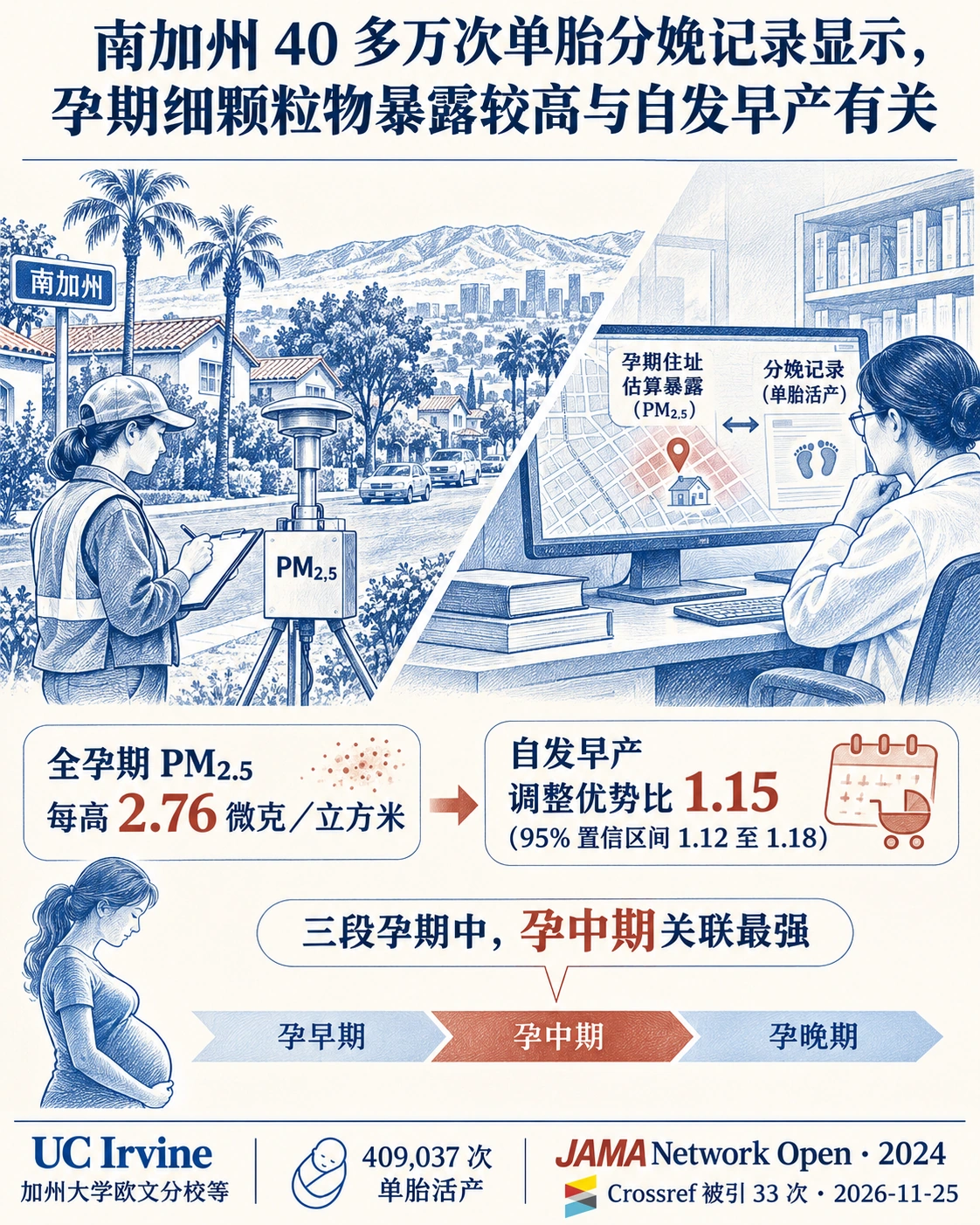
JAMA Network Open2024队列研究Crossref 记录被引 33 次
同样叫早产,研究为什么单挑自发早产?
在南加州 409,037 次单胎活产中,按孕期住址估算的细颗粒物暴露越高,自发早产越常见。全孕期平均 PM2.5 每高 2.76 微克/立方米,自发早产的调整后优势比为 1.15。
推荐阅读的理由
一部分早产是自发开始分娩,另一部分是医生因母亲或胎儿状况决定提前分娩。作者用病历文字识别前一类,再把分娩记录接上住址周边的空气污染暴露估计。这样才看得到不同颗粒成分、不同孕期和极端高温条件下的关联。
Fine Particulate Matter, Its Constituents, and Spontaneous Preterm Birth
作者摘要 · 中文编译
背景与目的 细颗粒物及组成成分与自发早产的关联尚缺乏系统研究。作者分析这种关联,并寻找社会经济和环境特征不同的人群之间的差异。
设计与指标 研究纳入 2008 至 2018 年南加州凯撒医疗系统内有孕期住址记录的单胎活产。按每日总 PM2.5 及每月硫酸盐、硝酸盐、铵盐、有机物和黑碳资料计算全孕期及分孕期平均暴露。用街景估算绿地、树木和低矮植被,同时估计野火颗粒和每日最高气温暴露。以病历文字识别自发早产,用离散时间生存模型估计关联,并检验教育、收入、族裔、绿化、野火和气温等是否改变关联。
结果 409,037 次分娩中,母亲平均年龄 30.3 岁(标准差 5.8)。PM2.5、黑碳、硝酸盐和硫酸盐全孕期暴露每高一个四分位间距,自发早产调整优势比分别为 1.15(95% 置信区间 1.12 至 1.18)、1.15(1.11 至 1.20)、1.09(1.06 至 1.13)和 1.06(1.03 至 1.09)。孕早、中、晚期的 PM2.5 对应估计分别为 1.07(1.05 至 1.09)、1.10(1.08 至 1.12)和 1.09(1.07 至 1.11)。教育程度和收入较低、周边绿地较少、野火烟雾较多或暴露于极端高温的人群关联较强。以极端高温对温和气温为例,估计分别为 1.51(1.42 至 1.59)和 1.11(1.09 至 1.14)。
结论 孕期接触 PM2.5 及其特定成分与自发早产的较高发生优势相关,社会经济和其他环境暴露会改变这种关联。
展开英文原摘要收起英文原摘要The associations of exposure to fine particulate matter (PM2.5) and its constituents with spontaneous preterm birth (sPTB) remain understudied. Identifying subpopulations at increased risk characterized by socioeconomic status and other environmental factors is critical for targeted interventions. To examine associations of PM2.5 and its constituents with sPTB. This population-based retrospective cohort study was conducted from 2008 to 2018 within a large integrated health care system, Kaiser Permanente Southern California. Singleton live births with recorded residential information of pregnant individuals during pregnancy were included. Data were analyzed from December 2023 to March 2024. Daily total PM2.5 concentrations and monthly data on 5 PM2.5 constituents (sulfate, nitrate, ammonium, organic matter, and black carbon) in California were assessed, and mean exposures to these pollutants during pregnancy and by trimester were calculated. Exposures to total green space, trees, low-lying vegetation, and grass were estimated using street view images. Wildfire-related exposure was measured by the mean concentration of wildfire-specific PM2.5 during pregnancy. Additionally, the mean exposure to daily maximum temperature during pregnancy was calculated. The primary outcome was sPTB identified through a natural language processing algorithm. Discrete-time survival models were used to estimate associations of total PM2.5 concentration and its 5 constituents with sPTB. Interaction terms were used to examine the effect modification by race and ethnicity, educational attainment, household income, and exposures to green space, wildfire smoke, and temperature. Among 409 037 births (mean [SD] age of mothers at delivery, 30.3 [5.8] years), there were positive associations of PM2.5, black carbon, nitrate, and sulfate with sPTB. Adjusted odds ratios (aORs) per IQR increase were 1.15 (95% CI, 1.12-1.18; P < .001) for PM2.5 (IQR, 2.76 μg/m3), 1.15 (95% CI, 1.11-1.20; P < .001) for black carbon (IQR, 1.05 μg/m3), 1.09 (95% CI, 1.06-1.13; P < .001) for nitrate (IQR, 0.93 μg/m3), and 1.06 (95% CI, 1.03-1.09; P < .001) for sulfate (IQR, 0.40 μg/m3) over the entire pregnancy. The second trimester was the most susceptible window; for example, aORs for total PM2.5 concentration were 1.07 (95% CI, 1.05-1.09; P < .001) in the first, 1.10 (95% CI, 1.08-1.12; P < .001) in the second, and 1.09 (95% CI, 1.07-1.11; P < .001) in the third trimester. Significantly higher aORs were observed among individuals with lower educational attainment (eg, less than college: aOR, 1.16; 95% CI, 1.12-1.21 vs college [≥4 years]: aOR, 1.10; 95% CI, 1.06-1.14; P = .03) or income (<50th percentile: aOR, 1.17; 95% CI, 1.14-1.21 vs ≥50th percentile: aOR, 1.12; 95% CI, 1.09-1.16; P = .02) or who were exposed to limited green space (<50th percentile: aOR, 1.19; 95% CI, 1.15-1.23 vs ≥50th percentile: aOR, 1.12; 95% CI, 1.09-1.15; P = .003), more wildfire smoke (≥50th percentile: aOR, 1.19; 95% CI, 1.16-1.23 vs <50th percentile: aOR, 1.13; 95% CI, 1.09-1.16; P = .009), or extreme heat (aOR, 1.51; 95% CI, 1.42-1.59 vs mild temperature: aOR, 1.11; 95% CI, 1.09-1.14; P < .001). In this study, exposures to PM2.5 and specific PM2.5 constituents during pregnancy were associated with increased odds of sPTB. Socioeconomic status and other environmental exposures modified this association.
Importance · The associations of exposure to fine particulate matter (PM2.5) and its constituents with spontaneous preterm birth (sPTB) remain understudied. Identifying subpopulations at increased risk characterized by socioeconomic status and other environmental factors is critical for targeted interventions.
Objective · To examine associations of PM2.5 and its constituents with sPTB.
Design, Setting, and Participants · This population-based retrospective cohort study was conducted from 2008 to 2018 within a large integrated health care system, Kaiser Permanente Southern California. Singleton live births with recorded residential information of pregnant individuals during pregnancy were included. Data were analyzed from December 2023 to March 2024.
Exposures · Daily total PM2.5 concentrations and monthly data on 5 PM2.5 constituents (sulfate, nitrate, ammonium, organic matter, and black carbon) in California were assessed, and mean exposures to these pollutants during pregnancy and by trimester were calculated. Exposures to total green space, trees, low-lying vegetation, and grass were estimated using street view images. Wildfire-related exposure was measured by the mean concentration of wildfire-specific PM2.5 during pregnancy. Additionally, the mean exposure to daily maximum temperature during pregnancy was calculated.
Main Outcomes and Measures · The primary outcome was sPTB identified through a natural language processing algorithm. Discrete-time survival models were used to estimate associations of total PM2.5 concentration and its 5 constituents with sPTB. Interaction terms were used to examine the effect modification by race and ethnicity, educational attainment, household income, and exposures to green space, wildfire smoke, and temperature.
Results · Among 409 037 births (mean [SD] age of mothers at delivery, 30.3 [5.8] years), there were positive associations of PM2.5, black carbon, nitrate, and sulfate with sPTB. Adjusted odds ratios (aORs) per IQR increase were 1.15 (95% CI, 1.12-1.18; P < .001) for PM2.5 (IQR, 2.76 μg/m3), 1.15 (95% CI, 1.11-1.20; P < .001) for black carbon (IQR, 1.05 μg/m3), 1.09 (95% CI, 1.06-1.13; P < .001) for nitrate (IQR, 0.93 μg/m3), and 1.06 (95% CI, 1.03-1.09; P < .001) for sulfate (IQR, 0.40 μg/m3) over the entire pregnancy. The second trimester was the most susceptible window; for example, aORs for total PM2.5 concentration were 1.07 (95% CI, 1.05-1.09; P < .001) in the first, 1.10 (95% CI, 1.08-1.12; P < .001) in the second, and 1.09 (95% CI, 1.07-1.11; P < .001) in the third trimester. Significantly higher aORs were observed among individuals with lower educational attainment (eg, less than college: aOR, 1.16; 95% CI, 1.12-1.21 vs college [≥4 years]: aOR, 1.10; 95% CI, 1.06-1.14; P = .03) or income (<50th percentile: aOR, 1.17; 95% CI, 1.14-1.21 vs ≥50th percentile: aOR, 1.12; 95% CI, 1.09-1.16; P = .02) or who were exposed to limited green space (<50th percentile: aOR, 1.19; 95% CI, 1.15-1.23 vs ≥50th percentile: aOR, 1.12; 95% CI, 1.09-1.15; P = .003), more wildfire smoke (≥50th percentile: aOR, 1.19; 95% CI, 1.16-1.23 vs <50th percentile: aOR, 1.13; 95% CI, 1.09-1.16; P = .009), or extreme heat (aOR, 1.51; 95% CI, 1.42-1.59 vs mild temperature: aOR, 1.11; 95% CI, 1.09-1.14; P < .001).
Conclusions and Relevance · In this study, exposures to PM2.5 and specific PM2.5 constituents during pregnancy were associated with increased odds of sPTB. Socioeconomic status and other environmental exposures modified this association.
Anqi Jiao, Alexa N Reilly, Tarik Benmarhnia, Yi Sun, Chantal Avila, Vicki Chiu, Jeff Slezak, David A Sacks, John Molitor, Mengyi Li, Jiu-Chiuan Chen, Jun Wu, Darios Getahun
Copyright 2024 Jiao A et al. JAMA Network Open.
不同暴露物均提高各自一个四分位间距时
| 全孕期平均暴露 | 四分位间距(微克/立方米) | 自发早产调整优势比(95% 置信区间) |
|---|---|---|
| PM2.5 总量 | 2.76 | 1.15(1.12 至 1.18) |
| 黑碳 | 1.05 | 1.15(1.11 至 1.20) |
| 硝酸盐 | 0.93 | 1.09(1.06 至 1.13) |
| 硫酸盐 | 0.40 | 1.06(1.03 至 1.09) |
同一行的增量与优势比需要一起读。各行使用不同的暴露增量。 核对作者图表
作者的结论
作者认为,孕期接触细颗粒物及其部分成分与自发早产的较高发生优势相关;社会经济状况及多种环境暴露会改变这种关联的强度。
研究团队与论文影响
加州大学欧文分校等与南加州凯撒医疗合作,利用 2008 至 2018 年有完整居住信息的单胎分娩记录,匹配空气污染、街景绿化、野火烟雾和气温资料。
Crossref 收录本文引用 33 次。JAMA Network Open 在 2025 年度回顾中列出的期刊影响因子为 9.7。
单篇与期刊指标核查于 。
原文与延伸阅读
引用这篇文章与反馈纠错
研象编辑部.南加州 40 多万次单胎分娩记录显示,孕期细颗粒物暴露较高与自发早产有关[EB/OL].研象,2026-11-25.https://yanxiang.hk/papers/southern-california-pm-preterm
发现数字、译文或出处有误,可以在邮件里指出相应段落,附上核对依据。