
两套菜单都符合膳食指南,吃少加工那套,八周体重降得更多
Nature Medicine2025随机对照试验研究团队与论文影响
两套菜单都符合指南,晚餐究竟差在哪里?
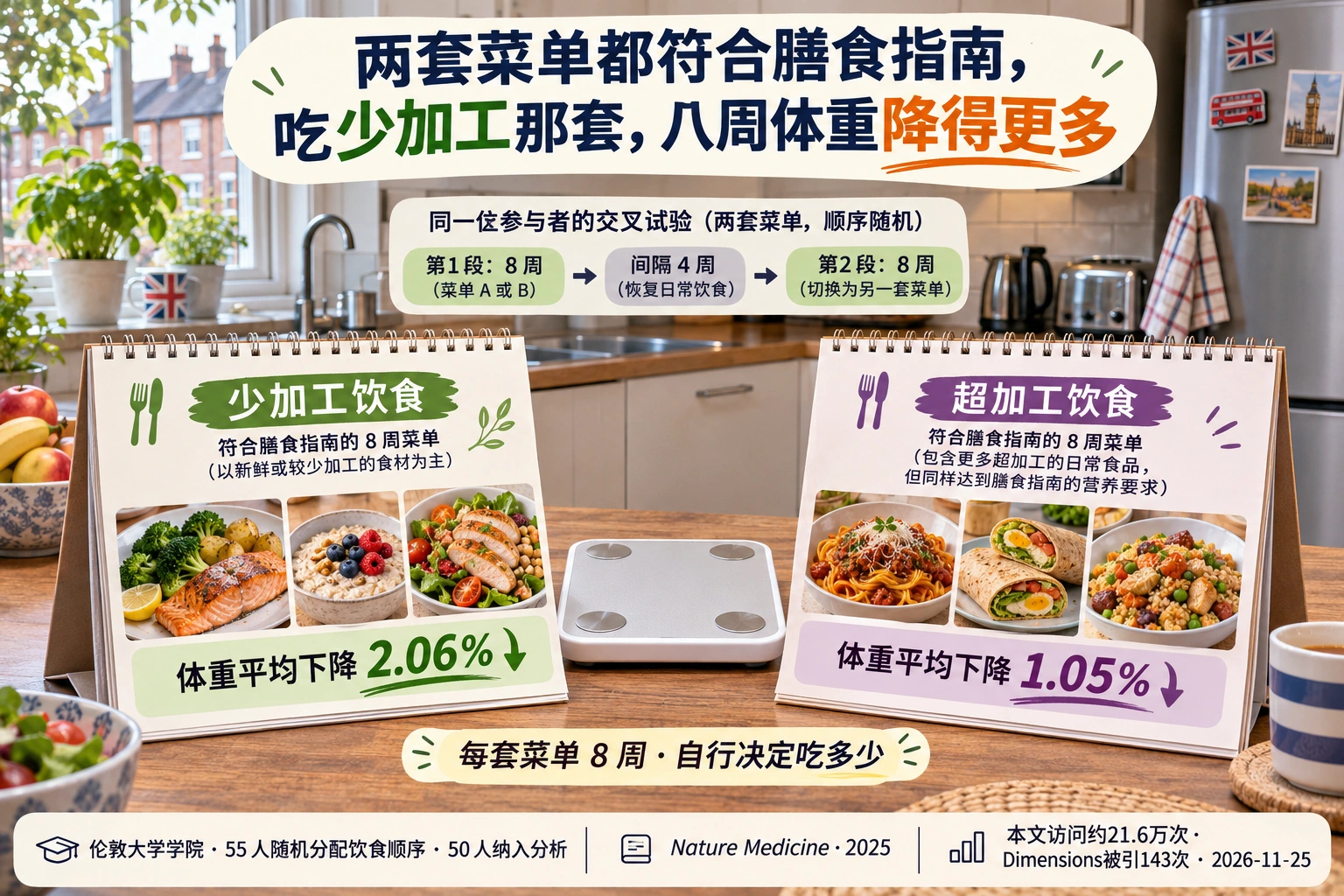
同一批成年人轮流吃两套符合英国膳食指南的菜单,都可以自行决定吃多少。少加工菜单吃八周,体重平均下降 2.06%,超加工菜单下降 1.05%。
推荐阅读的理由
试验里,一套菜单供应自制肉酱意面,另一套有买来加热就能吃的千层面。两者都能纳入均衡的一周食谱。下次挑方便食品时,这个例子提醒我们,除了看膳食搭配,还可以一起看看平时靠哪些食品凑齐一日三餐。 两个阶段之间隔四周。论文图 2 还逐人画出了体重变化,读者能看到同样吃一套菜单,不同人的变化幅度也不同。
Ultraprocessed or minimally processed diets following healthy dietary guidelines on weight and cardiometabolic health: a randomized, crossover trial
作者摘要 · 中文编译
食用超加工食品与非传染性疾病风险有关,但此前还没有试验研究过,当饮食符合国家膳食指南时,超加工食品对健康有什么影响。
研究人员在英格兰招募了 55 名成年人。他们的体质指数(BMI)在 25 至不足 40 kg/m² 之间,平常每天至少一半热量来自超加工食品。这是一项 2 × 2 随机交叉供餐试验。两套菜单都按英国《健康饮食指南》配制,一套以最低限度加工食品为主(下称少加工饮食),另一套以超加工食品为主。每套菜单吃 8 周,参与者自行决定吃多少。
饮食顺序由随机分配决定,28 人先吃少加工饮食,27 人先吃超加工饮食。意向性分析纳入 50 人。研究人员分别计算每个人从各阶段开始到第 8 周的体重变化百分比,再比较两段的差异。这是试验的主要结局,参与者事先不知道这一点。
两种饮食下体重都减轻了。少加工饮食期间平均变化为 −2.06%(95% 置信区间为 −2.99% 至 −1.13%),超加工饮食期间为 −1.05%(−1.98% 至 −0.13%)。少加工饮食的降幅显著更大。以少加工减去超加工,两者相差 −1.01 个百分点(95% 置信区间为 −1.87 至 −0.14 个百分点,P = 0.024)。标准化效应量 Cohen’s d 为 −0.48(95% 置信区间为 −0.91 至 −0.06)。两种饮食期间都常见轻微的胃肠道不适。
作者认为,少加工饮食比超加工饮食带来的体重降幅更大,现有膳食建议还需要补充关于食品加工的指导。试验在 ClinicalTrials.gov 的注册号为 NCT05627570。
展开英文原摘要收起英文原摘要Ultraprocessed food (UPF) consumption is associated with noncommunicable disease risk, yet no trial has assessed its health impact within the context of national dietary guidelines. In a 2 × 2 crossover randomized controlled feeding trial, 55 adults in England (body mass index ≥25 to <40 kg m−2, habitual UPF intake ≥50% kcal day−1) were provided with two 8-week ad libitum diets following the UK Eatwell Guide: (1) minimally processed food (MPF) and (2) UPF, in a random order. Twenty-eight people were randomized to MPF then UPF, and 27 to UPF then MPF; 50 participants comprised the intention-to-treat sample. The primary outcome was the within-participant difference in percent weight change (%WC) between diets, from baseline to week 8. Participants were blinded to the primary outcome. MPF (%WC, −2.06 (95% confidence interval (CI), −2.99, −1.13) and UPF (%WC, −1.05 (95% CI, −1.98, −0.13)) resulted in weight loss, with significantly greater %WC on MPF (Δ%WC, −1.01 (95% CI, −1.87, −0.14), P = 0.024; Cohen’s d, −0.48 (95% CI, −0.91, −0.06)). Mild gastrointestinal adverse events were common on both diets. Findings indicate greater weight loss on MPF than UPF diets and needing dietary guidance on food processing in addition to existing recommendations. Clinicaltrials.gov registration: NCT05627570.
Ultraprocessed food (UPF) consumption is associated with noncommunicable disease risk, yet no trial has assessed its health impact within the context of national dietary guidelines. In a 2 × 2 crossover randomized controlled feeding trial, 55 adults in England (body mass index ≥25 to <40 kg m−2, habitual UPF intake ≥50% kcal day−1) were provided with two 8-week ad libitum diets following the UK Eatwell Guide: (1) minimally processed food (MPF) and (2) UPF, in a random order. Twenty-eight people were randomized to MPF then UPF, and 27 to UPF then MPF; 50 participants comprised the intention-to-treat sample. The primary outcome was the within-participant difference in percent weight change (%WC) between diets, from baseline to week 8. Participants were blinded to the primary outcome. MPF (%WC, −2.06 (95% confidence interval (CI), −2.99, −1.13) and UPF (%WC, −1.05 (95% CI, −1.98, −0.13)) resulted in weight loss, with significantly greater %WC on MPF (Δ%WC, −1.01 (95% CI, −1.87, −0.14), P = 0.024; Cohen’s d, −0.48 (95% CI, −0.91, −0.06)). Mild gastrointestinal adverse events were common on both diets. Findings indicate greater weight loss on MPF than UPF diets and needing dietary guidance on food processing in addition to existing recommendations. Clinicaltrials.gov registration: NCT05627570.
Samuel J Dicken, Friedrich C Jassil, Adrian Brown, Monika Kalis, Chloe Stanley, Chaniqua Ranson, Tapiwa Ruwona, Sulmaaz Qamar, Caroline Buck, Ritwika Mallik, Nausheen Hamid, Jonathan M Bird, Alanna Brown, Benjamin Norton, Claudia A M Gandini Wheeler-Kingshott, Mark Hamer, Chris van Tulleken, Kevin D Hall, Abigail Fisher, Janine Makaronidis, Rachel L Batterham
© The Author(s) 2025, modified publication 2025
各吃八周,体重比这个阶段开始时改变多少?
| 菜单与比较 | 平均体重变化 | 95% 置信区间 |
|---|---|---|
| 少加工菜单 | −2.06% | −2.99% 至 −1.13% |
| 超加工菜单 | −1.05% | −1.98% 至 −0.13% |
| 少加工减去超加工 | −1.01 个百分点 | −1.87 至 −0.14 个百分点 |
原文图 2a、b 比较组平均值,图 2d、e 展示个人变化。 核对作者图表
作者的结论
作者认为,即使食物种类的搭配已经符合膳食指南,少加工菜单仍可让超重或肥胖的成年人在 8 周内减去更多体重。他们据此主张,在既有建议中补充选购和食用少加工食品的指导。 两套菜单的热量密度也不同,试验估计的是换整套菜单的效果。
研究团队与论文影响
伦敦大学学院团队在英格兰组织随机交叉供餐试验。55 人参加随机分组,50 人提供了至少一个阶段的可用数据,43 人完成两个阶段。研究方案和预设的主要结局可在试验注册库核对。
出版商统计本文访问约 21.6 万次,Dimensions 收录引用 143 次。Nature Medicine 的 2025 年期刊影响因子为 52.3。
单篇与期刊指标核查于 。
原文与延伸阅读
- 论文原文与讨论
- 同刊来信对原论文结论的讨论
- 期刊论文与作者摘要
- 原文图表
- 已发表的试验方案
- 试验注册与预设指标
- 研究团队介绍两套菜单
- Wang 与 Peng 的同刊来信
- 研究团队的回复
- 出版商的单篇访问和引用统计
- 期刊年度指标
引用这篇文章与反馈纠错
研象编辑部.两套菜单都符合膳食指南,吃少加工那套,八周体重降得更多[EB/OL].研象,2026-11-25.https://yanxiang.hk/papers/update-food-processing
发现数字、译文或出处有误,可以在邮件里指出相应段落,附上核对依据。