
西班牙学龄前儿童中,超加工食品吃得多的一组,腰围和空腹血糖也偏高
JAMA Network Open2024横断面研究Crossref 记录被引 60 次
除了看体重,这项研究还看了什么?
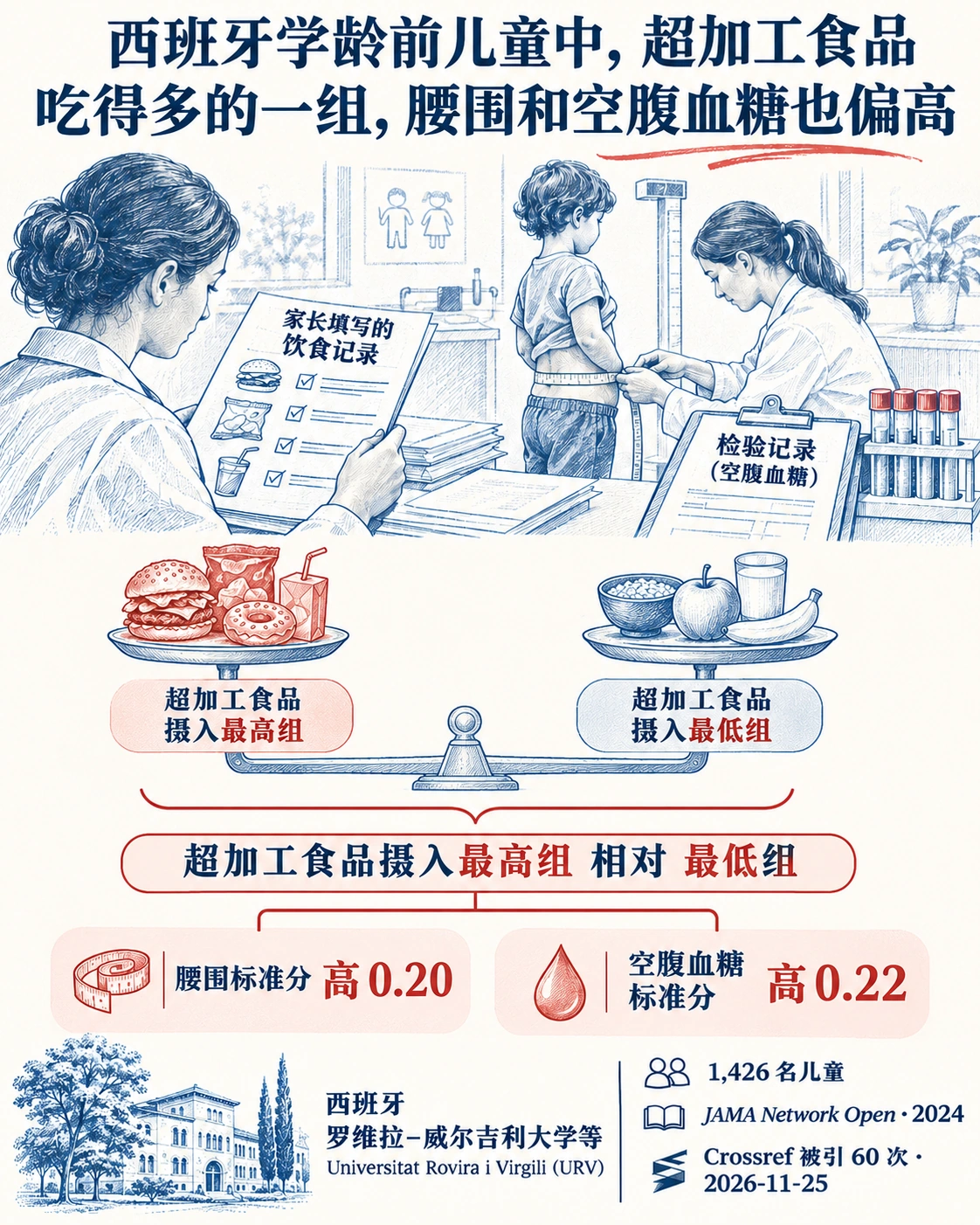
西班牙 1,426 名儿童的饮食与体检资料显示,超加工食品摄入较高的一组,腰围、体重指数、脂肪质量指数和空腹血糖的标准分较高,高密度脂蛋白胆固醇的标准分较低。
推荐阅读的理由
孩子长高时腰围和体重都会变化。研究把同年龄、同性别儿童的测量值放在一起比较,还同时检查空腹血糖和血脂。于是家长报告的日常饮食,不只和一个体重数字相连,也和几项代谢指标相连。这是一次基线比较。
Ultraprocessed Food Consumption and Cardiometabolic Risk Factors in Children
作者摘要 · 中文编译
背景与目的 成年人摄入较多超加工食品与较高心血管代谢风险有关,儿童证据较少。研究在儿童肥胖风险评估纵向队列 CORALS 中考察饮食与代谢风险指标的关系。
设计 使用 2019 年 3 月至 2022 年 6 月在西班牙七个城市招募的 3 至 6 岁儿童的基线资料,家长或监护人同意并完成问卷。排除西班牙语理解不足或住址不稳定者。用食物频率问卷与 NOVA 加工分类估算每日摄入克数并校正能量;用线性回归比较按年龄和性别标准化的体脂、血压、血糖、胰岛素抵抗和血脂指标。
结果 1,509 名入组儿童中有 1,426 人纳入本分析,平均年龄 5.8 岁(标准差 1.1),698 人(49.0%)为男孩。高摄入组儿童的母亲平均更年轻,体重指数更高、超重或肥胖更常见,教育和就业水平较低。最高与最低摄入组三分位数相比,体重指数、腰围、脂肪质量指数、空腹血糖的标准分分别高 0.20、0.20、0.17、0.22,高密度脂蛋白胆固醇标准分低 0.19。按摄入量每高一个标准差分析,这五项标准分的差依次为 +0.11、+0.09、+0.11、+0.10 和 −0.07。模型中把 100 克超加工食品替换为等重的未经加工或轻微加工食物,体重指数、脂肪质量指数与空腹血糖标准分分别低 0.03、0.03、0.04。
结论 学龄前儿童超加工食品摄入较高,与较多脂肪积累及其他心血管代谢风险指标有关。作者据此强调促进替换这类食物的公共卫生措施。
展开英文原摘要收起英文原摘要High intake of ultraprocessed foods (UPFs) has been associated with higher cardiometabolic risk in adults; however, the evidence in children is limited. To investigate the association between UPF consumption and cardiometabolic risk factors in the Childhood Obesity Risk Assessment Longitudinal Study (CORALS). This baseline cross-sectional analysis was conducted using the data of CORALS participants recruited between March 22, 2019, and June 30, 2022. Preschool children (aged 3-6 years) were recruited from schools and centers in 7 cities in Spain. Inclusion criteria included informed consent signed by parents or caregivers and having a completed a set of questionnaires about the child’s prenatal history at home. Exclusion criteria included low command of Spanish or unstable residence. Energy-adjusted UPF consumption (in grams per day) from food frequency questionnaires and based on the NOVA food classification system. Age- and sex-specific z scores of adiposity parameters (body mass index [BMI], fat mass index, waist-to-height ratio, and waist circumference) and cardiometabolic parameters (diastolic and systolic blood pressure, fasting plasma glucose, homeostasis model assessment for insulin resistance, high-density and low-density lipoprotein cholesterol, and triglycerides) were estimated using linear regression models. Of 1509 enrolled CORALS participants, 1426 (mean [SD] age, 5.8 [1.1] years; 698 boys [49.0%]) were included in this study. Mothers of children with high UPF consumption were younger, had a higher BMI, were more likely to have overweight or obesity, and had lower education levels and employment rates. Compared with participants in the lowest tertile of energy-adjusted UPF consumption, those in the highest tertile showed higher z scores of BMI (β coefficient, 0.20; 95% CI, 0.05-0.35), waist circumference (β coefficient, 0.20; 95% CI, 0.05-0.35), fat mass index (β coefficient, 0.17; 95% CI, 0.00-0.32), and fasting plasma glucose (β coefficient, 0.22; 95% CI, 0.06-0.37) and lower z scores for HDL cholesterol (β coefficient, −0.19; 95% CI, −0.36 to −0.02). One-SD increments in energy-adjusted UPF consumption were associated with higher z scores for BMI (β coefficient, 0.11; 95% CI, 0.05-0.17), waist circumference (β coefficient, 0.09; 95% CI, 0.02-0.15), fat mass index (β coefficient, 0.11; 95% CI, 0.04-1.18), and fasting plasma glucose (β coefficient, 0.10; 95% CI, 0.03-0.17) and lower HDL cholesterol (β coefficient, −0.07; 95% CI, −0.15 to −0.00). Substituting 100 g of UPFs with 100 g of unprocessed or minimally processed foods was associated with lower z scores of BMI (β coefficient, −0.03; 95% CI, −0.06 to −0.01), fat mass index (β coefficient, −0.03; 95% CI, −0.06 to 0.00), and fasting plasma glucose (β coefficient, −0.04; 95% CI, −0.07 to −0.01). These findings suggest that high UPF consumption in young children is associated with adiposity and other cardiometabolic risk factors, highlighting the need for public health initiatives to promote the replacement of UPFs with unprocessed or minimally processed foods.
Importance · High intake of ultraprocessed foods (UPFs) has been associated with higher cardiometabolic risk in adults; however, the evidence in children is limited.
Objective · To investigate the association between UPF consumption and cardiometabolic risk factors in the Childhood Obesity Risk Assessment Longitudinal Study (CORALS).
Design, Setting, and Participants · This baseline cross-sectional analysis was conducted using the data of CORALS participants recruited between March 22, 2019, and June 30, 2022. Preschool children (aged 3-6 years) were recruited from schools and centers in 7 cities in Spain. Inclusion criteria included informed consent signed by parents or caregivers and having a completed a set of questionnaires about the child’s prenatal history at home. Exclusion criteria included low command of Spanish or unstable residence.
Exposure · Energy-adjusted UPF consumption (in grams per day) from food frequency questionnaires and based on the NOVA food classification system.
Main Outcomes and Measures · Age- and sex-specific z scores of adiposity parameters (body mass index [BMI], fat mass index, waist-to-height ratio, and waist circumference) and cardiometabolic parameters (diastolic and systolic blood pressure, fasting plasma glucose, homeostasis model assessment for insulin resistance, high-density and low-density lipoprotein cholesterol, and triglycerides) were estimated using linear regression models.
Results · Of 1509 enrolled CORALS participants, 1426 (mean [SD] age, 5.8 [1.1] years; 698 boys [49.0%]) were included in this study. Mothers of children with high UPF consumption were younger, had a higher BMI, were more likely to have overweight or obesity, and had lower education levels and employment rates. Compared with participants in the lowest tertile of energy-adjusted UPF consumption, those in the highest tertile showed higher z scores of BMI (β coefficient, 0.20; 95% CI, 0.05-0.35), waist circumference (β coefficient, 0.20; 95% CI, 0.05-0.35), fat mass index (β coefficient, 0.17; 95% CI, 0.00-0.32), and fasting plasma glucose (β coefficient, 0.22; 95% CI, 0.06-0.37) and lower z scores for HDL cholesterol (β coefficient, −0.19; 95% CI, −0.36 to −0.02). One-SD increments in energy-adjusted UPF consumption were associated with higher z scores for BMI (β coefficient, 0.11; 95% CI, 0.05-0.17), waist circumference (β coefficient, 0.09; 95% CI, 0.02-0.15), fat mass index (β coefficient, 0.11; 95% CI, 0.04-1.18), and fasting plasma glucose (β coefficient, 0.10; 95% CI, 0.03-0.17) and lower HDL cholesterol (β coefficient, −0.07; 95% CI, −0.15 to −0.00). Substituting 100 g of UPFs with 100 g of unprocessed or minimally processed foods was associated with lower z scores of BMI (β coefficient, −0.03; 95% CI, −0.06 to −0.01), fat mass index (β coefficient, −0.03; 95% CI, −0.06 to 0.00), and fasting plasma glucose (β coefficient, −0.04; 95% CI, −0.07 to −0.01).
Conclusions and Relevance · These findings suggest that high UPF consumption in young children is associated with adiposity and other cardiometabolic risk factors, highlighting the need for public health initiatives to promote the replacement of UPFs with unprocessed or minimally processed foods.
Nadine Khoury, María Ángeles Martínez, Tany E Garcidueñas-Fimbres, Belén Pastor-Villaescusa, Rosaura Leis, Sara de Las Heras-Delgado, María L Miguel-Berges, Santiago Navas-Carretero, Olga Portoles, Karla Alejandra Pérez-Vega, Jose Manuel Jurado-Castro, Rocío Vázquez-Cobela, Gisela Mimbrero, Raquel Andía Horno, J Alfredo Martínez, Katherine Flores-Rojas, Rosaura Picáns-Leis, Verónica Luque, Luis A Moreno, Cristina Castro-Collado, Mercedes Gil-Campos, Jordi Salas-Salvadó, Nancy Babio
Copyright 2024 Khoury N et al. JAMA Network Open.
摄入量最高的三分之一,相对最低的三分之一
| 指标 | 校正后标准分差(95% 置信区间) |
|---|---|
| 体重指数 | +0.20(0.05 至 0.35) |
| 腰围 | +0.20(0.05 至 0.35) |
| 脂肪质量指数 | +0.17(0.00 至 0.32) |
| 空腹血糖 | +0.22(0.06 至 0.37) |
| 高密度脂蛋白胆固醇 | −0.19(−0.36 至 −0.02) |
表 3 报告按摄入量分组以及作为连续变量的两套分析。上表来自分组比较。 核对作者图表
作者的结论
作者认为,学龄前儿童吃较多超加工食品,与脂肪积累及其他心血管代谢风险指标相关。这些结果支持鼓励以未经加工或仅轻微加工的食物替代部分超加工食品。
研究团队与论文影响
西班牙罗维拉-威尔吉利大学等在七座城市的学校及相关机构招募 CORALS 队列。本文分析入组时的饮食资料和体检,而非以后各次体重的变化。
Crossref 收录本文引用 60 次。JAMA Network Open 在 2025 年度回顾中列出的期刊影响因子为 9.7。
单篇与期刊指标核查于 。
原文与延伸阅读
引用这篇文章与反馈纠错
研象编辑部.西班牙学龄前儿童中,超加工食品吃得多的一组,腰围和空腹血糖也偏高[EB/OL].研象,2026-11-25.https://yanxiang.hk/papers/preschool-processed-food-spain
发现数字、译文或出处有误,可以在邮件里指出相应段落,附上核对依据。